13:11
Probability with Applications in Engineering, Science, and Technology
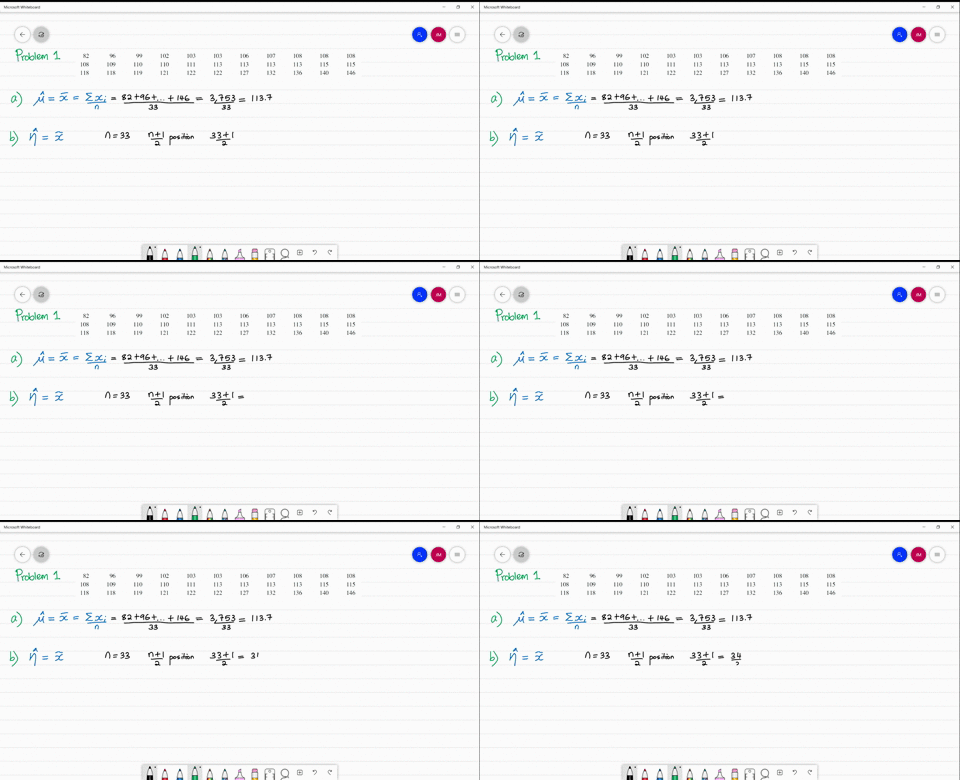
A study of children's intelligence and behavior included the following IQ data for 33 first-graders
that participated in the study.
$\begin{array}{ccccc}{82} & {96} & {99} & {102} & {103} & {103} \\ {108} & {109} & {110} & {110} & {111} & {113} \\ {118} & {118} & {119} & {121} & {122} & {122}\end{array}$
$\begin{array}{lllll}{106} & {107} & {108} & {108} & {108} \\ {113} & {113} & {113} & {115} & {115} \\ {127} & {132} & {136} & {140} & {146}\end{array}$
(a) Calculate a point estimate of the mean IQ for the conceptual population of all first graders in
this school, and state which estimator you used.
(b) Calculate a point estimate of the IQ value that separates the lowest 50$\%$ of all such students
from the highest $50 \%,$ and state which estimator you used.
(c) Calculate and interpret a point estimate of the population standard deviation $\sigma .$ Which
estimator did you use?
(d) Calculate a point estimate of the proportion of all such students whose IQ exceeds 100.
(e) Calculate a point estimate of the population coefficient of variation, $100 \sigma / \mu,$ and state what estimator you used.