During my undergraduate studies at Zewailcity of Science and Technology, I started working as a junior teaching assistant helping my colleagues to get through their studies. Currently, I'm working as a Teaching Assistant at the same University, I will start my Ph.D. at the University of Nebraska-Lincoln next semester.
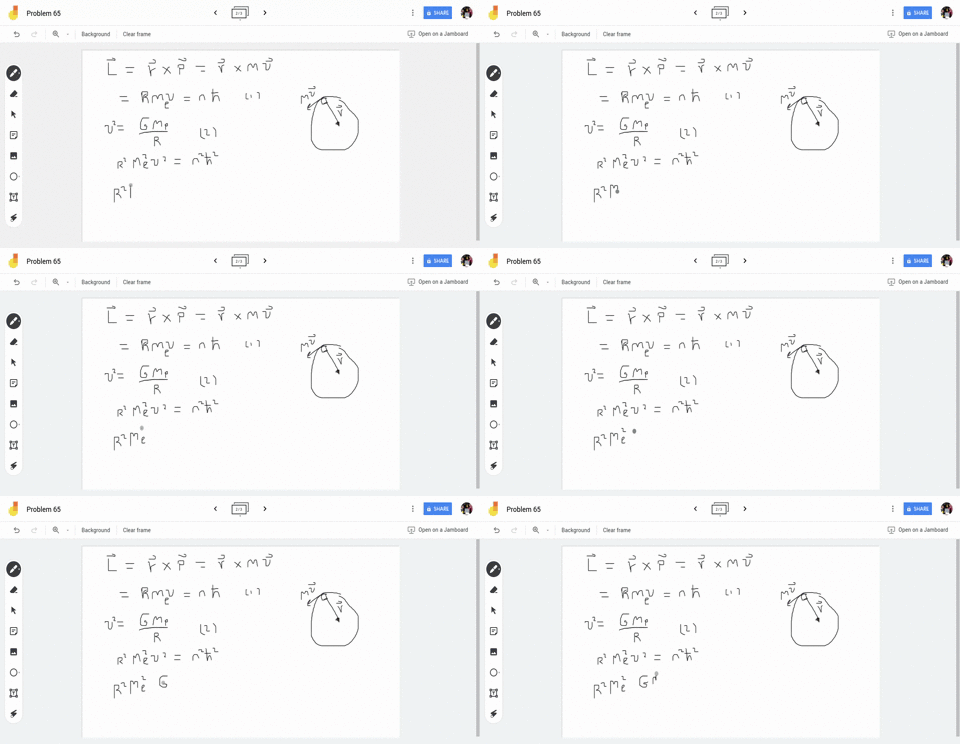
Suppose an electron was bound to a proton, as in the hydrogen atom, but by the gravitational force rather than by the electric force. What would be the radius, and energy, of the first Bohr orbit?
In a lab frame of reference, an observer finds Newton's second law is valid in the form $\sum F=m a .$ Show that Newton's second law is not valid in a reference frame moving past the laboratory frame of Problem 1 with a constant acceleration $a_{1}$. Assume that mass is an invariant quantity and is constant in time.
An airplane flying upwind, downwind, and crosswind shows the main principle of the Michelson-Morley experiment. A plane capable of flying at speed $c$ in still air is flying in a wind of speed $v$. Suppose the plane flies upwind a distance $L$ and then returns downwind to its starting point. (a) Find the time needed to make the round-trip and compare it with the time to fly crosswind a distance $L$ and return. Before calculating these times, sketch the two situations. (b) Compute the time difference for the two trips if $L=100 \mathrm{mi}$ $c=500 \mathrm{mi} / \mathrm{h},$ and $v=100 \mathrm{mi} / \mathrm{h}$
A clock on a moving spacecraft runs 1 s slower per day relative to an identical clock on Earth. What is the relative speed of the spacecraft? (Hint: For $v / c<<1$, note that $\gamma \approx 1+v^{2} / 2 c^{2} .$ )
A meter stick moving in a direction parallel to its length appears to be only $75 \mathrm{cm}$ long to an observer. What is the speed of the meter stick relative to the observer?
A spacecraft moves at a speed of 0.900 $c .$ If its length is L as measured by an observer on the spacecraft, what is the length measured by a ground observer?