Natalie Britton

University of Pittsburgh - Main Campus
Chemistry Teaching Assistant

Biography

As a sophomore economics major and chemistry minor, I'm passionate about environmental sustainability. Because I'm building a background in both the social and natural sciences to better tackle this issue, I have succeeded in college-level courses in general and organic chemistry, calculus, and economics and am prepared to provide assistance for a wide range of subjects. I love tutoring because it allows me to share my love for these subjects and reinforce my own learning by explaining concepts to others. As a chemistry teaching assistant, I've worked one-on-one with a semester-long tutee and also led a group of 10+ students asking questions during office hours. Before the coronavirus outbreak, I also really enjoyed tutoring a refugee family new to the Pittsburgh area in English once a week to help them adjust to life in America. I'm excited about this opportunity because it would allow me to further develop my teaching skills so I can better serve my students.

Education

BS Economics
University of Pittsburgh - Main Campus

Educator Statistics

Numerade tutor for 6 years
201 Students Helped

Topics Covered

Unlocking the Power of Composition: Tips and Techniques
Understanding Chemical Bonding: The Key to Molecular Structure
Atoms, Molecules, and Ions: Understanding the Building Blocks of Matter
Markets and Welfare
The Long-Term Impact of the Real Economy: Insights and Analysis
Understanding Short-Term Economic Fluctuations
Discover the Power of Introduction: Your Guide to Making a Lasting Impression
How Markets Work: Understanding the Dynamics of Supply and Demand
Balancing Markets and Welfare: Striving for Equilibrium
Explore Deeper: Topics for Further Study
Unlocking Insights: Macroeconomic Data Analysis
The Macroeconomics of Open Economies: Understanding Global Markets
Understanding the Impact of Money and Prices in the Long Run
Understanding Firm Behavior and Industry Organization
The Economics of Public Sector: Understanding Government Spending
How Markets Work
The Economics of Labor Markets: Understanding the Dynamics
Introduction
Final Thoughts: Reflections and Insights for Moving Forward

Natalie's Textbook Answer Videos

02:50
Principles of Economics

Suppose there are two possible income distributions in a society of ten people. In the first distribution, nine people have incomes of \$30,000 and one person has an income of $10,000. In the second distribution, all ten people have incomes of \$25,000.
a. If the society had the first income distribution, what would be the utilitarian argument for redistributing income?
b. Which income distribution would Rawls consider more equitable? Explain.
c. Which income distribution would Nozick consider more equitable? Explain.

Chapter 20: Income Inequality and Poverty
Natalie Britton
02:51
Principles of Microeconomics

Which of the following might lead to an increase in
the equilibrium price of jelly and a decrease in the
equilibrium quantity of jelly sold?
a. an increase in the price of peanut better, a complement to jelly
b. an increase in the price of Marshmallow Fluff,
a substitute for jelly
c. an increase in the price of grapes, an input into jelly
d. an increase in consumers' incomes,
as long as jelly is a normal good

Chapter 4: The Market Forces of Supply and Demand
Natalie Britton
02:04
Principles of Microeconomics for AP® Courses

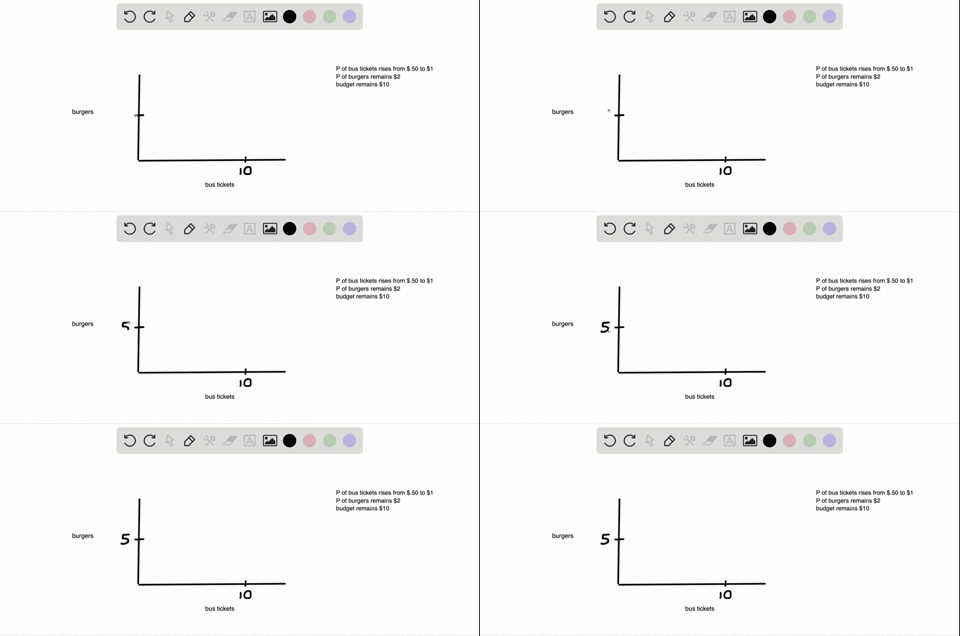
Suppose Alphonso’s town raised the price of bus tickets to $1 per trip (while the price of burgers stayed at $2 and his budget remained $10 per week.) Draw Alphonso’s new budget constraint. What happens to the opportunity cost of bus tickets?

Chapter 2: Choice in a World of Scarcity
Natalie Britton
03:00
Principles of Microeconomics for AP® Courses

Table 3.9 illustrates the market's demand and supply for cheddar cheese. Graph the data and find the
equilibrium. Next, create a table showing the change in quantity demanded or quantity supplied, and a graph of the new equilibrium, in each of the following situations:
a. The price of milk, a key input for cheese production, rises, so that the supply decreases by 80 pounds at every price.
b. A new study says that eating cheese is good for your health, so that demand increases by 20$\%$ at
every price.

Chapter 3: Demand and Supply
Natalie Britton
03:01
Principles of Microeconomics for AP® Courses

Mary and Raj are the only two growers who provide organically grown corn to a local grocery store.
They know that if they cooperated and produced less corn, they could raise the price of the corn. If they work independently, they will each earn $\$ 100$ . If they decide to work together and both lower their output, and the other does not, the person who lowers output will earn $\$ 0$ and the other person will capture the entire market and will earn $\$ 200$ . Table 10.6 represents the choices available to Mary and Raj. What is the bestchoice for Raj if he is sure that Mary will cooperate? If Mary thinks Raj will cheat, what should Mary do and why? What is the prisoner's dilemma result? What is the preferred choice if they could ensure cooperation? A $=$ Work independently; $\mathrm{B}=$ Cooperate and Lower Output. (Each results entry lists Raj's earnings first, and Mary's
earnings second.)

Chapter 10: Monopolistic Competition and Oligopoly
Natalie Britton
02:27
Principles of Microeconomics for AP® Courses

What would be evidence of serious competition between firms in an industry? Can you identify two
highly competitive industries?

Chapter 11: Monopoly and Antitrust Policy
Natalie Britton
1 2 3 4 5 ... 33