Ryan Conley

Arizona State University
Chemical Engineering Student

Biography

Hello, I am a recently graduated Chemical Engineering student with a minor in Spanish. I am applying to this job because I can use my education experience to help a lot of students. Throughout my four years in engineering school my classmates and I constantly encountered homework problems we had no idea how to start. Luckily we had each other and in some cases friends that had taken the classes before, in some cases this was me. Starting there we would work together and start taking different approaches at solving the problem. This lead to lots of time spent doing problems the wrong way. Having a reputable service like Numerade would have helped us a lot and saved us a lot of time. I would love to be someone who helps current engineering students learn and master their coursework, especially in this challenging time when it is difficult to meet in person with your fellow students.

When it comes to how I solve problems, I always focus on showing a lot of work and writing down as much as possible. While sometimes not necessary, it is a great practice to have because it makes it easier to find any mistakes you might make. It also makes it much easier for other people to follow your work and learn from it too. This makes me a great candidate to solve problems on Numerade.

At the top I checked engineering as it would seem to be a high need field and one with a smaller supply of potential tutors but I am also proficient in mathematics through Differential Equations and Calc 3. I hope to hear back from you soon and further discuss my qualifications.

Education

BA Chemical Engineering
Arizona State University

Educator Statistics

Numerade tutor for 6 years
50 Students Helped

Topics Covered

Mastering Matrices: An Introduction to the Fundamentals
Differential Equations Made Simple: Expert Tips & Resources
Exploring the World of Derivatives: A Comprehensive Guide
Stand Out with Differentiation Strategies | Boost Your Business
Volume
Mastering the Basics of Parametric Equations: A Comprehensive Guide
Polar Coordinates: Understanding the Basics and Applications
Introduction to Conic Sections
Discover the Relationship Between Parallel and Perpendicular Lines
Mastering Partial Derivatives: Essential Techniques and Tips

Ryan's Textbook Answer Videos

12:19
Calculus: Early Transcendentals

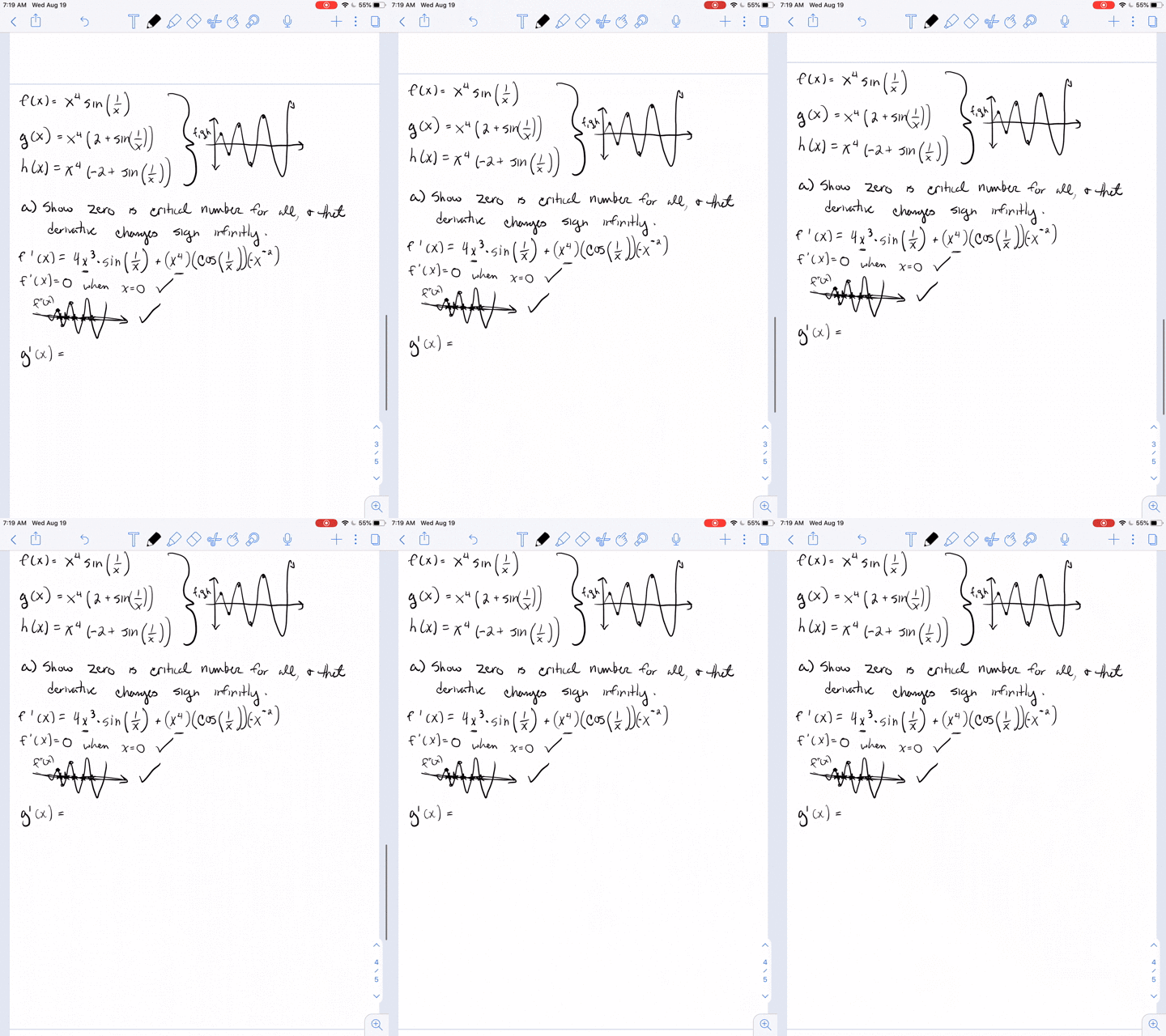
The three cases in the First Derivative Test cover the situations one commonly encounters but do not exhaust all possibilities. Consider the functions $ f $, $ g $, and $ h $ whos values at $ 0 $ are all $ 0 $ and, for $ x \not= 0 $,
$$ f(x) = x^4 \sin \frac{1}{x} $$ $$ g(x) = x^4 \left(2 + \sin \frac{1}{x} \right) $$
$$ h(x) = x^4 \left(-2 + \sin \frac{1}{x} \right) $$
(a) Show that $ 0 $ is a critical number of all three functions but their derivatives change sign infinitely often on both sides of $ 0 $.
(b) Show that $ f $ has neither a local maximum nor a local minimum at $ 0 $, $ g $ has a local minimum, and $ h $ has a local maximum.

Chapter 4: Applications of Differentiation
Section 3: How Derivatives Affect the Shape of a Graph
Ryan Conley
03:06
Calculus: Early Transcendentals

Describe how the graph of $ f $ varies as $ c $ varies. Graph several members of the family to illustrate the trends that you discover. In particular, you should investigate how maximum and minimum points and inflection points move when $ c $ changes. You should also identify any transitional values of $ c $ at which basic shape of the curve changes.

$ f(x) = \dfrac{cx}{1 + c^2x^2} $

Chapter 4: Applications of Differentiation
Section 6: Graphing with Calculus and Calculators
Ryan Conley
04:26
Calculus: Early Transcendentals

Describe how the graph of $ f $ varies as $ c $ varies. Graph several members of the family to illustrate the trends that you discover. In particular, you should investigate how maximum and minimum points and inflection points move when $ c $ changes. You should also identify any transitional values of $ c $ at which basic shape of the curve changes.

$ f(x) = \dfrac{\sin x}{c + \cos x} $

Chapter 4: Applications of Differentiation
Section 6: Graphing with Calculus and Calculators
Ryan Conley
03:45
Calculus: Early Transcendentals

Describe how the graph of $ f $ varies as $ c $ varies. Graph several members of the family to illustrate the trends that you discover. In particular, you should investigate how maximum and minimum points and inflection points move when $ c $ changes. You should also identify any transitional values of $ c $ at which basic shape of the curve changes.

$ f(x) = cx + \sin x $

Chapter 4: Applications of Differentiation
Section 6: Graphing with Calculus and Calculators
Ryan Conley
06:51
Calculus: Early Transcendentals

The family of functions $ f(t) = C(e^{-at} - e^{-bt}) $, where $ a $, $ b $, and $ C $ are positive numbers and $ b > a $, has been used to model the concentration of a drug injected into the bloodstream at time $ t = 0 $. Graph several members of this family. What do they have in common? For fixed values of $ C $ and $ a $, discover graphically what happens as $ b $ decreases. Then use calculus to prove what you have discovered.

Chapter 4: Applications of Differentiation
Section 6: Graphing with Calculus and Calculators
Ryan Conley
04:18
Calculus: Early Transcendentals

Investigate the family of curves given by $ f(x) = xe^{-cx} $, where $ c $ is a real number. Start by computing the limits as $ x \to \pm \infty $. Identify any transitional values of $ c $ where the basic shape changes. What happens to the maximum or minimum points and inflection points as $ c $ changes? Illustrate by graphing several members of the family.

Chapter 4: Applications of Differentiation
Section 6: Graphing with Calculus and Calculators
Ryan Conley
1 2 3 4 5 ... 8