Sajin Shajee

New Jersey Institute of Technology
Tutor

Biography

Graded and explain people's work

Education

BA Mathematical Science
New Jersey Institute of Technology

Educator Statistics

Numerade tutor for 6 years
601 Students Helped

Topics Covered

Exploring the World of Derivatives: A Comprehensive Guide
Applications of the Derivative
Applications of Integration: Exploring Real-World Solutions
Mastering Integrals: Tips and Tricks for Calculus Success
Integration
Mastering Second Order Differential Equations: Tips and Techniques
Unlocking the Power of Functions: Boost Your Programming Skills
Stand Out with Differentiation Strategies | Boost Your Business
Mastering Partial Derivatives: Essential Techniques and Tips
Exploring the Functions of Multiple Variables
Breaking Limits: Unlock Your Potential with Our Expert Solutions
Explore the Power of Continuous Functions: Boost Your Mathematical Skills
Mastering Integration Techniques for Optimal Results
Differential Equations Made Simple: Expert Tips & Resources
Unlock the Power of Sequences: Boost Your Productivity
Discover the Best Series to Binge-Watch | Your Ultimate Guide
Mastering Polynomials: Essential Tips and Tricks | [Brand Name]
Vector Functions: Understanding the Basics
Functions
Mastering Exponential and Logarithmic Functions: Your Ultimate Guide
Mastering Multiple Integrals: Techniques and Tips
Exploring Probability Topics: From Basics to Advanced Strategies
Understanding Continuous Random Variables: Key Concepts
Master Algebra Basics: Topics Reviewed at Semester Start
Mastering Matrices: Essential Tips and Tricks | Boost Your Math Skills
Solving Systems of Equations and Inequalities: A Comprehensive Guide
Unlock the Power of Vectors: Discover Their Limitless Possibilities

Sajin's Textbook Answer Videos

03:42
Fundamentals of Differential Equations

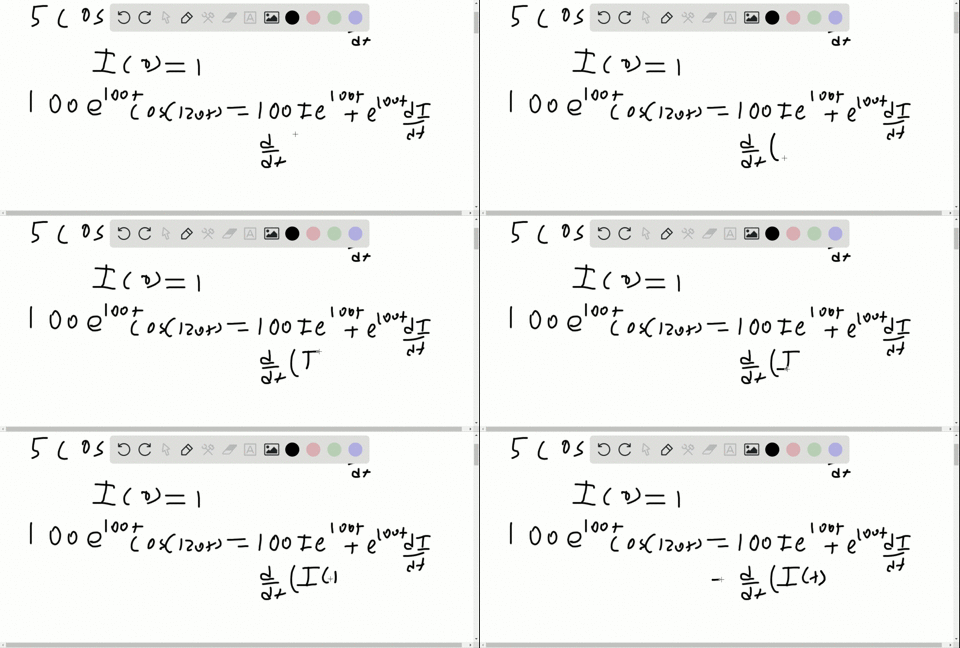
An RL circuit with a $$5 - \Omega$$ resistor and a $$0.05 - \mathrm { H }$$ inductor carries a current of 1 A at $$t = 0$$, at which time a voltage source $$E ( t ) = 5 \cos 120 t \mathrm { V }$$ is added. Determine the subsequent inductor current and voltage.

Chapter 3: Mathematical Models and Numerical Methods Involving First-Order Equations
Section 5: Electrical Circuits
Sajin Shajee
08:30
Fundamentals of Differential Equations

The pathway for a binary electrical signal between gates in an integrated circuit can be modeled as an RC circuit, as in Figure 3.13(b); the voltage source models the transmitting gate, and the capacitor models the receiving gate.Typically, the resistance is $$100 \Omega$$ and the capacitance is very small, say, $$10^{-12} \mathrm{F}(1 \text { picofarad, } \mathrm{pF})$$ If the capacitoris initially uncharged and the transmitting gate changes instantaneously from $$0 \text { to } 5 \mathrm{V}$$ how long will it take for the voltage at the receiving gate to reach (say) $$3 \mathrm{V}?$$ (This is the time it takes to transmit a logical $$" 1 "$$

Chapter 3: Mathematical Models and Numerical Methods Involving First-Order Equations
Section 5: Electrical Circuits
Sajin Shajee
02:02
Fundamentals of Differential Equations

Verify that for $$b=0$$ and $$F_{\operatorname{ext}}(t)=0$$, equation (3) has a
solution of the form

$$y(t)=\cos \omega t, \text { where } \omega=\sqrt{k / m}$$

Chapter 4: Linear Second-Order Equations
Section 1: Introduction: The Mass-Spring Oscillator
Sajin Shajee
01:14
Fundamentals of Differential Equations

Show that if $$F_{\mathrm{ext}}(t)=0, m=1, k=9$$, and $$b=6$$, then equation (3) has the 'critically damped' solutions $$y_{1}(t)=e^{-3 t}$$ and $$y_{2}(t)=t e^{-3 t}$$. What is the limit of these solutions as $$t \rightarrow \infty$$?

Chapter 4: Linear Second-Order Equations
Section 1: Introduction: The Mass-Spring Oscillator
Sajin Shajee
02:58
Fundamentals of Differential Equations

$$y^{\prime \prime}+2 y^{\prime}+4 y=6 \cos 2 t+8 \sin 2 t, \quad \Omega=2$$

Chapter 4: Linear Second-Order Equations
Section 1: Introduction: The Mass-Spring Oscillator
Sajin Shajee
10:35
Fundamentals of Differential Equations

Undamped oscillators that are driven at resonance have unusual (and nonphysical) solutions.
(a) To investigate this, find the synchronous solution $A \cos \Omega t+B \sin \Omega t$ to the generic forced oscillator
equation
(7)
$$
m y^{\prime \prime}+b y^{\prime}+k y=\cos \Omega t
$$
(b) Sketch graphs of the coefficients $A$ and $B,$ as functions of $\Omega,$ for $m=1, b=0,1,$ and $k=25$
(c) Now set $b=0$ in your formulas for $A$ and $B$ and resketch the graphs in part (b), with $m=1,$ and $k=25 .$ What happens at $\Omega=5 ?$ Notice that the amplitudes of the synchronous solutions grow without bound as $\Omega$ approaches 5 .
(d) Show directly, by substituting the form $A \cos \Omega t+$ $B \sin \Omega t$ into equation $(7),$ that when $b=0$ there are no synchronous solutions if $\Omega=\sqrt{k / m}$
(e) Verify that $(2 m \Omega)^{-1} t \sin \Omega t$ solves equation (7) when $b=0$ and $\Omega=\sqrt{k / m}$. Notice that this nonsynchronous solution grows in time, without bound.
Clearly one cannot neglect damping in analyzing an oscillator forced at resonance, because otherwise the solutions, as shown in part (e), are nonphysical. This behavior will be studied later in this chapter.

Chapter 4: Linear Second-Order Equations
Section 1: Introduction: The Mass-Spring Oscillator
Sajin Shajee
1 2 3 4 5 ... 92

Sajin's Quick Ask Videos

05:46
Algebra

is a diagonalizable. If your answer is YES, find P. If your answer is NO explain.

Sajin Shajee
01:52
Geometry

Figure A has a perimeter of 60 inches and one of the side lengths is 5 inches. Figure B has a perimeter of 84 inches. Find the missing corresponding side length.

Sajin Shajee
01:42
Precalculus

Prove the equation is an identity: 2-csc x sin x= sin^(2) x + cos^(2) x

Sajin Shajee
03:02
Precalculus

Prove the equation is an identity: (1-2cos^(2)y)/(1-2cosysiny)=(siny+cosy)/(siny-cosy)

Sajin Shajee
01:08
Precalculus

Prove the identity:\left(sin\:\theta -cos\:\theta \right)^2=1-sin\:2\theta

Sajin Shajee
01:37
Precalculus

Prove the identity: (cos(x+y))/(cos x cos y)=1-tan x tan y

Sajin Shajee
1 2 3