Simran Hiranandani

Other Schools
-

Biography

- Algebra is the gateway to higher-level math. In my classroom, I create a supportive environment where students build a solid mathematical foundation. Witnessing those "light bulb" moments fuels my passion for teaching algebra.

Education

BS Physics
Other Schools
BS Physics
University of Toronto

Educator Statistics

Numerade tutor for 6 years
118 Students Helped

Topics Covered

Motion in 2d or 3d
Understanding the Second Law of Thermodynamics: Key Principles
Discovering the Fundamentals: Newton's Laws of Motion Explained
Unlock the Power of Kinetic Energy: Boost Your Efficiency Today
Unlocking the Power of Potential Energy: Discover the Benefits
Save Energy and Money with Effective Conservation Techniques
Understanding Moment Impulse and Collisions for Better Physics
Understanding Electric Charge and Field: A Comprehensive Guide
Understanding Alternating Current: A Comprehensive Guide
Unlock the Secrets of Fluid Mechanics with Our Expert Guide
Exploring the World of Derivatives: A Comprehensive Guide
Stand Out with Differentiation Strategies | Boost Your Business

Simran's Textbook Answer Videos

01:36
University Physics with Modern Physics

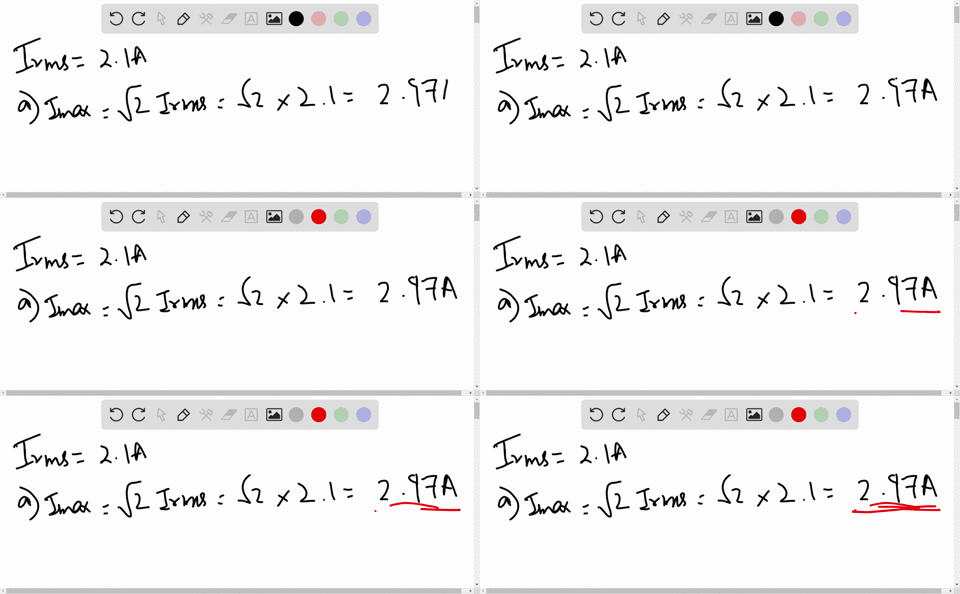
A sinusoidal current $i=I \cos \omega t$ has an rms value $I_{\mathrm{rms}}=$2.10 A. (a) What is the current amplitude? (b) The current is passed through a full-wave rectifier circuit. What is the rectified
average current? (c) Which is larger: $I_{\text { ms or }} I_{\text { rav }} ?$ Explain, using graphs of $i^{2}$ and of the rectified current.

Chapter 31: Alternating Current
Simran Hiranandani
00:40
University Physics with Modern Physics

The voltage across the terminals of an ac power supply varies with time according to Eq. $(31.1) .$ The voltage amplitude is $V=45.0 \mathrm{V} .$ What are (a) the root-mean-square potential difference
$V_{\mathrm{rms}}$ and (b) the average potential difference $V_{\mathrm{av}}$ between the two terminals of the power supply?

Chapter 31: Alternating Current
Simran Hiranandani
02:11
University Physics with Modern Physics

A capacitor is connected across an ac source that has voltage amplitude 60.0 $\mathrm{V}$ and frequency 80.0 $\mathrm{Hz}$ (a) What is the phase angle $\phi$ for the source voltage relative to the current? Does the source voltage lag or lead the current? (b) What is the capacitance Cof the capacitor if the current amplitude is 5.30 $\mathrm{A} ?$

Chapter 31: Alternating Current
Simran Hiranandani
01:43
University Physics with Modern Physics

Kitchen Capacitance. The wiring for a refrigerator contains a starter capacitor. A voltage of amplitude 170 $\mathrm{V}$ and frequency 60.0 Hz applied across the capacitor is to produce a current amplitude of 0.850 A through the capacitor. What capacitance $C$ is required?

Chapter 31: Alternating Current
Simran Hiranandani
03:07
University Physics with Modern Physics

A $150-\Omega$ resistor is connected in series with a $0.250-\mathrm{H}$ inductor and an ac source. The voltage across the resistor is $v_{R}=(3.80 \mathrm{V}) \cos [(720 \mathrm{rad} / \mathrm{s}) t]$ . ( a) Derive an expression for the circuit current. (b) Determine the inductive reactance of the inductor. (c) Derive an expression for the voltage $v_{L}$ across the inductor.

Chapter 31: Alternating Current
Simran Hiranandani
05:05
University Physics with Modern Physics

A resistor with $R=300 \Omega$ and an inductor are connected in series across an ac source that has voltage amplitude 500 $\mathrm{V}$ . The rate at which electrical energy is dissipated in the resistor is 216 $\mathrm{W}$ (a) What is the impedance $Z$ of the circuit? (b) What is the amplitude of the voltage across the inductor? (c) What is the power factor?

Chapter 31: Alternating Current
Simran Hiranandani
1 2 3 4 5 ... 20