I teach physics at Robert College, one of the premier schools in Turkey.
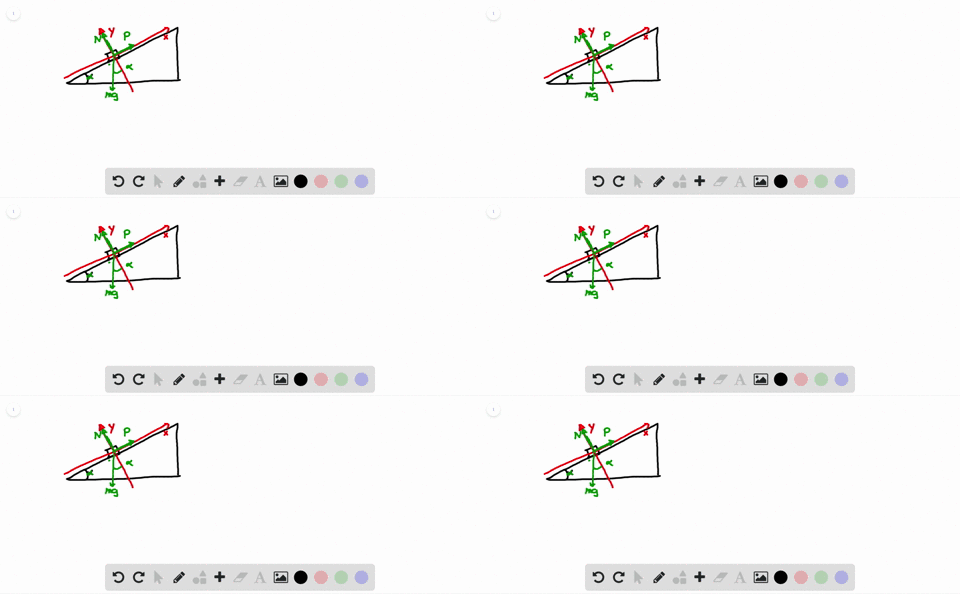
(II) What is the minimum work needed to push a 950-kg car 710 m up along a 9.0$^\circ$ incline? Ignore friction.
The space shuttle travels at a speed of about $7.6 \times 10^{3} \mathrm{m} / \mathrm{s}$ . Theblink of an astronaut's eye lasts about 110 $\mathrm{ms}$ . How many football fields(length $=91.4 \mathrm{m} )$ does the shuttle cover in the blink of an eye?
Due to continental drift, the North American and European continents are drifting apart at an average speed of about 3 $\mathrm{cm}$ per year. At this speed, how long (in years) will it take for them to drift apart by another 1500 $\mathrm{m}$ (a little less than a mile)?
The data in the following table describe the initial and final positions of a moving car. The elapsed time for each of the three pairs of positions listed in the table is 0.50 s. Review the concept of averagevelocity in Section 2.2 and then determine the average velocity (magnitude and direction) for each of the three pairs. Note that the algebraic sign of your answers will convey the direction.
The three-toed sloth is the slowest-moving land mammal. On the ground, the sloth moves at an average speed of $0.037 \mathrm{m} / \mathrm{s},$ considerably slower than the giant tortoise, which walks at 0.076 $\mathrm{m} / \mathrm{s}$ . After 12 minutes of walking, how much further would the tortoise have gone relative to the sloth?
A tourist being chased by an angry bear is running in a straight line toward his car at a speed of 4.0 $\mathrm{m} / \mathrm{s}$ . The car is a distance $d$ away. The bear is 26 $\mathrm{m}$ behind the tourist and running at 6.0 $\mathrm{m} / \mathrm{s}$ . The tourist reaches the car safely. What is the maximum possible value for $d ?$