I have just recently completed all the requirements to obtain my bachelors degree and I am looking to get some experience. As far as video making goes I do enjoy making them recreationally and I have the equipment needed. None of the videos I have made were educational in nature however though I would be up to the challenge. I do not actually have any paid tutoring or teaching experience, although I would be excited to strengthen my knowledge of economics through teaching.
Use MROZ for this exercise.(i) Reestimate the labor supply function in Example $16.5,$ using log(hours) as the dependent variable. Compare the estimated elasticity (which is now constant) to the estimate obtained from equation $(16.24)$ at the average hours worked.(ii) In the labor supply equation from part (i), allow educ to be endogenous because of omitted ability. Use motheduc and fatheduc as IVs for educ. Remember, you now have two endogenous variables in the equation.(iii) Test the overidentifying restrictions in the 2 SLS estimation from part (ii). Do the IVs pass the test?
Use the data in OPENNESS for this exercise.(i) Because log(pcinc) is insignificant in both $(16.22)$ and the reduced form for open, drop it from the analysis. Estimate $(16.22)$ by OLS and IV without log $(p c i n c) .$ Do any important conclusions change?(ii) Still leaving log(pcinc) out of the analysis, is land or log(land) a better instrument for open? (Hint: Regress open on each of these separately and jointly.)(iii) Now, return to $(16.22) .$ Add the dummy variable oil to the equation and treat it as exogenous. Estimate the equation by IV. Does being an oil producer have a ceteris paribus effect on inflation?
Use the data in CEMENT for this exercise.(i) A static (inverse) supply function for the monthly growth in cement price $(g p r c)$ as a function of growth in quantity $(g c e m)$ is$g p r c_{t}=\alpha_{1} g c e m_{t}+\beta_{0}+\beta_{1} g p r c p e t+\beta_{2} f e b_{t}+\ldots+\beta_{12} d e c_{t}+u_{t}^{s}$where gprcpet (growth in the price of petroleum) is assumed to be exogenous and $f e b, \ldots,$ dec are monthly dummy variables. What signs do you expect for $\alpha_{1}$ and $\beta_{1} ?$ Estimate the equation by OLS. Does the supply function slope upward?(ii) The variable $g$ defs is the monthly growth in real defense spending in the United States. What do you need to assume about gdefs for it to be a good IV for gcem? Test whether gcem is partially correlated with gdefs. (Do not worry about possible serial correlation in the reduced form.) Can you use $g d e f s$ as an IV in estimating the supply function?(iii) Shea $(1993)$ argues that the growth in output of residential (gres) and nonresidential (gnon) construction are valid instruments for gcem. The idea is that these are demand shifters that should be roughly uncorrelated with the supply error $u_{t}^{s} .$ Test whether gcem is partially correlated with gres and gnon; again, do not worry about serial correlation in the reduced form.(iv) Estimate the supply function, using gres and gnon as IVs for gcem. What do you conclude about the static supply function for cement? [The dynamic supply function is, apparently, upward sloping; see Shea $(1993) . ]$
Use the data in 401KSUBS for this exercise. The equation of interest is a linear probability model:$$p i r a=\beta_{0}+\beta_{1} p 401 k+\beta_{2} i n c+\beta_{3} i n c^{2}+\beta_{4} a g e+\beta_{5} a g e^{2}+u$$The goal is to test whether there is a tradeoff between participating in a 401$(\mathrm{k})$ plan and havin an individual retirement account (IRA). Therefore, we want to estimate $\beta_{1}$ .(i) Estimate the equation by OLS and discuss the estimated effect of $p 401 k$(ii) For the purposes of estimating the ceteris paribus tradeoff between participation in two differenttypes of retirement savings plans, what might be a problem with ordinary least squares?(iii) The variable $e 401 k$ is a binary variable equal to one if a worker is eligible to participatein a 401$(\mathrm{k})$ plan. Explain what is required for $e 401 k$ to be a valid IV for $p 401 k .$ Do these assumptions seem reasonable?(iv) Estimate the reduced form for $p 401 k$ and verify that $e 401 k$ has significant partial correlation with $p 401 k .$ Since the reduced form is also a linear probability model, use a heteroskedasticity-robust standard error.(v) Now, estimate the structural equation by IV and compare the estimate of $\beta_{1}$ with the OLS estimate. Again, you should obtain heteroskedasticity-robust standard errors.(vi) Test the null hypothesis that $p 401 k$ is in fact exogenous, using a heteroskedasticity-robust test.
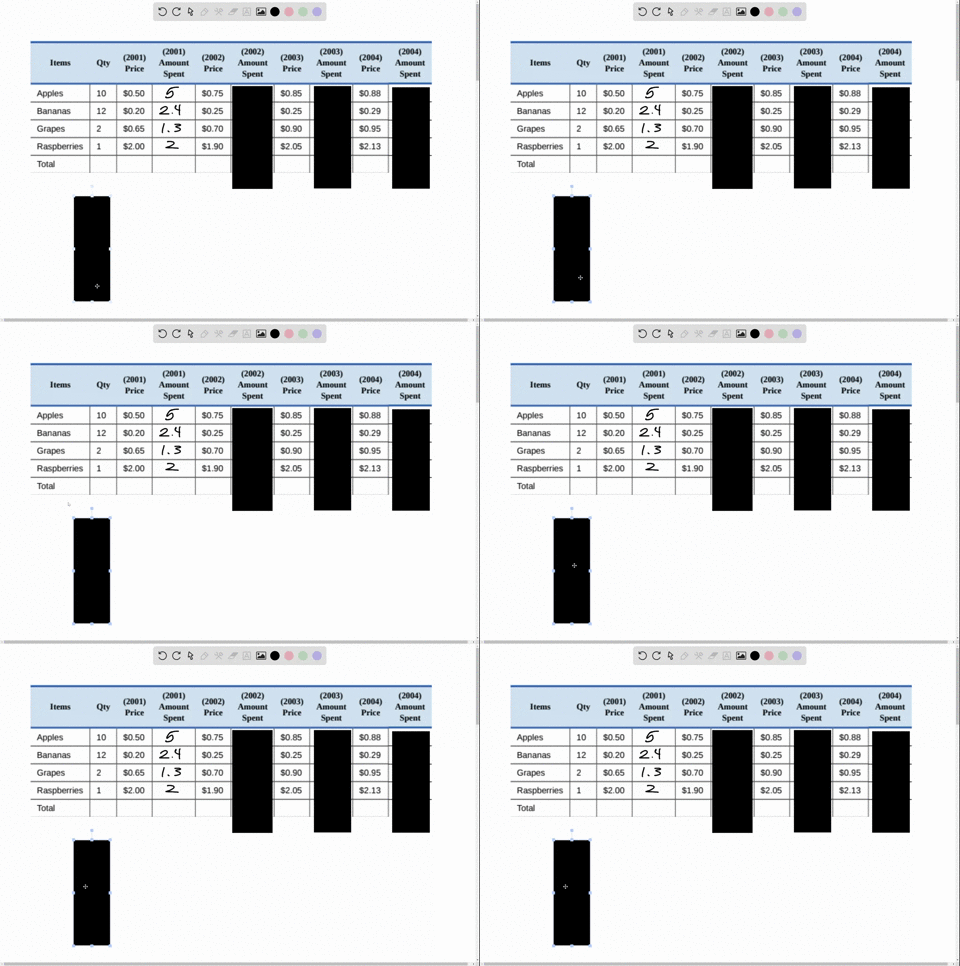
Table 9.4 shows the fruit prices that the typical college student purchased from 2001 to 2004. What is the amount spent each year on the "basket" of fruit with the quantities shown in column $2 ?$
Construct the price index for a "fruit basket" in each year using 2003 as the base year.