Gage Bonner

Numerade Educator
Teaching Assistant

Biography

I am a physics PhD postdoctoral researcher.

Education

Gage has not yet added their education credentials.

Educator Statistics

Numerade tutor for 4 years
21 Students Helped

Topics Covered

Unlocking the Power of Potential Energy: Discover the Benefits
Save Energy and Money with Effective Conservation Techniques
Calculating Electrical Power: Resistance and EMF
Discover the Science of Sound and Hearing: Your Guide to Better Listening

Gage's Textbook Answer Videos

04:28
University Physics with Modern Physics

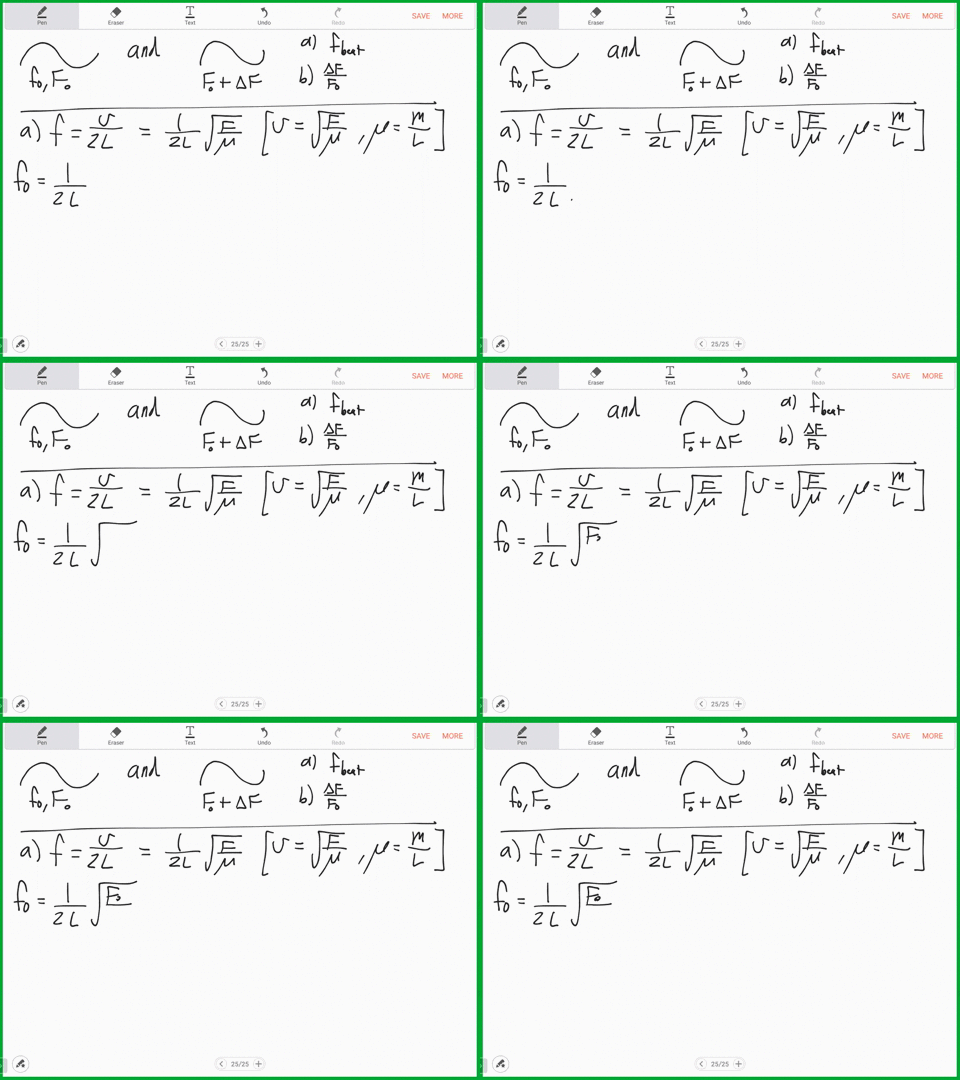
CP Two identical taut strings under the same tension $F$ produce a note of the same fundamental frequency $f_{0}$ . The tension in one of them is now increased by a very small amount $\Delta F .$ (a) If they are played together in their fundamental, show that the frequency of the beat produced is $f_{\text { beat }}=f_{0}(\Delta F / 2 F)$ . (b) Two identical violin strings, when in tune and stretched with the same tension, have a fundamental frequency of 440.0 Hz. One of the strings is retuned by increasing its tension. When this is done, 1.5 beats per second are heard when both strings are plucked simultaneously at their centers. By what percentage was the string tension changed?

Chapter 16: Sound and Hearing
Gage Bonner
07:39
University Physics with Modern Physics

A soprano und a bass are singing a duet. While the soprano sings an $A$ -sharp at 932 $\mathrm{Hz}$ , the bass sings an $A$ -sharp but three octaves lower. In this concert hall, the density of air is 1.20 $\mathrm{kg} / \mathrm{m}^{3}$ and its bulk modulus is $1.42 \times 10^{5} \mathrm{Pa.}$ In order for their notes to have the same sound intensity level, what must be (a) the ratio of the pressure amplitude of the bass to that of the soprano and (b) the ratio of the displacement amplitude of the bass to that
of the soprano? (c) What displacement amplitude (in $m$ and in nm $)$ does the soprano produce to sing her A-sharp at 72.0 $\mathrm{dB} ?$

Chapter 16: Sound and Hearing
Gage Bonner
03:22
University Physics with Modern Physics

A Thermometer. Suppose you have a tube of length $L$ containing a gas whose temperature you want to take, but you cannot get inside the tube. One end is closed, and the other end is open but a small speaker producing sound of variable frequency is at that end. You gradually increase the frequency of the speaker until the sound from the tube first becomes very loud. With further increase of the frequency, the loudness decreases but then gets very loud again at still higher frequencies. Call $f_{0}$ the lowest frequency at which the sound is very loud. (a) Show that the absolute temperature of this gas is given by $T=16 M L^{2} f_{0}^{2} / \gamma R,$ where $M$ is the molar mass of the gas, $\gamma$ is the ratio of its heat capacities, and $R$ is the ideal gas constant. (b) At what frequency above $f_{0}$ will the sound from the tube next reach a maximum in loudness? (c) How could you determine the speed of sound in this tube at temperature $T ?$

Chapter 16: Sound and Hearing
Gage Bonner
07:13
University Physics with Modern Physics

CP A uniform $165-\mathrm{N}$ bar is supported horizontally by two identical wires $A$ and $B$
(Fig. Pl6.62). A small $185-\mathrm{N}$ cube of lead is placed three-fourths of the way from $A$ to $B$ .The wires are each 75.0 $\mathrm{cm}$ long and have a mass of 5.50 $\mathrm{g}$ If both of them are simultaneously plucked at the center, what is the frequency of the beats that they will produce when vibrating in their fundamental?

Chapter 16: Sound and Hearing
Gage Bonner
04:27
University Physics with Modern Physics

CP A person is playing a small flute 10.75 $\mathrm{cm}$ long, open at one end and closed at the other, near a taut string having a fundamental frequency of 600.0 Hz. If the speed of sound is $344.0 \mathrm{m} / \mathrm{s},$ for which harmonics of the flute will the string resonate? In each case, which harmonic of the string is in resonance?

Chapter 16: Sound and Hearing
Gage Bonner
1 2 3 4