Ian Grigsby

The University of Texas at Dallas
Teacher

Biography

Taught for 5 years as a grad student at Baylor.

Education

BS Physics
The University of Texas at Dallas

Educator Statistics

Numerade tutor for 5 years
141 Students Helped

Topics Covered

Master Trigonometry with Our Comprehensive Guide
Discover the Basics of Trigonometry: Your Introduction to Triangles
Breaking Limits: Unlock Your Potential with Our Expert Solutions
Exploring the World of Derivatives: A Comprehensive Guide
Mastering Integrals: Tips and Tricks for Calculus Success
Stand Out with Differentiation Strategies | Boost Your Business
Understanding Discrete Random Variables: A Comprehensive Guide
Discover the Power of Ratio Proportions and Measurements
Master Algebra Basics: Topics Reviewed at Semester Start
Functions
Mastering Linear Functions: A Comprehensive Guide
Unlocking the Power of Geometric Proof: A Comprehensive Guide
Mastering Angles: A Comprehensive Guide to Geometry
Discover the Power of Polygons: Unleash Your Creativity with Our Comprehensive Guide
Discover the Best Series to Binge-Watch | Your Ultimate Guide
Mastering Quadratic Functions: Unlocking Their Power
Understanding Complex Numbers: A Comprehensive Guide
Mastering Polynomials: Essential Tips and Tricks | [Brand Name]
Rational Functions: Understanding Their Properties and Applications
Unlocking the Power of Functions: Boost Your Programming Skills
Unlock the Power of Sequences: Boost Your Productivity
Applications of Integration: Exploring Real-World Solutions

Ian's Textbook Answer Videos

04:15
Calculus: Early Transcendentals

Sketch the graph of an example of a function $ f $ that satisfies all of the given conditions.

$ \displaystyle \lim_{x \to 0^-}f(x) = 2 $, $ \displaystyle \lim_{x \to 0^+}f(x) = 0 $,
$ \displaystyle \lim_{x \to 4^-}f(x) = 3 $, $ \displaystyle \lim_{x \to 4^+}f(x) = 0 $, $ f(0) = 2 $, $ f(4) = 1 $

Chapter 2: Limits and Derivatives
Section 2: The Limit of a Function
Ian Grigsby
08:09
Probability with Applications in Engineering, Science, and Technology

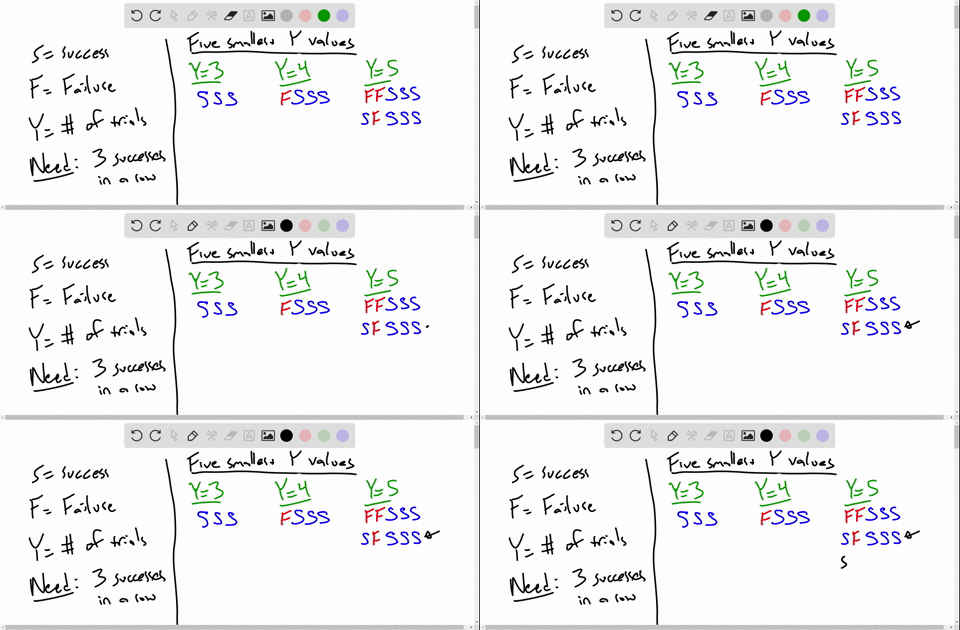
Each time a component is tested, the trial is a success $(S)$ or failure $(F) .$ Suppose the component is tested repeatedly until a success occurs on three consecutive trials. Let $Y$ denote the number of trials necessary to achieve this. List all outcomes corresponding to the five smallest possible values of $Y,$ and state which $Y$ value is associated with each one.

Chapter 2: Discrete Random Variables and Probability Distributions
Section 1: Random Variables
Ian Grigsby
00:53
Calculus Early Transcendentals

Differentiate.

$f(x)=3 x^{2}-2 \cos x$

Chapter 3: Differentiation Rules
Section 3: Derivatives of Trigonometric Functions
Ian Grigsby
01:33
Calculus Early Transcendentals

Differentiate.
$f(x)=\sqrt{x} \sin x$

Chapter 3: Differentiation Rules
Section 3: Derivatives of Trigonometric Functions
Ian Grigsby
01:31
Calculus Early Transcendentals

Differentiate.
$h(\theta)=\csc \theta+e^{\theta} \cot \theta$

Chapter 3: Differentiation Rules
Section 3: Derivatives of Trigonometric Functions
Ian Grigsby
01:32
Calculus Early Transcendentals

Differentiate.
$y=e^{u}(\cos u+c u)$

Chapter 3: Differentiation Rules
Section 3: Derivatives of Trigonometric Functions
Ian Grigsby
1 2 3 4 5 ... 20

Ian's Quick Ask Videos

08:09
Intro Stats / AP Statistics

Each time a component is tested, the trial is a success $(S)$ or failure $(F) .$ Suppose the component is tested repeatedly until a success occurs on three consecutive trials. Let $Y$ denote the number of trials necessary to achieve this. List all outcomes corresponding to the five smallest possible values of $Y,$ and state which $Y$ value is associated with each one.

Ian Grigsby
04:16
Calculus 1 / AB

Sketch the graph of an example of a function $ f $ that satisfies all of the given conditions.

$ \displaystyle \lim_{x \to 0^-}f(x) = 2 $, $ \displaystyle \lim_{x \to 0^+}f(x) = 0 $,
$ \displaystyle \lim_{x \to 4^-}f(x) = 3 $, $ \displaystyle \lim_{x \to 4^+}f(x) = 0 $, $ f(0) = 2 $, $ f(4) = 1 $

Ian Grigsby
02:43
Prealgebra

In the following exercises, solve and write your answer in mixed units.
Renee attached a 6 -foot-6-inch extension cord to her computer's 3 -foot-8-inch power cord. What was the total length of the cords?

Ian Grigsby
01:32
Precalculus

At 6 am, an online company has sold 120 items that day. If the company sells an average of 30 items per hour for the remainder of the day, write an expression to represent the number of items that were sold $n$ after 6 am.

Ian Grigsby
02:17
Geometry

Tell whether each statement is true or false. Then write the converse and tell whether it is true or false.
If $x=-6,$ then $|x|=6$

Ian Grigsby
05:58
Calculus 2 / BC

(a) You delete a finite number of terms from a divergent series. Will the new series still diverge? Explain your reasoning.
(b) You add a finite number of terms to a convergent series. Will the new series still converge? Explain your reasoning.

Ian Grigsby
1 2 3 4 5