I have over 10 years of experience teaching AP Chemistry, Gifted Chemistry, Honors Chemistry, Standard Chemistry, and IB SL/HL Chemistry. I also have been flipping my classroom for the past 6 years, recording videos and solving problems on my tablet PC, and requiring students to watch the videos and take notes for homework.
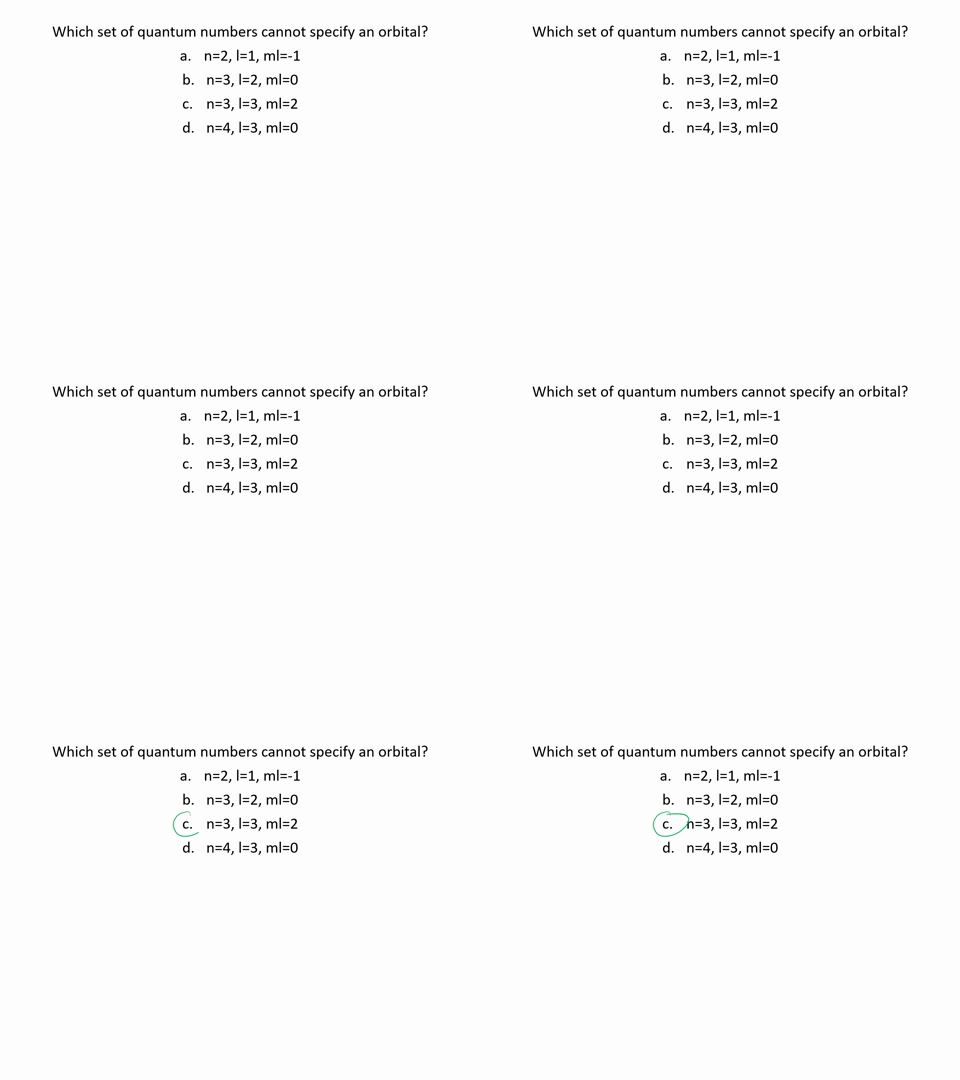
Which set of quantum numbers callinot specify an orbital? MISSED THIST Read Section 8.5 , Watch KCV $8.54,$ WE 8.5a. $n-2,1-1, m_{i}--1$b. $n-3,1-2, m_{1}-0$c. $n-3, l-3, m-2$d. $n-4, l-3, m_{1}-0$
According to the quantum-mechanical model for the hydrogen atom, which electron transition produces light with the longer wavelength: $2 p \longrightarrow 1 s$ or $3 p \longrightarrow 1 s ?$MiSSED This? Read Section 8.5; Watch KCV 8.58
Ultraviolet radiation and radlation of shorter wavelengths can damage biological molecules because these kinds of radlation carry enough energy to break bonds within the molecules. A typical carbon-carbon bond fequires 348 kl / mol to beeak. What is the longest wavelength of radiation with enough energy to break carbon-carbon bonds?
The human eye contains a molecule called 11 -cis-retinal that changes shape when struck with light of sufficient energy. The change in shape trifecers a serles of events that result in an electrical slgnal being sent to the bealn that results in vision. The minimum energy required to change the conformation of 11 -cis-fetinal within the eye is about 164 kJ / mol. Calculate the longest wavelength visible to the human eye.
Suppose that in an alternate universe, the possible values of I are the lnteger values from 0 to $n$ (instead of 0 to $n-1$ ). Assuming no other differences between this imaginary universe and ours, how many orbitals exist in each level in the alternate universe?a. $n=1$b. $n-2$c. $n=3$
Determine which of the following H atom electron transitions hasthe longest wavelength and which has the shortest wavelength:(a) n = 1 to n = 3(b) n = 3 to n = 5(c) n = 3 to n = 9(d) n = 1 to n = 8Longest-wavelength photon: a b c dShortest-wavelength photon: a b c d
How many of the following elements belong to the chemical familyknown as the alkaline earths? sodium, magnesium, chlorine, neon,calcium, bromine, argon, fluorine, helium, hydrogenGroup of answer choices:a- 2b- 5c- 3d- 4e- 1
The pH of a 0.12 M solution of arsenic acid (H3AsO4) is measured to be 1.64. Use this information to determine a value of Ka for arsenic acid.
H3AsO4(aq) + H2O(l) ⇌ H2AsO4-(aq) + H3O+(aq)
Ka =
100.00 cm^3 of a 0.200 M solution of methylamine in a conical flask is titrated with a 0.100 M solution of hydrochloric acid, until the equivalence point is reached. Given: Kb(CH3NH2) = 4.4 x 10^-4 at 25°C. What is the (i) volume of acid required (cm^3), (ii) the number of moles of the base in the flask, (iii) the number of moles of the conjugate acid in the flask, (iv) the concentration of the conjugate acid in the flask (mol.L^-1), (v) the final pH of the solution in the flask.
Acid-Base Buffers Worksheet1a) The combination of HBr and NaClO4 cannot be used toform a buffer. (T or F)b) If the logarithmic term in the Henderson-Hasselbalchequation is = 0, then is the acid concentration greater, less thanor equal to the base concentration?c) When a strong base is added to a buffer solution, the pHwill decrease but only slightly. (T or F)d) If you start with 50.0 mL of 0.20 M C6H5ONa, how many mLof 0.40 M HBr do you need to add to make a buffer of C6H5OH /C6H5ONa? Record your answer with 2 digits after the decimalpoint.
Balance the following reaction in KOH. What are the coefficients in front of H2O and KOH in the balanced reaction and list which side of the equation that H2O and KOH appear? C3H8O2(aq) + KMnO4(aq) → C3H2O4K2(aq) + MnO2(aq)
A. H2O = 1, KOH = 4, rightB. H2O = 4, KOH = 1, leftC. H2O = 9, KOH = 2, rightD. H2O = 3, KOH = 2, rightE. H2O = 4, KOH = 2, leftF. none of these