I am a passionate math educator with teaching qualifications specialized for the Intermediate and Senior Divisions. I hold both a Bachelor's and a Master's degree in Computer Science, which helps me connect math to real-world applications.
I enjoy tutoring and creating supportive learning environments where students can build their confidence in math. I have also had the opportunity to mentor students in the STEM Fellowship Undergraduate Big Data Challenge, guiding them through complex problems and sharing valuable insights.
I strive to inspire my students to appreciate math and develop critical thinking skills, making the learning process both enjoyable and effective.
Find the area of the shaded region in the figure.(FIGURE CANNOT COPY)
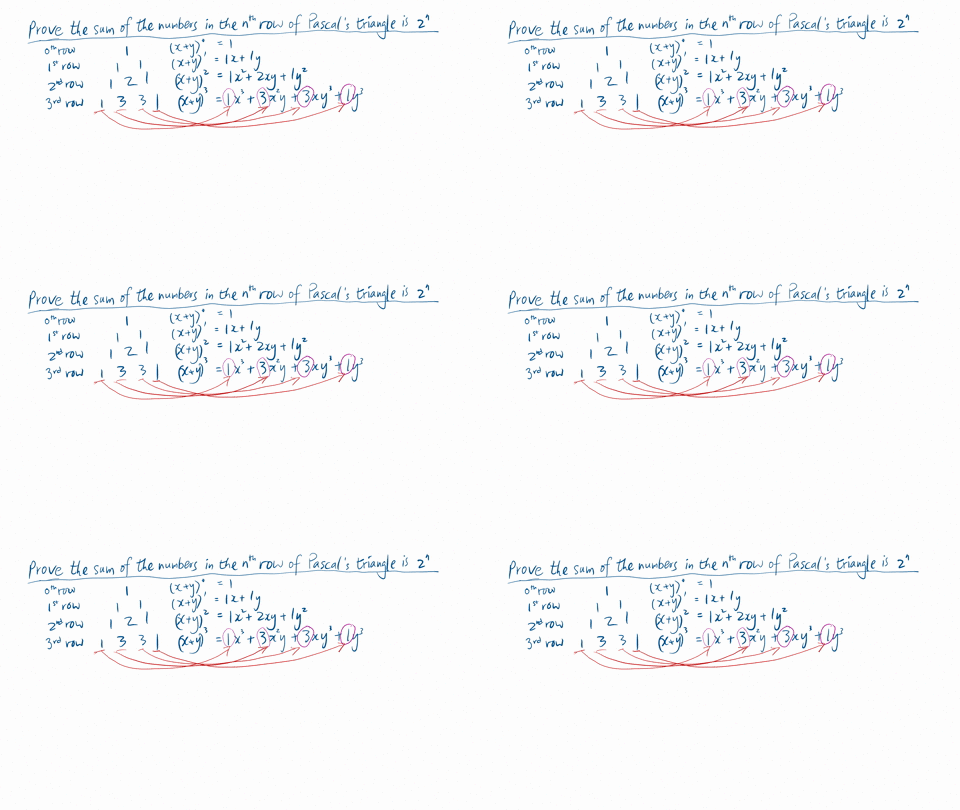
The sum of the numbers in the $n$ th row of Pascal's Triangle is $2^{n}$.
The seasonal variation in length of daylight can be modeled by a sine function. For example, the daily number of hours of daylight in New Orleans is given by the equation$$h=\frac{35}{3}+\frac{7}{3} \sin \frac{2 \pi x}{365}$$where $x$ is the number of days after March 21 (disregarding leap year). (Data from Bushaw, D., et al., A Sourcebook of Applications of School Mathematics, National Council of Teachers of Mathematics.)(a) On what date will there be about 14 hr of daylight?(b) What date has the least number of hours of daylight?(c) When will there be about 10 hr of daylight?
The function $w(x)=$ $-0.01 x^{2}+0.27 x+8.60$ can be used to estimate the number of self-employed workers in the United States, in millions, $x$ years after 1980 (Source: U.S. Bureau of Labor Statistics). Use this function for Exercises 107 and 108 .For what years were there $9.1$ million self-employed workers in the United States?
Using the Law of Sines to find a triangle with one obtuse angleif ∠ A = 46 ∘ , a = 26 , b = 28 . If no answer exists, enter DNEfor all answers.
Apply inverse trigonometry to degreemeasure
Problems 20-22 show a transformation of y = 1/x.(a) Find a possible formula for the graph.(b) Write the formula from part (a) as the ratio of two linear polynomials.(c) Find the coordinates of the intercepts of the graph.
You are given the graph of f'(x), and your task is to reconstruct the graph of f(x). Once you can do this well, you are ready for the first derivative test:
Explore1. The graph of f'(x) is shown in red. Drag the blue points up and down so that together they follow the shape of the graph of f(x). As help, the three large green points are points on the graph of f(x). 2. Are the three green points necessary? Theoretically, could you reconstruct f(x) from only one green point? From no green points?3. How can you tell where the f-graph is increasing? decreasing?4. How can you tell where the f-graph has a max? a min?5. What information in the f'-graph would tell you the point where f increases the fastest?6. Keep practicing until you can get your accuracy consistently in the 90's.
Tiffany and Michael begin running around a circular track of radius 80 yards. They start at the locations pictured. Michael is running 0.029 rad/sec counterclockwise and Tiffany is running 0.03 rad/sec counterclockwise. Impose coordinates as pictured. (Round your answers to two decimal places.)
yTiffany starts herer = 80 yards0.029 rad/secxMichael starts here0.03 rad/sec
(a) Where is each runner located (in xy-coordinates) after 8 seconds?Michael (x, y) =Tiffany (x, y) =
(b) How far has each runner traveled after 8 seconds?Michael ydsTiffany yds
Convert the following Cartesian equation into a polar equation y = 2x + 3r = 3 / (sin(theta) - 2 cos(theta))r = 2 / (sin(theta) - 3 cos(theta))r = 3 / (sin(theta) - 2 cos(theta))r = 2 / (sin(theta) + 3 cos(theta))Convert the following polar equation into a Cartesian equation.r = 5 / (1 - 9 cos(theta))x^2 + y^2 = (5 - 9x)^2x^2 + y^2 = (5 + 9x)^2x^2 + y^2 = 5 - 9xx^2 + y^2 = 5 + 9x