Mystique Till

University of Michigan - Ann Arbor
Teacher

Biography

I teach physical science at a high school in Detroit, Michigan, and I love teaching science.

Education

BS Biology
University of Michigan - Ann Arbor

Educator Statistics

Numerade tutor for 4 years
1313 Students Helped

Topics Covered

Discover the Power of the Cell: Unleash Your Potential with Our Products
The Importance of Understanding the Cell Cycle for Cellular Reproduction
Discover the Fascinating World of Vertebrates: A Comprehensive Guide
Discover the Power of Organic Compounds: Benefits and Uses
Discover the Power of Alkynes: Properties, Reactions, and Applications
Addition reactions of alkenes
Discover the Power of Lipids: Benefits and Uses | [Brand Name]
Carbohydrates, proteins, and lipids
Carboxylic Acids: Properties, Reactions, and Applications
Exploring Carboxylic Acid Derivatives: Properties and Applications
Carboxylic acids and their derivatives
Acids and bases
Acid-Base Equilibria: Understanding the Balance
Understanding Acids and Bases: A Comprehensive Guide
Alcohols and phenols
Ethers, epoxides, thiols, and sulfides
Ethers, Epoxides, and Thioethers: Understanding their Properties
Effective Solutions for Your Business Needs
Aqueous Solutions
Amines
Discover the Power of Amines: Benefits, Uses, and More
Carbohydrates and Nucleic Acids: The Building Blocks of Life
Understanding Chemical Bonding: The Key to Molecular Structure
Understanding Structure and Bonding: A Comprehensive Guide
Unlocking the Wonders of Organic Chemistry: An Introduction
Understanding the Differences Between Ketones and Aldehydes
Aldehydes and ketones

Mystique's Textbook Answer Videos

01:27
General, Organic, Biological Chemistry: Structures of Life

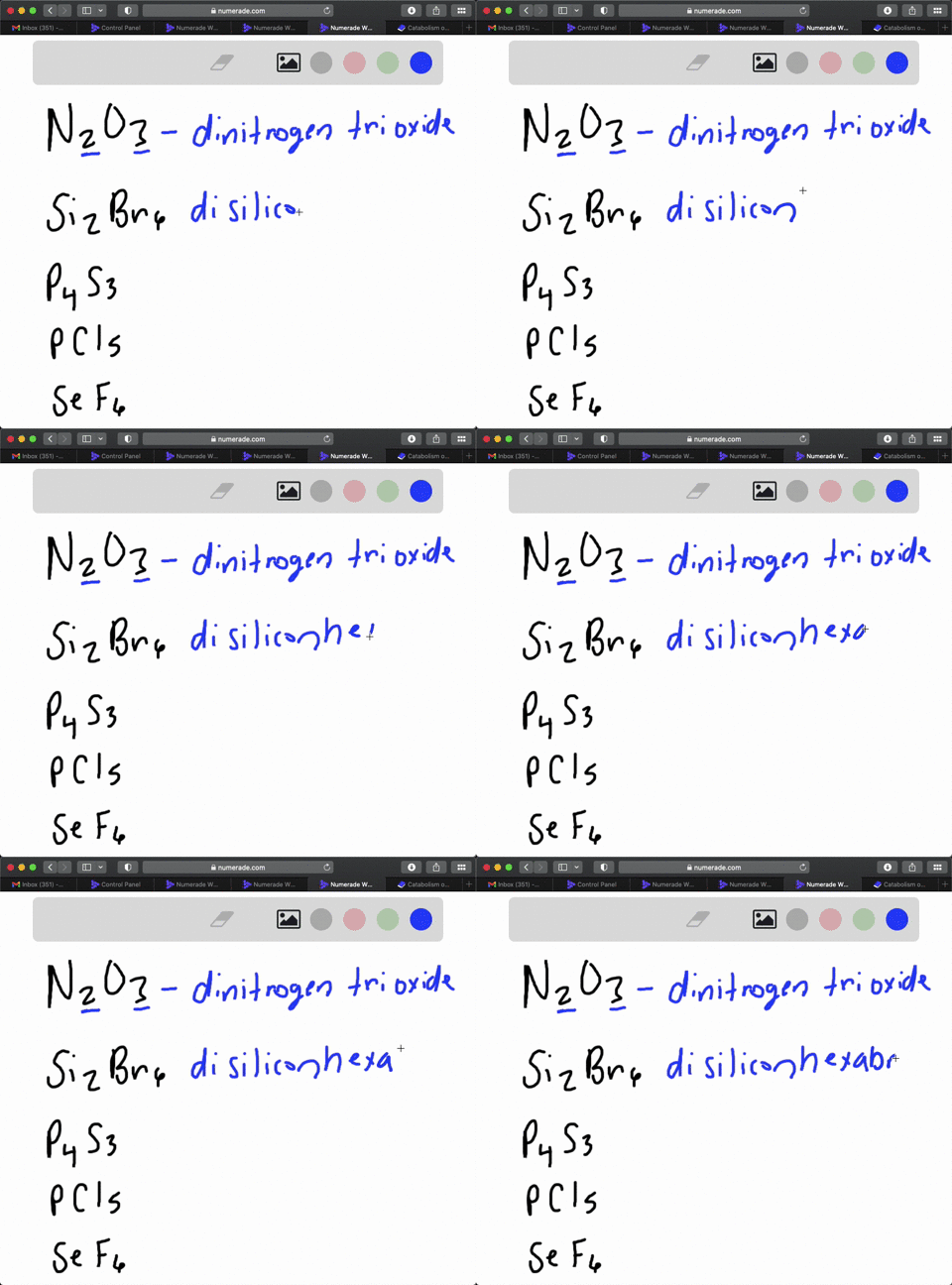
Name each of the following molecular compounds:
a. $\mathrm{N}_{2} \mathrm{O}_{3}$
b. $\mathrm{Si}_{2} \mathrm{Br}_{6}$
c. $\mathrm{P}_{4} \mathrm{~S}_{3}$
d. $\mathrm{PCl}_{5}$
e. $\mathrm{SeF}_{6}$

Chapter 6: Ionic and Molecular Compounds
Section 5: Molecular Compounds: Sharing Electrons
Mystique Till
01:30
General, Organic, Biological Chemistry: Structures of Life

Predict whether each of the following bonds is nonpolar covalent, polar covalent, or ionic:
a. $\mathrm{Si}-\mathrm{Br}$
b. $\mathrm{Li}-\mathrm{F}$
c. $\mathrm{Br}-\mathrm{F}$
d. I - I
e. $\mathrm{N}-\mathrm{P}$
f. $\mathrm{C}-\mathrm{P}$

Chapter 6: Ionic and Molecular Compounds
Section 7: Electronegativity and Bond Polarity
Mystique Till
00:43
General, Organic, Biological Chemistry: Structures of Life

For each of the following bonds, indicate the positive end with $\delta^{+}$ and the negative end with $\delta^{-}$. Draw an arrow to show the dipole for each.
a. $\mathrm{N}-\mathrm{F}$
b. $\mathrm{Si}-\mathrm{Br}$
c. $\mathrm{C}-\mathrm{O}$
d. $\mathrm{P}-\mathrm{Br}$
e. $\mathrm{N}-\mathrm{P}$

Chapter 6: Ionic and Molecular Compounds
Section 7: Electronegativity and Bond Polarity
Mystique Till
02:39
General, Organic, Biological Chemistry: Structures of Life

Identify the reactant that is a Brønsted-Lowry acid and the reactant that is a Brønsted-Lowry base in each of the following:
a. $\mathrm{HI}(a q)+\mathrm{H}_{2} \mathrm{O}(l) \longrightarrow \mathrm{I}^{-}(a q)+\mathrm{H}_{3} \mathrm{O}^{+}(a q)$
b. $\mathrm{F}^{-}(a q)+\mathrm{H}_{2} \mathrm{O}(l) \rightleftarrows \mathrm{HF}(a q)+\mathrm{OH}^{-}(a q)$
c. $\mathrm{H}_{2} \mathrm{~S}(a q)+\mathrm{CH}_{3}-\mathrm{CH}_{2}-\mathrm{NH}_{2}(a q) \rightleftarrows$
$\mathrm{HS}^{-}(a q)+\mathrm{CH}_{3}-\mathrm{CH}_{2}-\mathrm{NH}_{3}^{+}(a q)$

Chapter 11: Acids and Bases
Section 2: Bronsted-Lowry Acids and Bases
Mystique Till
03:21
General, Organic, Biological Chemistry: Structures of Life

Identify the reactant that is a Brønsted-Lowry acid and the reactant that is a Brønsted-Lowry base in each of the following:
a. $\mathrm{CO}_{3}^{2-}(a q)+\mathrm{H}_{2} \mathrm{O}(l) \rightleftarrows \mathrm{HCO}_{3}^{-}(a q)+\mathrm{OH}^{-}(a q)$
b. $\mathrm{H}_{2} \mathrm{SO}_{4}(a q)+\mathrm{H}_{2} \mathrm{O}(l) \longrightarrow \mathrm{HSO}_{4}^{-}(a q)+\mathrm{H}_{3} \mathrm{O}^{+}(a q)$
c. $\mathrm{C}_{2} \mathrm{H}_{3} \mathrm{O}_{2}^{-}(a q)+\mathrm{H}_{3} \mathrm{O}^{+}(a q) \rightleftarrows \mathrm{HC}_{2} \mathrm{H}_{3} \mathrm{O}_{2}(a q)+\mathrm{H}_{2} \mathrm{O}(l)$

Chapter 11: Acids and Bases
Section 2: Bronsted-Lowry Acids and Bases
Mystique Till
1 2 3 4 5 ... 38

Mystique's Quick Ask Videos

00:46
Biology

The template DNA at the replication fork is prevented from self
hybridizing by the
A.
Primase
B.
Gyrase
C.
Single strand binding protein

Mystique Till
01:36
Biology

A brown-eyed heterozygous man marries a blue-eyed woman. Assume
that brown eyes are dominant to blue. What ratio of eye
colors would you expect to see in their children?
- Not enough information
- All brown eyed
- Equal numbers blue and brown eyed
- Roughly 3 brown to 1 blue
- Roughly 3 blue to 1 brown

Mystique Till
00:33
Biology

1.) The haploid human genome is approximately 3 billion base
pairs (3000 Mb). How long is the human genome in cm?

Mystique Till
04:20
Biology

a. Membrane transporters and membrane channels
b. Active and passive transport
c. Uniporter, Symporter, and Antiporter
d. Voltage-gated, ligand-gated, and stress-gated channels

Mystique Till
00:51
Biology

Draw a cartoon of a phospholipid bilayer membrane and describe
its chemical properties.

Mystique Till
00:16
Biology

two glucose molecules are combined to make maltose molecule

Mystique Till
1 2 3 4 5 ... 180