Nicholas Salas

Biola University
Teacher

Biography

I love my job!

Education

BA Mathematical Science
Biola University

Educator Statistics

Numerade tutor for 4 years
323 Students Helped

Topics Covered

The Power of Algebraic Language: Unlocking Mathematical Potential
Mastering Equations and Inequalities: Your Guide to Mathematical Success
Understanding Complex Numbers: A Comprehensive Guide
Discover the Power of Right Triangles in Geometry
Discover the Properties of Congruent Triangles | Exploring Geometry
Exploring Relationships Within Triangles
Mastering Polynomials: Essential Tips and Tricks | [Brand Name]
Rational Functions: Understanding Their Properties and Applications
Exploring Probability Topics: From Basics to Advanced Strategies
Mastering Sequences and Series: An Introduction
Understanding the Normal Distribution: A Comprehensive Guide
Unlocking the Power of Functions: Boost Your Programming Skills
Maximizing Accuracy with Effective Sampling and Data Analysis

Nicholas's Textbook Answer Videos

0:00
Introductory Statistics

Use the following information to answer the next four exercises: X ~ N(54, 8)
Find the probability that $x>56$

Chapter 6: The Normal Distribution
Section 2: Using the Normal Distribution
Nicholas Salas
0:00
Introductory Statistics

Use the following information to answer the next four exercises: X ~ N(54, 8)
Find the $60^{\text { th }}$ percentile.

Chapter 6: The Normal Distribution
Section 2: Using the Normal Distribution
Nicholas Salas
0:00
Algebra and Trigonometry

Find the complex zeros of each polynomial function. Write fin factored form.
$$f(x)=x^{3}-1$$

Chapter 5: Polynomial and Rational Functions
Section 6: Complex Zeros; Fundamental Theorem of Algebra
Nicholas Salas
0:00
Algebra and Trigonometry

Find the complex zeros of each polynomial function. Write fin factored form.
$$f(x)=3 x^{4}-x^{3}-9 x^{2}+159 x-52$$

Chapter 5: Polynomial and Rational Functions
Section 6: Complex Zeros; Fundamental Theorem of Algebra
Nicholas Salas
1 2

Nicholas's Quick Ask Videos

02:20
Intro Stats / AP Statistics

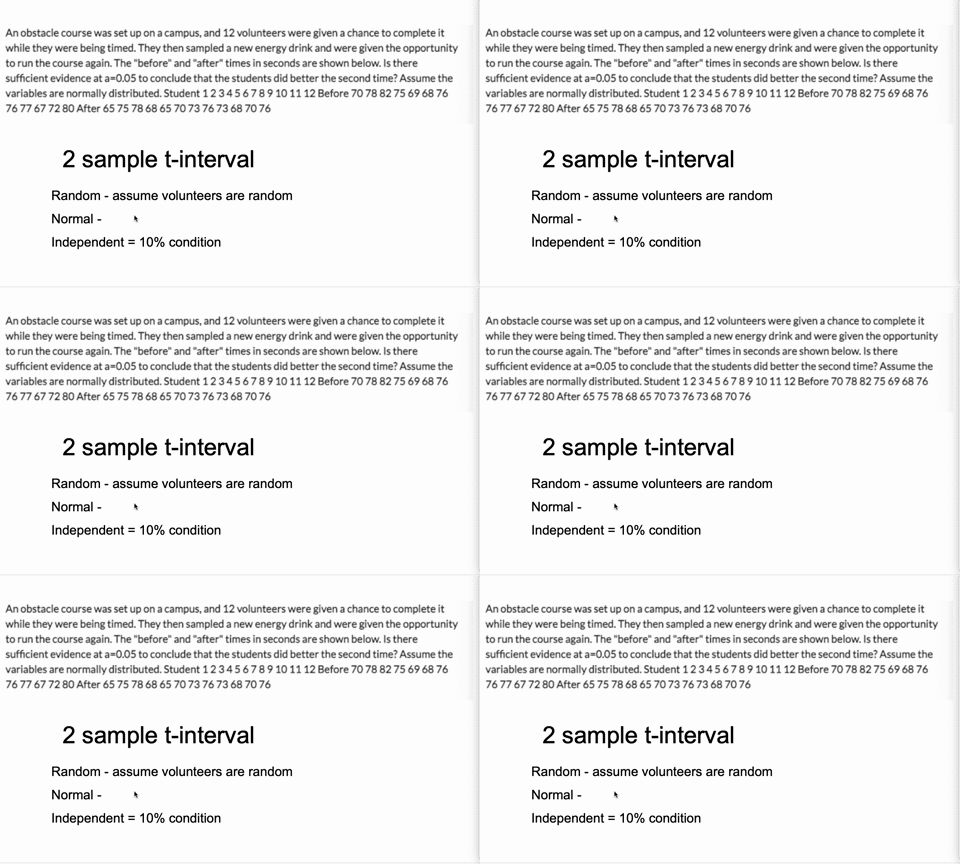
An obstacle course was set up on a campus,
and 12 volunteers were given a chance to complete it
while they were being timed. They then sampled a new energy drink
and were given the opportunity to run the course again. The
"before" and "after" times in seconds are shown below. Is there
sufficient evidence at a=0.05 to conclude that the
students did better the second time? Assume the variables are
normally distributed.
Student
1
2
3
4
5
6
7
8
9
10
11
12
Before
70
78
82
75
69
68
76
76
77
67
72
80
After
65
75
78
68
65
70
73
76
73
68
70
76

Nicholas Salas
02:06
Algebra

3. A chemical degrades over time, and the amount of chemical
present in a sample is an exponential function. The half-life of
the chemical is 6 years. Answer each of the questions below.
Provide an exact answer or a numerical value rounded to 2 decimal
places.
a. Find the yearly decay rate for the chemical.
b. How long will it take until the amount of the chemical in a
package is reduced to 20% of its original amount? Length of time
(years):
c. A package is found that has 5g of the chemical. If the
package is 8 years old how much of the chemical was in the package
at the initial time?

Nicholas Salas
02:10
Intro Stats / AP Statistics

A nationwide test taken by high school sophomores and juniors
has three sections, each scored on a scale of 20 to 80 . In a
recent year, the national mean score for the writing section was
47.5, with a standard deviation of 10.0. Based on this information,
complete the following statements about the distribution of the
scores on the writing section for the recent year.
a) According to Chebyshev's theorem, at least 36% of the scores
lie between (blank) and (blank)
b) According to Chebyshev's theorem, at least ( blank %) of the
scores lie between 27.5 and 67.5 .

Nicholas Salas
03:09
Geometry

Given this data set: 22, 29, 33, 34, 35, 36, 39, 45, 47, 48, 49, 50, 56.
1. Make a stemplot of the data.
2. Find the minimum, maximum, q1, q2, median, and mean.
3. Explain if the data is normal, left-skewed, or right-skewed.

Nicholas Salas
02:14
Prealgebra

Let P(x) = 9x^4 - 7x^3 + 4x - 12. Use the Remainder Theorem and synthetic division to evaluate P(2) and verify your result by evaluating P(2) directly.

Nicholas Salas
02:18
Algebra

Express the product of (4/3x+1) and (1/5x+3/2) as a
trinomial simplest form.

Nicholas Salas
1 2 3 4 5 ... 48