Nick Roster

Numerade Educator
Professor

Biography

I am passionate about learning, and my specialties are Anatomy & Physiology, General Biology, and Genetics. Learning should be fun, be hard, and we should make a lot of mistakes along the way.

Education

Nick has not yet added their education credentials.

Educator Statistics

Numerade tutor for 5 years
20 Students Helped

Topics Covered

Mendelian Genetics: Understanding Inheritance Patterns
The Central Dogma: Understanding Gene Expression

Nick's Textbook Answer Videos

09:52
Biology: The Dynamic Science

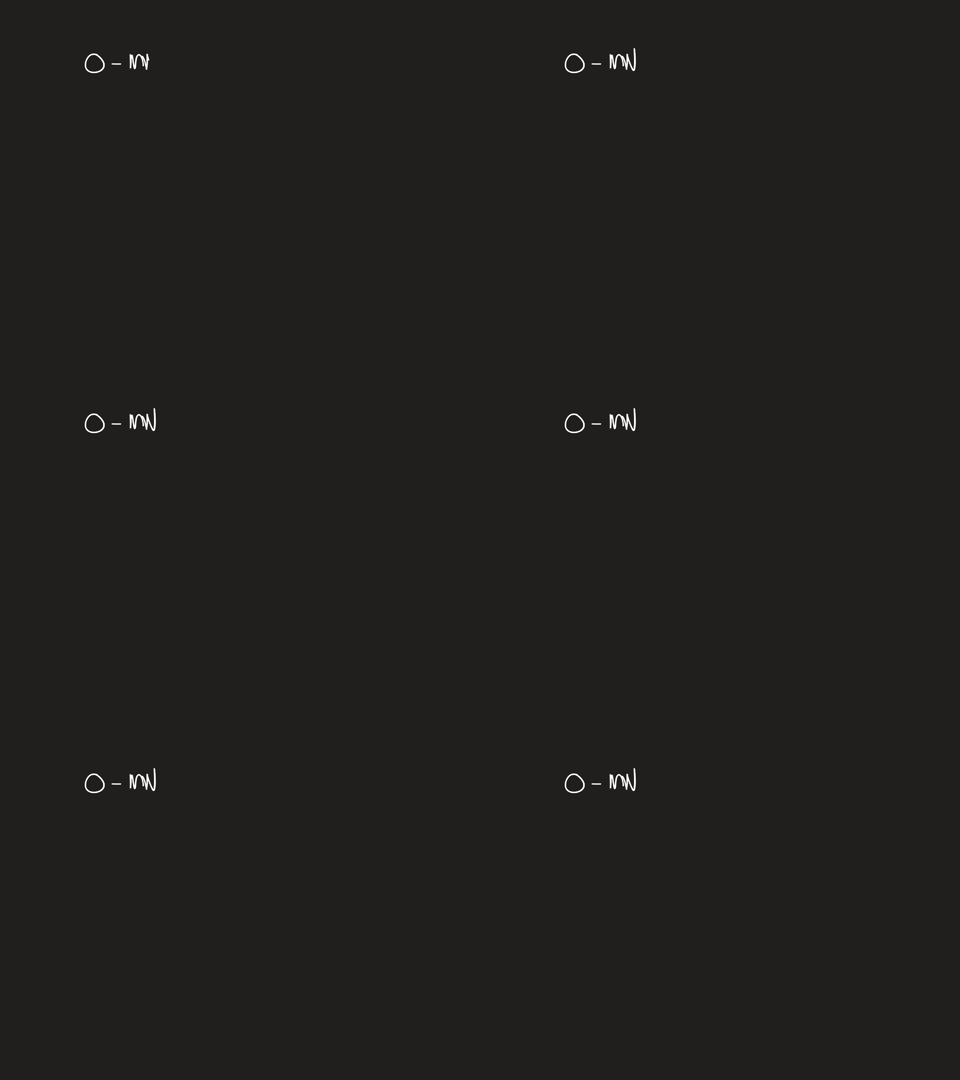
A mix-up in a hospital ward caused a mother with $\mathrm{O}$ and $\mathrm{MN}$ blood types to think that a baby given to her really belonged to someone else. Tests in the hospital showed that the doubting mother was able to taste PTC (see problem 9). The baby given to her had O and MN blood types and had no reaction when the bitter PTC chemical was placed on its tongue. The mother had four other children with the following blood types and tasting abilities for PTC:
1. type $A$ and $M N$ blood, taster
2. type $B$ and $N$ blood, nontaster
3. type A and M blood, taster
4. type $A$ and $N$ blood, taster
Without knowing the father's blood types and tasting ability, can you determine whether the child is really hers? (Assume that all her children have the same father.)

Chapter 12: Mendel, Genes, and Inheritance
Nick Roster
1

Nick's Quick Ask Videos

0:00
Biology

Applications of DNA biotechnology vary depending on the goals of firms, pharmaceutical companies, and forensic scientists. In forensic DNA analysis, a very common tool is the polymerase chain reaction (PCR) used to make billions of copies of selected pieces of DNA. It involves two major steps: (1) synthesizing short pieces of DNA, called primers, that identify the DNA segment to be copied, and (2) running repetitive reactions to make multiple copies of the DNA. To start with, forensic scientists collect DNA samples such as blood from a crime scene. The target DNA is then mixed with primers, free nucleotides, and an enzyme called DNA polymerase in a small test tube. The mixture is then cycled through a series of temperature changes, doubling the amount of DNA with every cycle. Following PCR, the now amplified DNA sample is subjected to restriction enzymes, enzymes that cut DNA at specific locations. The mixture of DNA fragments is then separated by a technique called gel electrophoresis, where DNA fragments are separated by size, forming distinct bands on the gel. By the end of the process, a DNA profile is established and suspects can be identified.

Nick Roster
03:39
Biology

5. What happens when cortisol is released into the bloodstream? Choose the correct option.
A. It alters the physiology of the body and brain.
B. It stimulates the release of the hormone corticotropin.
C. It regulates blood volume and salt concentration.
D. It mobilizes energy systems and suppresses the immune system.

6. Where are the cell bodies of preganglionic neurons, which drive the postganglionic neurons of the ANS, located? Choose the correct option.
A. Autonomic ganglia
B. Outside of the central nervous system
C. Brainstem and spinal cord
D. Middle portion of the spinal cord

7. Which neurons monitor the chemical status of the stomach and intestinal contents? Choose the correct option.
A. Neurosecretory neurons
B. Postganglionic neurons
C. Enteric sensory neurons
D. Raphe neurons

8. Why does the drug atropine cause pupil dilation? Choose the correct option.
A. Mimics activation of the parasympathetic division
B. Interferes with the chemical synaptic transmission
C. Balance of ANS activity shifts toward the sympathetic division
D. Inhibits firing of raphe neurons

Nick Roster
01:25
Biology

Nick Roster
01:13
Biology

Which of the following is NOT a specialized chewing adaptation found in genus Paranthropus (robust australopiths)?
Large zygomatic arches
Sagittal crest
Large molars
Smaller molars and canines
The sagittal crest is:
The dry river bed where remains of Homo habilis and Australopithecus africanus were found
Where temporalis muscles attach
A term for the pointy part of molars
A term for a baby's soft spot

Nick Roster
04:22
Biology

5) The type of reaction required for energy to be produced from a kcal is called: a) Destruction c) Catabolism b) Anabolism d) Construction 6) Absorption of nutrients results in a 50/50 split of ATP and.... a) Water c) ADP b) Heat d) Peanut butter 7) Oxygen is used in this cell structure to generate ATP and excretes CO2 as a byproduct. a) Lysosome c) Mitochondria b) Endoplasmic Reticulum d) Cell wall proteins 8) The greater the energy produced by metabolism...(i.e. more calories burned) a) the greater the O2 used. b) the more water consumed. c) the greater CO2 used. d) the more fluid lost. 9) An increase in exercise causes an increase in... a) sweat. c) metabolism. b) more looks at the gym. d) shoe size. 10) Glycogen is stored in these two places in the body. a) Liver and Kidneys c) Hands and feet d) Smooth muscle and liver d) Liver and skeletal muscle

Nick Roster
0:00
Biology

We measure the concentration of glucose, amino acids, and oxygen in the blood as it enters and leaves the small intestine. At the same time, we observe a change in the color of the blood. The results are represented in the table below. Based on the table, answer questions A to D. (5 marks)

Blood entering the small intestine: 022
Blood leaving the small intestine: 052
Glucose Amino acid

A. Compare the concentration of glucose and amino acids in the blood as it enters and leaves the small intestine. What can you conclude? (2)
B. Name the process responsible for the difference in the concentration of glucose and amino acids in the blood entering and leaving the small intestine. (1)
C. Explain how the structure of the small intestine helps in the process shown above. (1)
D. Explain the role of lymphatic vessels in the small intestine. (1)

Nick Roster
1 2 3 4