I've been teaching physics to both high school and college students for almost a decade. I work hard to find the cleanest and clearest ways to support and coach students into understanding complex concepts.
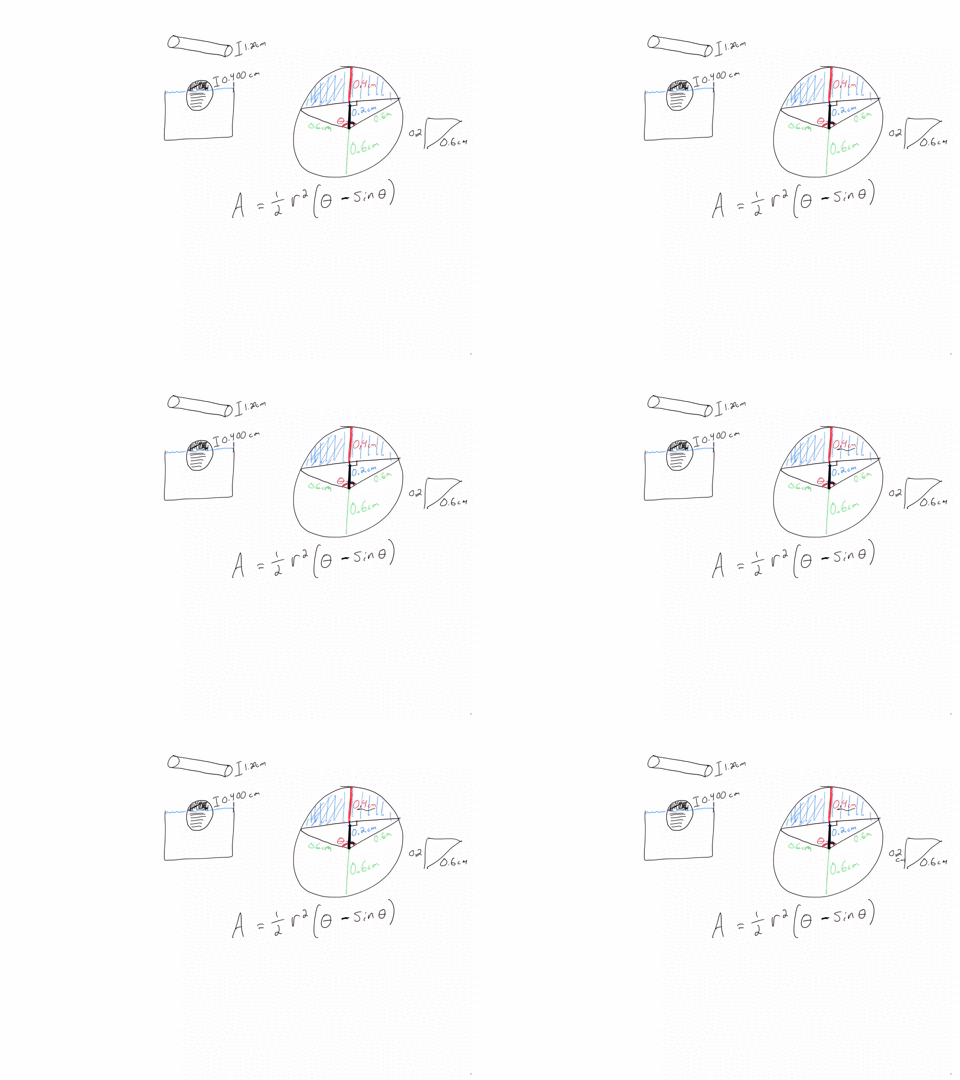
A wooden dowel has a diameter of $1.20 \mathrm{cm} .$ It floats in water with 0.400 $\mathrm{cm}$ of its diameter above water (Fig. Pl4.58). Determine the density of the dowel.
A cube of ice whose edges measure 20.0 $\mathrm{mm}$ is floating in a glass of ice-cold water with one of its faces parallel to the water's surface. (a) How far below the water surface is the bottom face of the block? (b) Ice-cold ethyl alcohol is gently poured onto the water surface to form a layer 5.00 $\mathrm{mm}$ thick above the water. The alcohol does not mix with the water. When the ice cube again attains hydrostatic equilibrium, what will be the distance from the top of the water to the bottom face of the block? (c) Additional cold ethyl alcohol is poured onto the water's surface until the top surface of the alcohol coincides with the top surface of the ice cube (in hydrostatic equilibrium). How thick is the required layer of ethyl alcohol?
An underwater scuba diver sees the Sun at an apparentangle of 45.0° above the horizontal. What is the actual ele-vation angle of the Sun above the horizontal?
A room contains air in which the speed of sound is 343 $\mathrm{m} / \mathrm{s}$ . The walls of the room are made of concrete, in which the speed of sound is 1850 $\mathrm{m} / \mathrm{s}$ . (a) Find the critical angle for total internal reflection of sound at the concrete-air boundary. (b) In which medium must the sound be traveling in order to undergo total internal reflection? (c) "A bare concrete wall is a highly efficient mirror for sound." Give evidence for or against this statement.
A light ray enters the atmosphere of a planet where it descends vertically to the surface a distance $h$ below. The index of refraction where the light enters the atmosphere is $1.000,$ and it increases linearly to the surface where it has the value $n$ . (a) How long does it take the ray to traverse this path? (b) Compare this to the time interval required in the absence of an atmosphere.
A desperate hiker has to think fast to help his friend who has fallen below him. Quickly, he ties a rope to a rock of mass m1 and makes his way over the ledge (see the figure). If the coefficient of maximum static friction between the rock and the ground is μ, and the mass of the hiker is m2, what is the maximum mass of the friend, m3, that the rock can hold so the hikers can then make their way up over the ledge? Assume the rope is parallel to the ground and the point where the rope passes over the ledge is frictionless.
lock A, with mass ma, is initially at rest on a smooth horizontal floor. Block B, with mass mg, is initially at rest on the horizontal top surface of A. The coefficient of static friction between the two blocks is u. Block A is pulled with a horizontal force. It will begin to slide out from under B if the force is greater than
A golf ball has a mass of 46 g. Just after being struck by adriver, a typical ball speed for a good golfer is 61 m/s.(a) Find a slow-motion video of a golf ball being hit onYoutube and watch it.(b) What is the momentum of the ball just afterimpact?(c) The collision between the club and the ball lasts 0.5ms (0.0005 s). What is the average force exerted by the club headon the ball?(d) The club head of a driver has a mass of 200 g. If theclub speed is 42 m/s just before impact, what is the club speedjust after impact, due to the reaction force exerted by the ball onthe club?
A 30.0 kg body is moving in the direction of the positive x axiswith a speed of 268 m/s when, owing to an internal explosion, itbreaks into three pieces. One part, whose mass is 8.50 kg, movesaway from the point of explosion with a speed of 479. m/s along thepositive y axis. A second fragment, whose mass is 4.00 kg, movesaway from the point of explosion with a speed of 438. m/s along thenegative x axis.a) What is the speed of the third fragment? Ignore effects dueto gravity.b) How much energy was released in the explosion?
Two masses are hung vertically around a pulley that can beneglected. When released from rest, mass 1 falls inside aliquid that always produces a force on this mass that is 5 N in theupward direction. Mass 2, on the other hand, is pulled upwithout air resistance. When mass 2 is 5 kg, the massesaccelerated at a rate of 3 m/s/s.What is the mass of m1?What is the speed of the masses when mass 1 has fallen 4 meters. Sign not required.
A coin is placed on a horizontal disk at a distance r from the center of the disk. The rotational velocity of the disk can be controlled.The coefficient of static friction between the coin and the surface of the disk is 2.00.The coin is placed at a distance r = 50 cm from the center of the disk.The disk is slowly rotated to higher and higher rotational velocities.How fast is the coin moving in m/s when it slips off the disk?