Stark Ledbetter

Princeton University
Professor

Biography

I have taught high school (certified K-12 educator), test prep, community college, and university level courses. I am passionate about education. My YouTube channel, with many videos I made during the pandemic: https://youtube.com/channel/UCESEJMP1XbubLjfR5seXgwQ

Education

BA Mathematics
Princeton University
Phd Mathematics
University of Washington

Educator Statistics

Numerade tutor for 5 years
473 Students Helped

Topics Covered

Exploring the World of Derivatives: A Comprehensive Guide
Stand Out with Differentiation Strategies | Boost Your Business
Breaking Limits: Unlock Your Potential with Our Expert Solutions
Integration
Taylor Series
Exploring Probability Topics: From Basics to Advanced Strategies
Mastering Partial Derivatives: Essential Techniques and Tips
Mastering Integrals: Tips and Tricks for Calculus Success
Discover the Best Series to Binge-Watch | Your Ultimate Guide
Unlock the Power of Sequences: Boost Your Productivity
Unlock the Power of Vectors: Discover Their Limitless Possibilities
Unlocking the Power of Functions: Boost Your Programming Skills
Explore the Power of Continuous Functions: Boost Your Mathematical Skills
Mastering Multiple Integrals: Techniques and Tips

Stark's Textbook Answer Videos

01:06
Calculus: Early Transcendentals

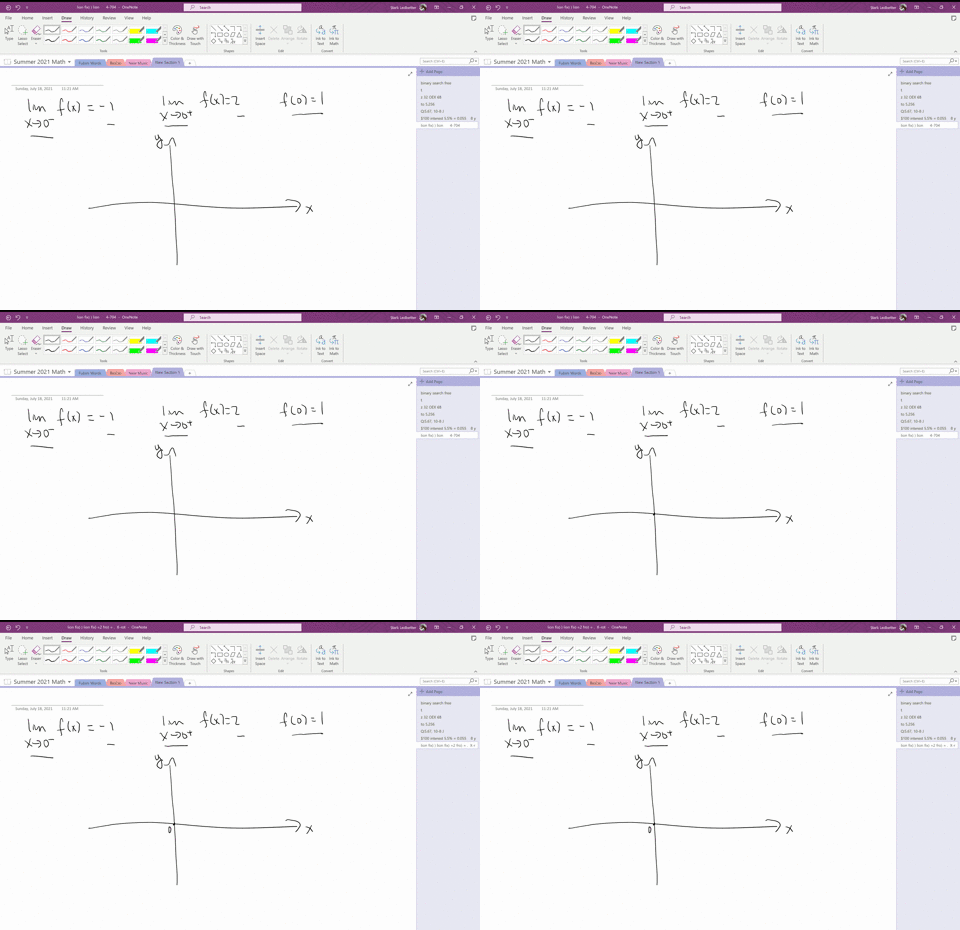
Sketch the graph of an example of a function $ f $ that satisfies all of the given conditions.

$ \displaystyle \lim_{x \to 0^-}f(x) = -1 $, $ \displaystyle \lim_{x \to 0^+}f(x) = 2 $, $ f(0) = 1 $

Chapter 2: Limits and Derivatives
Section 2: The Limit of a Function
Stark Ledbetter
03:43
Calculus: Early Transcendentals

(a) What is wrong with the following equation?
$$ \frac {x^2 + x - 6}{x - 2} = x + 3 $$

(b) In view of part (a), explain why the equation
$$ \lim_{x \to 2}\frac {x^2 + x - 6}{x - 2} = \lim_{x \to 2}(x + 3) $$
is correct.

Chapter 2: Limits and Derivatives
Section 3: Calculating Limits Using the Limit Laws
Stark Ledbetter
02:44
Calculus: Early Transcendentals

Use the definition of continuity and the properties of limits to show that the function is continuous at the given number $ a $.

$ f(x) = (x + 2x^3)^4, \hspace{5mm} a = -1 $

Chapter 2: Limits and Derivatives
Section 5: Continuity
Stark Ledbetter
02:18
Calculus: Early Transcendentals

Suppose $ f $ is continuous on $ [1, 5] $ and the only solutions of the equation $ f(x) = 6 $ are $ x = 1 $ and $ x = 4 $. If $ f(2) = 8$, explain why $ f(3) > 6 $.

Chapter 2: Limits and Derivatives
Section 5: Continuity
Stark Ledbetter
01:48
Calculus: Early Transcendentals

Use the Intermediate Value Theorem to show that there is a root of the given equation in the specified interval.

$ x^4 + x - 3 = 0 $, $ (1, 2) $

Chapter 2: Limits and Derivatives
Section 5: Continuity
Stark Ledbetter
02:34
Calculus: Early Transcendentals

Use the Intermediate Value Theorem to show that there is a root of the given equation in the specified interval.

$ \ln x = x - \sqrt{x} $, $ (2, 3) $

Chapter 2: Limits and Derivatives
Section 5: Continuity
Stark Ledbetter
1 2 3 4 5 ... 60

Stark's Quick Ask Videos

03:12
Calculus 2 / BC

Form a binary search tree for the words mathematics, physics, geography, zoology, meteorology, geology, psychology and chemistry (using alphabetical order).
Stark Ledbetter
01:06
Calculus 1 / AB

Sketch the graph of an example of a function $ f $ that satisfies all of the given conditions.

$ \displaystyle \lim_{x \to 0^-}f(x) = -1 $, $ \displaystyle \lim_{x \to 0^+}f(x) = 2 $, $ f(0) = 1 $

Stark Ledbetter
03:43
Calculus 1 / AB

(a) What is wrong with the following equation?
$$ \frac {x^2 + x - 6}{x - 2} = x + 3 $$

(b) In view of part (a), explain why the equation
$$ \lim_{x \to 2}\frac {x^2 + x - 6}{x - 2} = \lim_{x \to 2}(x + 3) $$
is correct.

Stark Ledbetter
02:44
Calculus 1 / AB

Use the definition of continuity and the properties of limits to show that the function is continuous at the given number $ a $.

$ f(x) = (x + 2x^3)^4, \hspace{5mm} a = -1 $

Stark Ledbetter
02:18
Calculus 1 / AB

Suppose $ f $ is continuous on $ [1, 5] $ and the only solutions of the equation $ f(x) = 6 $ are $ x = 1 $ and $ x = 4 $. If $ f(2) = 8$, explain why $ f(3) > 6 $.

Stark Ledbetter
01:48
Calculus 1 / AB

Use the Intermediate Value Theorem to show that there is a root of the given equation in the specified interval.

$ x^4 + x - 3 = 0 $, $ (1, 2) $

Stark Ledbetter
1 2 3 4 5 ... 19