Steven Brown

George Mason University
Graduate Teaching Assistant

Biography

Currently, a Technical Project Manager with the Defense Threat Reduction Agency. I work in Research and Development and work on a broad range of science projects. I have a strong passion for science outreach and usually take on tasks that require me to communicate difficult topics to non-technical audiences.

Prior to working at DTRA, I pursued by my PhD in Physics from George Mason. I taught as a Graduate Teaching assistant for 5 years. In my last two years, I was tasks with creating a new curriculum for students pursuing medical school. This was challenging but VERY rewarding.

I my current role, I find that I miss being able to teach and am looking for other outlets that will allow me to do that again.

Education

Phd Physics
George Mason University

Educator Statistics

Numerade tutor for 5 years
11 Students Helped

Topics Covered

Master the Fundamentals of Physics: Learn Physics Basics
Motion in 2d or 3d
Calculating Electrical Power: Resistance and EMF
Discovering the Fundamentals: Newton's Laws of Motion Explained
Understanding Moment Impulse and Collisions for Better Physics
Mastering the Rotation of Rigid Bodies: Tips & Techniques

Steven's Textbook Answer Videos

15:18
Physics: Principles with Applications

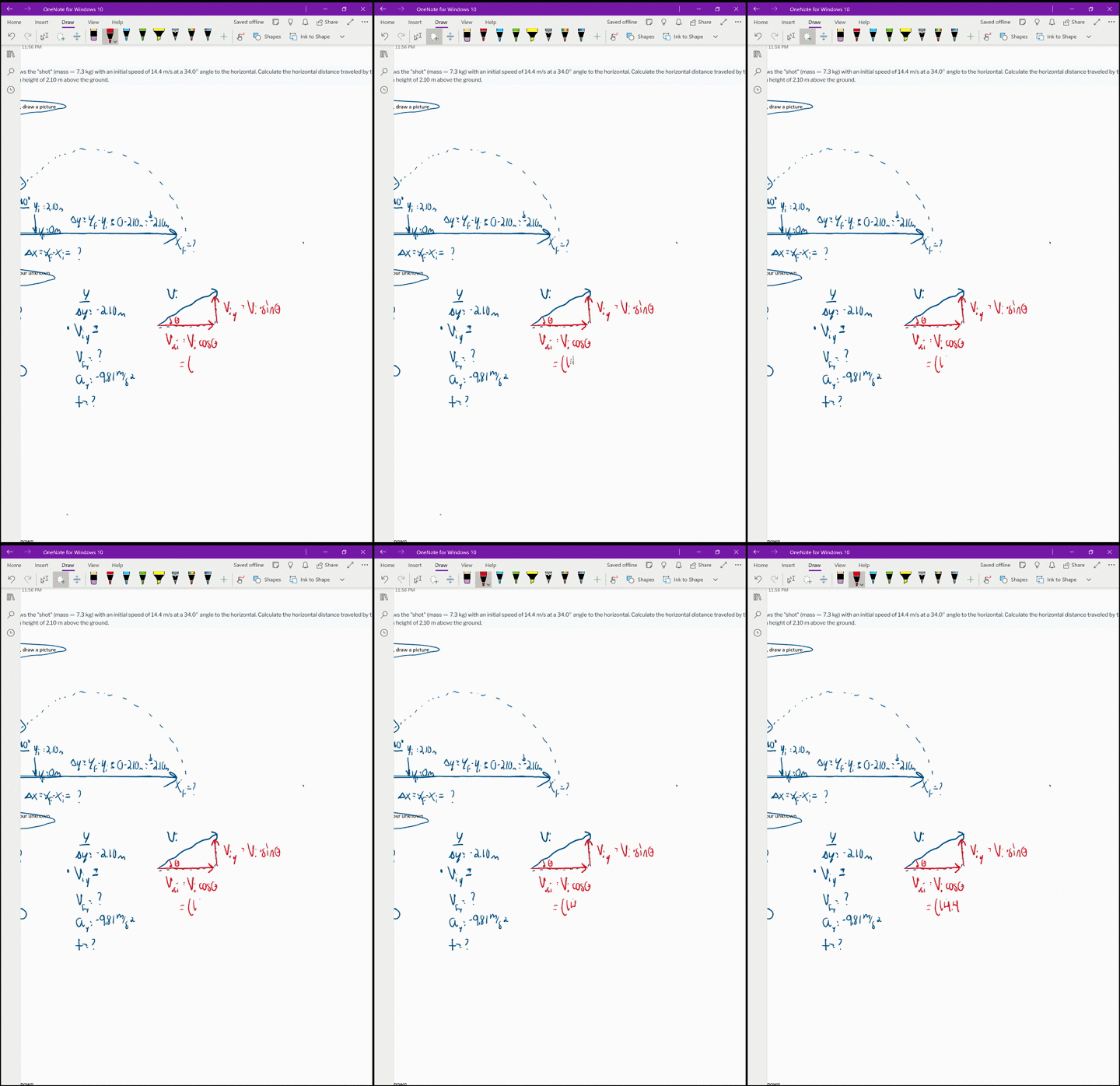
(II) A shot-putter throws the "shot" (mass $=$ 7.3 kg) with an initial speed of 14.4 m/s at a 34.0$^\circ$ angle to the horizontal. Calculate the horizontal distance traveled by the shot if it leaves the athlete's hand at a height of 2.10 m above the ground.

Chapter 3: KINEMATICS IN TWO DIMENSIONS; VECTORS
Section 5: Projectile Motion
Steven Brown
04:07
Inquiry into Physics

Materials can be classified into four categories based on the ease with which charges can flow through them. Give the names of these categories and describe each one.

Chapter 7: Electricity
Steven Brown
0:00
Inquiry into Physics

If a new material is found that is a superconductor at all temperatures, what parts of some common electric devices would definitely not be made out of it? Explain.

Chapter 7: Electricity
Steven Brown
03:02
Inquiry into Physics

A power supply is connected to two bare wires that are inserted into a glass of saltwater. The resistance of the water decreases as the voltage is increased. Sketch a graph of the voltage versus the current in the water showing this type of behavior.

Chapter 7: Electricity
Steven Brown
04:53
Inquiry into Physics

Rank the force on each of the point charges $q_{1}$ and $q_{2}$ in the following pairings from most attractive to most repulsive. The separation, $d$, between each pair is given. Explain the reasoning you used to arrive at your rankings.
$$\begin{aligned}
&\text { Pair } 1: q_{1}=+2 \mu \mathrm{C} ; q_{2}=-4 \mu \mathrm{C} ; \text { and } d=10 \mathrm{cm}\\
&\text { Pair } 2: q_{1}=+2 \mu \mathrm{C} ; q_{2}=-2 \mu \mathrm{C} ; \text { and } d=5 \mathrm{cm}\\
&\text { Pair } 3: q_{1}=+3 \mu \mathrm{C} ; q_{2}=+3 \mu \mathrm{C} ; \text { and } d=10 \mathrm{cm}\\
&\text { Pair } 4: q_{1}=-5 \mu \mathrm{C} ; q_{2}=-2 \mu \mathrm{C} ; \text { and } d=20 \mathrm{cm}
\end{aligned}$$

Chapter 7: Electricity
Steven Brown
17:29
College Physics

Two pieces of aluminum and copper wire are identical in length and diameter. At some temperature, one of the wires will have the same resistance that the other has at $20^{\circ} \mathrm{C}$. (a) What is that temperature? (Hint: There may be more than one temperature.) (b) If the two wires are connected in series, compute the ratio of the total resistance initially to the total resistance at the temperatures in part (a). (c) Repeat part (b) if the wires were instead connected in parallel.

Chapter 17: Electric Current and Resistance
Steven Brown
1 2