Thomas Wells

University of Wisconsin - Milwaukee

Biography

Thomas has not yet added a biography.

Education

BS Microbiology
University of Wisconsin - Milwaukee

Educator Statistics

Numerade tutor for 7 years
53 Students Helped

Topics Covered

Atoms, Molecules, and Ions: Understanding the Building Blocks of Matter
Unlocking the Power of Composition: Tips and Techniques
Understanding Electronic Structure: A Comprehensive Guide
Polar Coordinates: Understanding the Basics and Applications
Discovering Conic Sections: An Introduction
Understanding Chemical Bonding: The Key to Molecular Structure

Thomas's Textbook Answer Videos

13:00
Chemistry: Structure and Properties

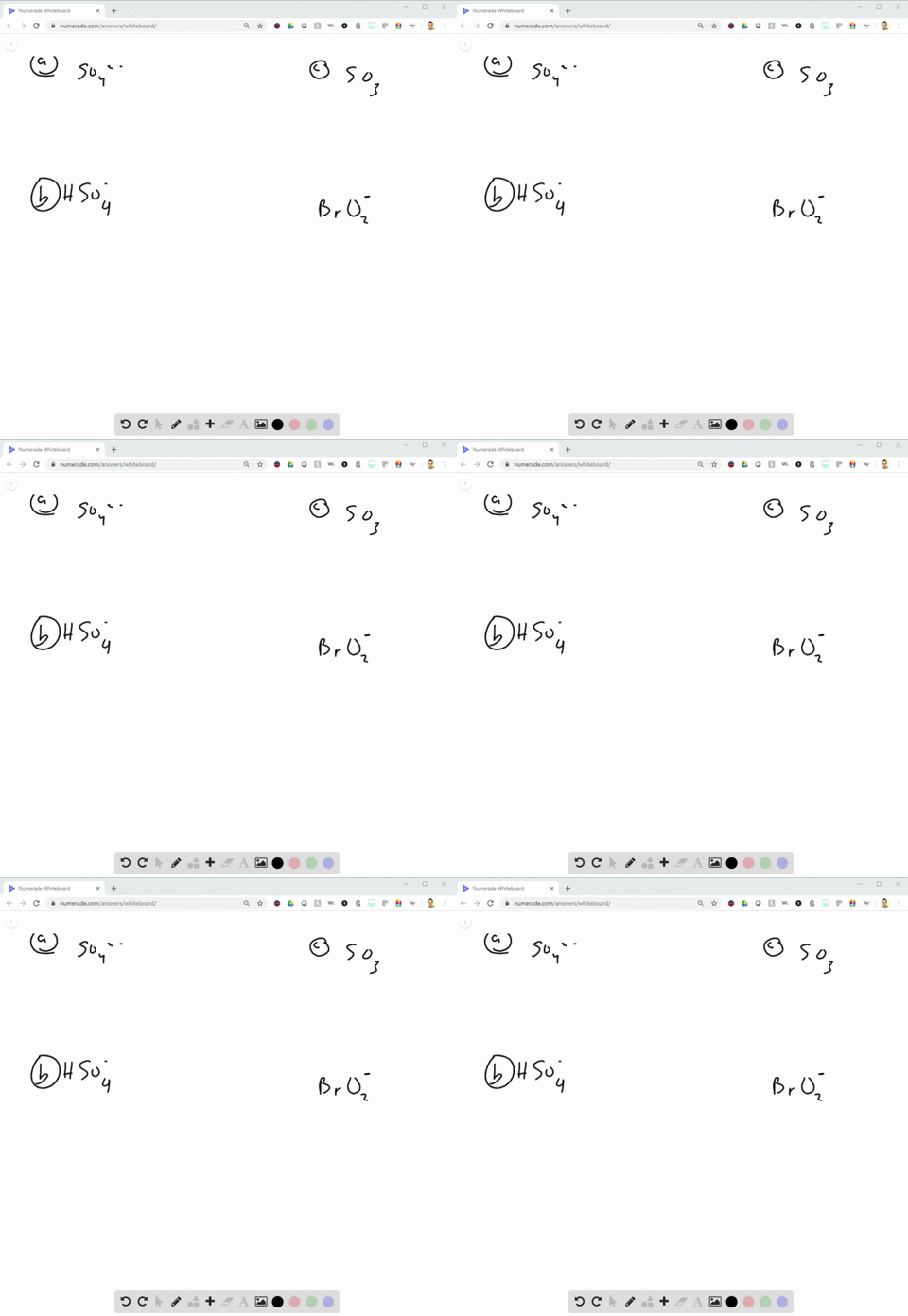
Write Lewis structures for each molecule or ion. Include resonance structures if necessary and assign formal charges to all atoms. If you need to, expand the octet on the central atom to lower formal charge.
a. SO4 2-
b. HSO4 -
c. SO3
d. BrO2 -

Chapter 5: Chemical Bonding I
Thomas Wells
03:45
Chemistry: Structure and Properties

Use Lewis structures to explain why Br3- and I3- are stable, while F3- is not.

Chapter 5: Chemical Bonding I
Thomas Wells
03:19
Chemistry: Structure and Properties

Free radicals are important in many environmentally significant reactions. For example, photochemical smog-smog that results from the action of sunlight on air pollutants-forms in part by these two steps:

The product of this reaction, ozone, is a pollutant in the lower atmosphere. (Upper atmospheric ozone is a natural part of the atmosphere that protects life on Earth from ultraviolet light.) Ozone is an eye and lung irritant and also accelerates the weathering of rubber products. Rewrite the above reactions using the Lewis structure of each reactant and product. Identify the free radicals.

Chapter 5: Chemical Bonding I
Thomas Wells
02:24
Chemistry: Structure and Properties

In the very first chapter of this book, we described the scientific approach and put a special emphasis on scientific models or theories. In this chapter, we looked carefully at the Lewis model of chemical bonding. Why is this theory successful? What are some of the limitations of the theory?

Chapter 5: Chemical Bonding I
Thomas Wells
04:54
Chemistry: Structure and Properties

Draft a list of step-by-step instructions for writing the correct Lewis structure for any molecule or polyatomic ion.

Chapter 5: Chemical Bonding I
Thomas Wells
01:25
Chemistry: Structure and Properties

Determine the empirical formula for the compound represented by each molecular formula.
a. N2O4
b. C5H12
c. C4H10

Chapter 4: Molecules and Compounds
Thomas Wells
1 2 3 4 5 ... 9