Question 3 Accounting for Inventory: Perpetual LIFO
1. The Ambiguous Dance Company is a retailer selling dance goods. The following transactions
affected its merchandise inventory during the month of March, 2011:
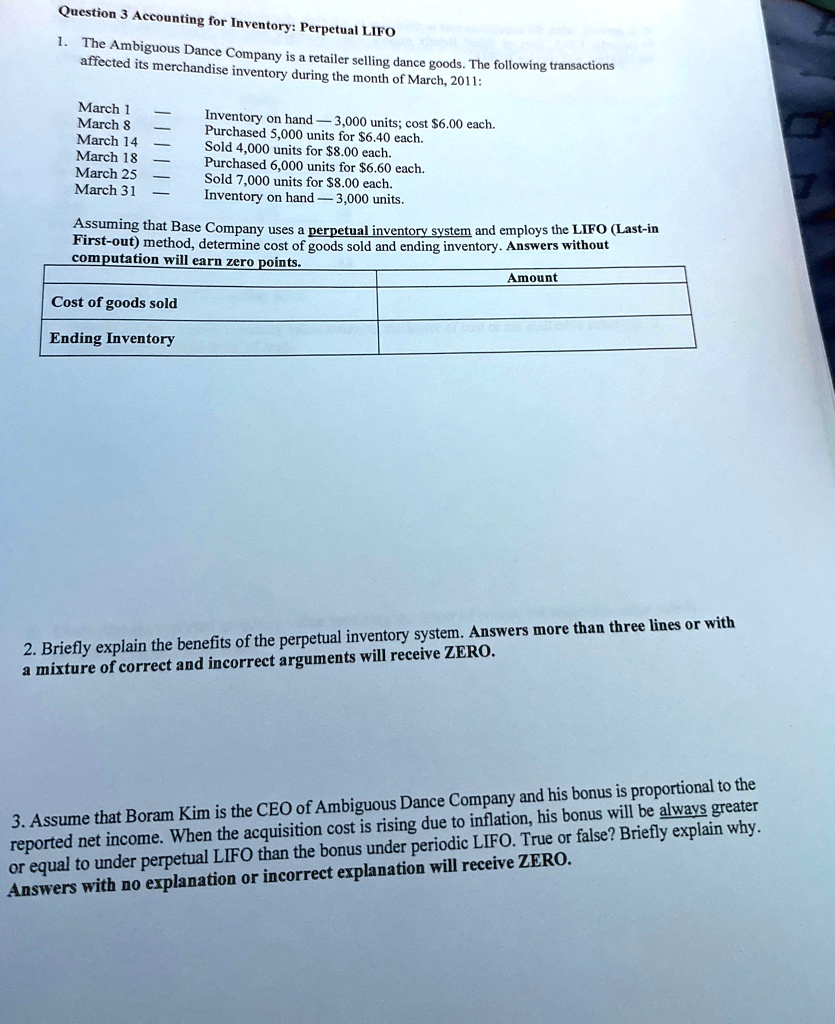
March 1 Inventory on hand — 3,000 units; cost $6.00 each.
March 8 Purchased 5,000 units for $6.40 each.
March 14 Sold 4,000 units for $8.00 each.
March 18 Purchased 6,000 units for $6.60 each.
March 25 Sold 7,000 units for $8.00 each.
March 31 Inventory on hand — 3,000 units.
Assuming that Base Company uses a perpetual inventory system and employs the LIFO (Last-in
First-out) method, determine cost of goods sold and ending inventory. Answers without
computation will earn zero points.
Cost of goods sold Amount
Ending Inventory
2. Briefly explain the benefits of the perpetual inventory system. Answers more than three lines or with
a mixture of correct and incorrect arguments will receive ZERO.
3. Assume that Boram Kim is the CEO of Ambiguous Dance Company and his bonus is proportional to the
reported net income. When the acquisition cost is rising due to inflation, his bonus will be always greater
or equal to under perpetual LIFO than the bonus under periodic LIFO. True or false? Briefly explain why.
Answers with no explanation or incorrect explanation will receive ZERO.