Ace - AI Tutor
Ask Our Educators
Textbooks
My Library
Flashcards
Scribe - AI Notes
Notes & Exams
Download App

Divider

Viewed Questions

Compute $95 \%$ confidence intervals, using both methods on page $317,$ for the proportion of defective items in a process when it is found that a sample of size 100 yields 8 defectives.

Compute $95 \%$ confidence intervals, using both methods on page $317,$ for the proportion of defective items in a process when it is found that a sample of size 100 yields 8 defectives.

Probability and Statistics for Engineers and Scientists

One- and Two-Sample Estimation Problems

Two Samples: Estimating the Difference…

We examine the effect of different inputs on determining the sample size needed to obtain a specific margin of error when finding a confidence interval for a proportion.
Find the sample size needed to give, with $95 \%$ confidence, a margin of error within $\pm 3 \%$ when estimating a proportion. First, find the sample size needed if we have no prior knowledge about the population proportion $p$. Then find the sample size needed if we have reason to believe that $p \approx 0.7$. Finally, find the sample size needed if we assume $p \approx 0.9 .$ Comment on the relationship between the sample size and estimates of $p$.

We examine the effect of different inputs on determining the sample size needed to obtain a specific margin of error when finding a confidence interval for a proportion. Find the sample size needed to give, with $95 \%$ confidence, a margin of error within $\pm 3 \%$ when estimating a proportion. First, find the sample size needed if we have no prior knowledge about the population proportion $p$. Then find the sample size needed if we have reason to believe that $p \approx 0.7$. Finally, find the sample size needed if we assume $p \approx 0.9 .$ Comment on the relationship between the sample size and estimates of $p$.

Statistics Unlocking the Power of Data

Inference for Means and Proportions

Confidence Interval for a Single…

In a certain city the temperature (in $ ^\circ F $) $ t $ hours after 9 am was modeled by the function
$$ T(t) = 50 + 14 \sin \frac{\pi t}{12} $$
Find the average temperature during the period from 9 am to 9 pm.

In a certain city the temperature (in $ ^\circ F $) $ t $ hours after 9 am was modeled by the function $$ T(t) = 50 + 14 \sin \frac{\pi t}{12} $$ Find the average temperature during the period from 9 am to 9 pm.

Calculus: Early Transcendentals

Applications of Integration

Average Value of a Function

Find the average value of the function on the given interval.

$ h(u) = \dfrac{(\ln u)}{u} $ , $ [1, 5] $

Find the average value of the function on the given interval. $ h(u) = \dfrac{(\ln u)}{u} $ , $ [1, 5] $

Calculus: Early Transcendentals

Applications of Integration

Average Value of a Function

Questions asked

INSTANT ANSWER

Linkage and Mapping Homework Biology 210 1. Two loci found in mice are suspected to be linked. To test this alternative hypothesis, a group of graduate students performed a test cross between mice that are true breeding for both dominant phenotypes and mice that are true breeding for both recessive phenotypes. Individuals from the \( \mathrm{F}_{1} \) generation were crossed with individuals that express both recessive phenotypes. The phenotypic results are shown in the table below. Use chi-square analysis to determine if the graduate students' hypothesis is supported by the evidence. \begin{tabular}{lc} Phenotype & Number of Offspring \\ Dominant 1, Dominant 2 & 182 \\ Recessive 1, Recessive 2 & 168 \\ Dominant 1, Recessive 2 & 156 \\ Recessive 1, Dominant 2 & 144 \end{tabular} a. (1 pt) What are the degrees of freedom and the critical chisquare value? b. (1 pt) What is the calculated chi-square value? c. (1 pt) Do the results support that the loci are linked or that they are independently assorted (unlinked)? 2. Two linked loci have a recombination frequency of \( 19 \% \). A series of crosses is performed. The P generation includes an individual that is homozygous dominant for trait 1 and homozygous recessive for trait 2. The second individual in the cross is homozygous recessive for trait 1 and homozygous dominant for trait 2. The \( \mathrm{F}_{1} \) generation is crossed with

View Answer
divider
INSTANT ANSWER

It is thought that 12% of all students taking a particular course received a grade of A. In a sample of 155 students, it is found that 21 made an A. What is the test statistic(z value) for testing whether the true proportion is 12%?

View Answer
divider
INSTANT ANSWER

incredole Pater \( = \) ineltrin?

View Answer
divider
INSTANT ANSWER

There are no equations given, I need to know which equations to use to solve this big problem. All the information to use for the problem is given in the file i submitted in the first attempt at asking this quest

View Answer
divider
INSTANT ANSWER

There are no equations given, I need to know which equations to use to solve this big problem

View Answer
divider
INSTANT ANSWER

incredole Pater \( = \) ineltrin?

View Answer
divider
INSTANT ANSWER

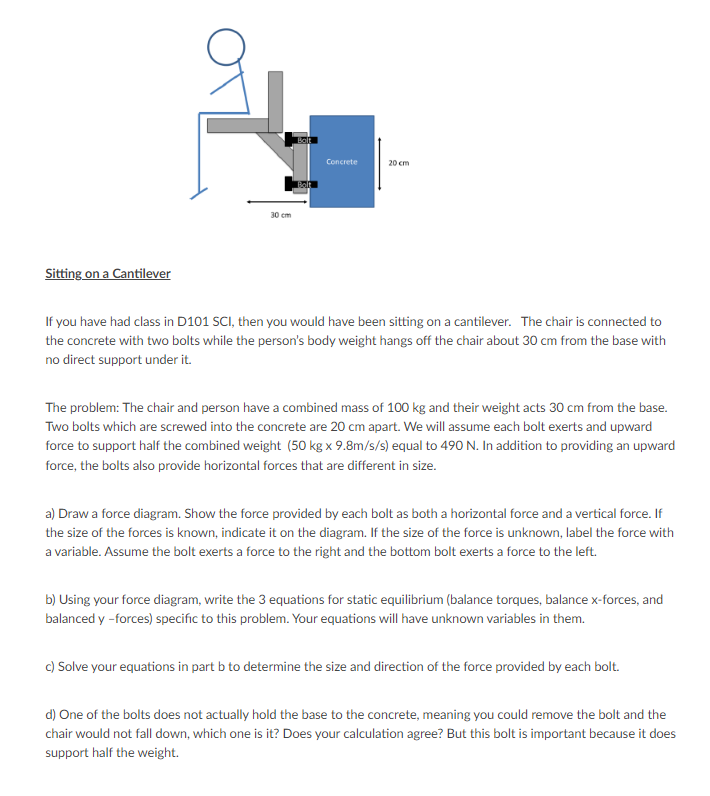
Sitting on a Cantilever If you have had class in D101 SCI, then you would have been sitting on a cantilever. The chair is connected to the concrete with two bolts while the person's body weight hangs off the chair about \( 30 \mathrm{~cm} \) from the base with no direct support under it. The problem: The chair and person have a combined mass of \( 100 \mathrm{~kg} \) and their weight acts \( 30 \mathrm{~cm} \) from the base. Two bolts which are screwed into the concrete are \( 20 \mathrm{~cm} \) apart. We will assume each bolt exerts and upward force to support half the combined weight ( \( 50 \mathrm{~kg} \times 9.8 \mathrm{~m} / \mathrm{s} / \mathrm{s} \) ) equal to \( 490 \mathrm{~N} \). In addition to providing an upward force, the bolts also provide horizontal forces that are different in size. a) Draw a force diagram. Show the force provided by each bolt as both a horizontal force and a vertical force. If the size of the forces is known, indicate it on the diagram. If the size of the force is unknown, label the force with a variable. Assume the bolt exerts a force to the right and the bottom bolt exerts a force to the left. b) Using your force diagram, write the 3 equations for static equilibrium (balance torques, balance \( x \)-forces, and balanced \( y \)-forces) specific to this problem. Your equations will have unknown variables in them. c) Solve your equations in part b to determine the size and direction of the force provided by each bolt. d) One of the bolts does not actually hold the base to the concrete, meaning you could remove the bolt and the chair would not fall down, which one is it? Does your calculation agree? But this bolt is important because it does support half the weight.
View Answer
divider
ANSWERED

Penny Riley verified

Numerade educator

She pushes off the floor with her legs and accelerates upward from rest to gain an upward velocity. Let’s assume she pushes for a 0.10 m distance, the approximate length of her (frog) legs. When her legs no longer touch the floor, she has gained enough upward velocity so that she may travel another 1.2 meters in “free fall” (accelerating downward) to the top of the dresser where she lands approximately at rest. Problem: a.) Draw a force diagram of Tiana while she is pushing off and in contact with the floor. Label each force with a phrase that describes what is exerting the force and what is feeling the force (for example: Jada pushes on the book). b.) Newton’s third law says for every action there is an equal and opposite reaction. Consider the force that is acting on Tiana in the upward direction. What is the reaction force to this one? What is that force exerted on? c.) Assuming Tiana has a mass of 0.050 kg, how large is the force she must exert on the ground to propel her to the top of the dresser? Hint: This problem involves a few sub-problems. In one of the sub-problems, you will need to determine how fast she is going when her legs no longer touch the ground. There is no need to measure time in this video. d.) How many times larger is the force in part c compared to her weight.

View Answer
divider