I need all the questions answered. I somehow got them wrong.
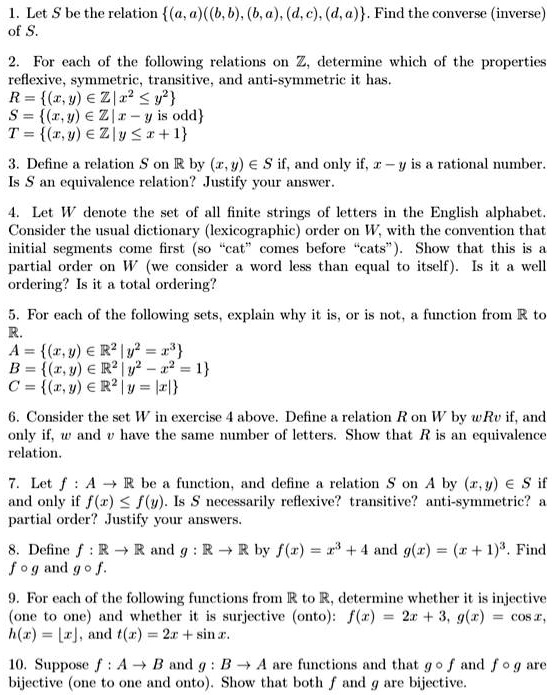
1. Let S be the relation {ab, b, b, adc, da}. Find the converse and inverse of S.
2. For each of the following relations on Z, determine which properties it has: reflexive, symmetric, transitive, and anti-symmetric.
R = {xy ∈ Z | xy}
S = {x, y ∈ Z | x - y is odd}
T = {x, y ∈ Z | yx + 1}
3. Define a relation S on R by S if and only if x is a rational number. Is S an equivalence relation? Justify your answer.
4. Let W denote the set of all finite strings of letters in the English alphabet. Consider the usual dictionary (lexicographic order) on W, with the convention that initial segments come first. For example, "socat" comes before "cats". Show that this is a partial order on W. Also, consider a word less than or equal to itself. Is it a well-ordering? Is it a total ordering?
5. For each of the following sets, explain whether it is a function from R to R or not.
A = {x ∈ R | y = x^3}
B = {xy ∈ R | y - x = 1}
C = {xy ∈ R | y = |x|}
6. Consider the set W in exercise 4 above. Define a relation R on W by wRv if and only if w and v have the same number of letters. Show that R is an equivalence relation.
7. Let f: A → R be a function and define a relation S on A by S if and only if f(x) = f(x). Is S necessarily reflexive, transitive, or anti-symmetric? Is it a partial order? Justify your answers.
8. Define f: R → R and g: R → R by f(x) = x^3 + 4 and g(x) = x + 13. Find fog and gof.
9. For each of the following functions from R to R, determine whether it is injective (one-to-one) and whether it is surjective (onto).
f(x) = 2x + 3
g(x) = cos(x)
h(x) = x
t(x) = 2x + sin(x)
10. Suppose f: A → B and g: B → A are functions and that q o f and f o q are bijective (one-to-one and onto). Show that both f and g are bijective.