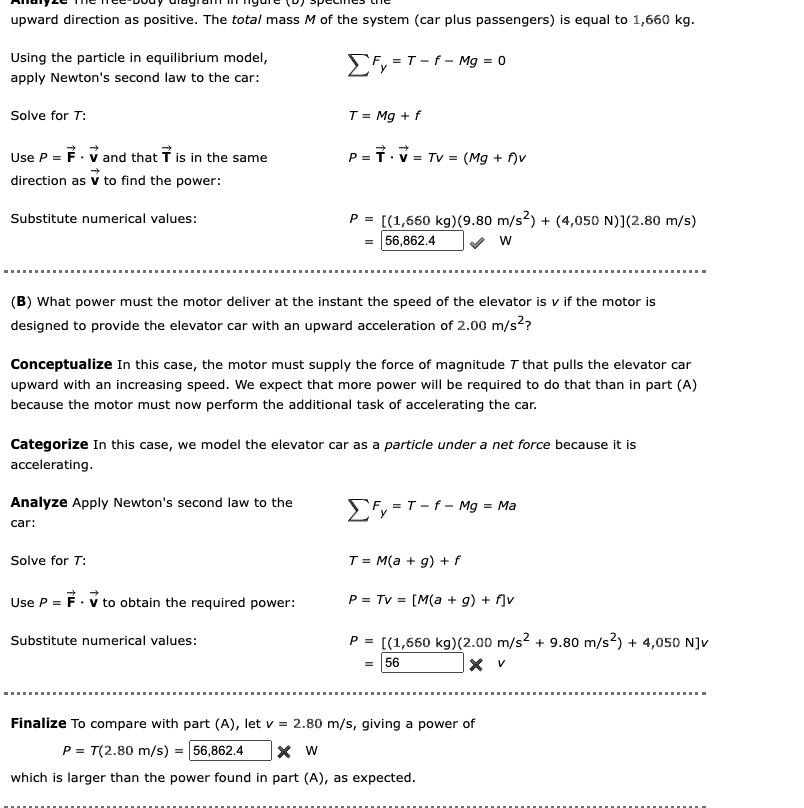
upward direction as positive. The total mass M of the system (car plus passengers) is equal to 1,660kg.
Using the particle in equilibrium model,
apply Newton's second law to the car:
Solve for T :
Use P=vec(F)*vec(v) and that vec(T) is in the same
direction as vec(v) to find the power:
Substitute numerical values:
sum F_(y)=T-f-Mg=0
T=Mg+f
P=vec(T)*vec(v)=TV=(Mg+f)v
P=[(1,660(kg))(9.80(m)/(s^(2)))+(4,050(N))](2.80(m)/(s))
=,W
w
(B) What power must the motor deliver at the instant the speed of the elevator is v if the motor is
designed to provide the elevator car with an upward acceleration of 2.00(m)/(s^(2)) ?
Conceptualize In this case, the motor must supply the force of magnitude T that pulls the elevator car
upward with an increasing speed. We expect that more power will be required to do that than in part (A)
because the motor must now perform the additional task of accelerating the car.
Categorize In this case, we model the elevator car as a particle under a net force because it is
accelerating.
Analyze Apply Newton's second law to the
car:
Solve for T :
Use P=vec(F)*vec(v) to obtain the required power:
Substitute numerical values:
sum F_(y)=T-f-Mg=Ma
T=M(a+g)+f
P=TV=[M(a+g)+f]v
P=[(1,660(kg))(2.00(m)/(s^(2))+9.80(m)/(s^(2)))+4,050(N)]v
=, imes v
Finalize To compare with part (A), let v=2.80(m)/(s), giving a power of
P=T(2.80(m)/(s))=
which is larger than the power found in part (A), as expected.
upward direction as positive. The total mass M of the system (car plus passengers) is equal to 1,660 kg
Using the particle in equilibrium model, apply Newton's second law to the car:
=T -f -Mg =0
Solve for T:
T = Mg + f
Use P = F . V and that T is in the same direction as v to find the power:
P=.=Tv=(Mg+fv
Substitute numerical values:
P = [(1,660 kg)(9.80 m/s2) + (4,050 N)](2.80 m/s) 56,862.4 W
(B) what power must the motor deliver at the instant the speed of the elevator is v if the motor is
designed to provide the elevator car with an upward acceleration of 2.00 m/s2?
Conceptualize In this case, the motor must supply the force of magnitude T that pulls the elevator car upward with an increasing speed. We expect that more power will be required to do that than in part (A) because the motor must now perform the additional task of accelerating the car.
Categorize In this case, we model the elevator car as a particle under a net force because it is accelerating.
Analyze Apply Newton's second law to the car:
Fy=T -f -Mg=Ma
Solve for T:
T = M(a + g) + f
Use P = F . V to obtain the required power:
P=Tv=[Ma+g)+f]v
Substitute numerical values:
P = [(1,660 kg)(2.00 m/s2 + 9.80 m/s2) + 4,050 N]v =56 X v
Finalize To compare with part (A), let v = 2.80 m/s, giving a power of P=T2.80m/s)=56,862.4 Ix w
which is larger than the power found in part (A), as expected.