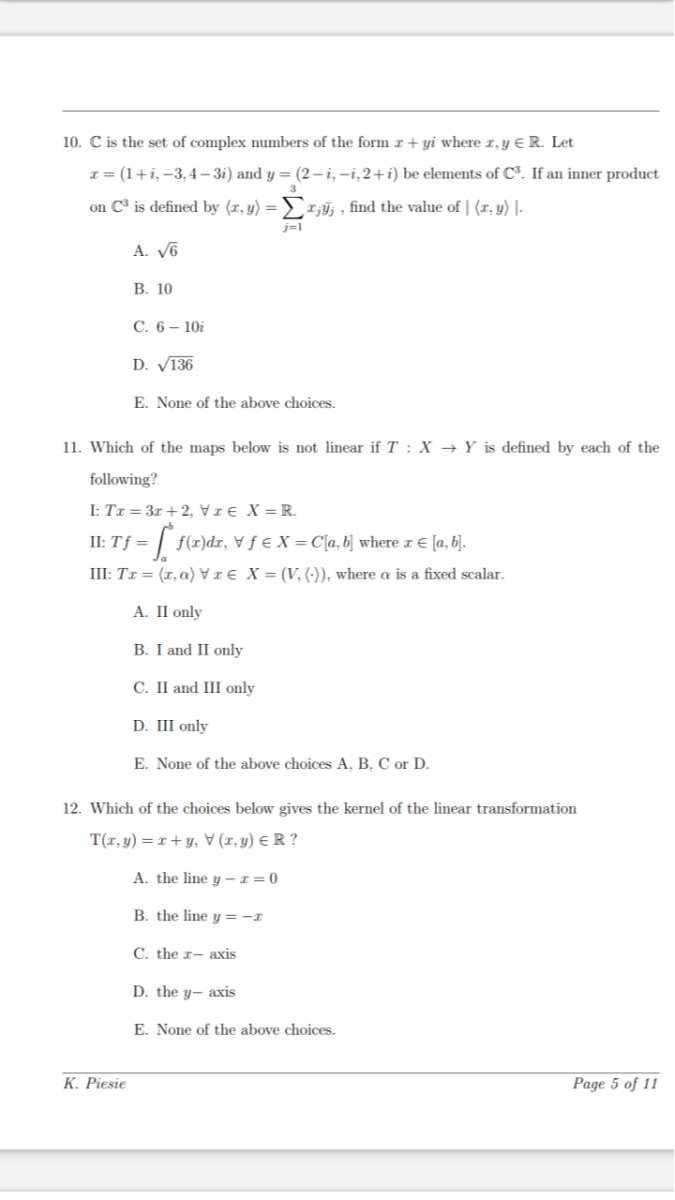
10. \( \mathrm{C} \) is the set of complex numbers of the form \( x+y i \) where \( x, y \in \mathbb{R} \). Let \( x=(1+i,-3,4-3 i) \) and \( y=(2-i,-i, 2+i) \) be elements of \( C^{3} \). If an inner product on \( \mathrm{C}^{3} \) is defined by \( \langle x, y\rangle=\sum_{j=1}^{3} x_{j} \bar{y}_{j} \), find the value of \( |\langle x, y\rangle| \).
A. \( \sqrt{6} \)
B. 10
C. \( 6-10 i \)
D. \( \sqrt{136} \)
E. None of the above choices.
11. Which of the maps below is not linear if \( T: X \rightarrow Y \) is defined by each of the following?
I: \( T x=3 x+2, \forall x \in X=\mathbb{R} \).
II: \( T f=\int_{a}^{b} f(x) d x, \forall f \in X=C[a, b] \) where \( x \in[a, b] \).
III: \( T x=\langle x, \alpha) \forall x \in X=(V,(\cdot\rangle) \), where \( \alpha \) is a fixed scalar-
A. II only
B. I and II only
C. II and III only
D. III only
E. None of the above choices A, B, C or D.
12. Which of the choices below gives the kernel of the linear transformation \( \mathrm{T}(x, y)=x+y, \forall(x, y) \in \mathbb{R} \) ?
A. the line \( y-x=0 \)
B. the line \( y=-x \)
C. the \( x \) - axis
D. the \( y \)-axis
E. None of the above choices.
K. Piesie
Page 5 of 11