Ace - AI Tutor
Ask Our Educators
Textbooks
My Library
Flashcards
Scribe - AI Notes
Notes & Exams
Download App
aki shop

aki s.

Divider

Viewed Questions

In Exercises $15 - 18$
a. Find the area of the triangle determined by the points $P , Q ,$ and $R .$
b. Find a unit vector perpendicular to plane $P Q R$ .
$$
P ( 1,1,1 ) , \quad Q ( 2,1,3 ) , \quad R ( 3 , - 1,1 )
$$

In Exercises $15 - 18$ a. Find the area of the triangle determined by the points $P , Q ,$ and $R .$ b. Find a unit vector perpendicular to plane $P Q R$ . $$ P ( 1,1,1 ) , \quad Q ( 2,1,3 ) , \quad R ( 3 , - 1,1 ) $$

Thomas Calculus

Vectors and the Geometry of Space

The Cross Product

Find $r$ so that the vector from the point $A(1,-1,3)$ to the point $B(3,0,5)$ is orthogonal to the vector from $A$ to the point $P(r, r, r)$

Find $r$ so that the vector from the point $A(1,-1,3)$ to the point $B(3,0,5)$ is orthogonal to the vector from $A$ to the point $P(r, r, r)$

Calculus Early Transcendentals

THREE-DIMENSIONAL SPACE; VECTORS

Dot Product; Projections

For each given $p$ -series, identify $p$ and determine whether the series converges.
$$
\text { (a) } \sum_{k=1}^{\infty} k^{-4 / 3} \text { (b) } \sum_{k=1}^{\infty} \frac{1}{\sqrt[4]{k}} \quad \text { (c) } \sum_{k=1}^{\infty} \frac{1}{\sqrt[3]{k^{5}}} \quad \text { (d) } \sum_{k=1}^{\infty} \frac{1}{k^{\pi}}
$$

For each given $p$ -series, identify $p$ and determine whether the series converges. $$ \text { (a) } \sum_{k=1}^{\infty} k^{-4 / 3} \text { (b) } \sum_{k=1}^{\infty} \frac{1}{\sqrt[4]{k}} \quad \text { (c) } \sum_{k=1}^{\infty} \frac{1}{\sqrt[3]{k^{5}}} \quad \text { (d) } \sum_{k=1}^{\infty} \frac{1}{k^{\pi}} $$

Calculus Early Transcendentals

INFINITE SERIES

Convergence Tests

For each given $p$ -series, identify $p$ and determine whether the series converges.
$$
\text { (a) } \sum_{k=1}^{\infty} \frac{1}{k^{3}} \quad \text { (b) } \sum_{k=1}^{\infty} \frac{1}{\sqrt{k}} \quad \text { (c) } \sum_{k=1}^{\infty} k^{-1} \quad \text { (d) } \sum_{k=1}^{\infty} k^{-2 / 3}
$$

For each given $p$ -series, identify $p$ and determine whether the series converges. $$ \text { (a) } \sum_{k=1}^{\infty} \frac{1}{k^{3}} \quad \text { (b) } \sum_{k=1}^{\infty} \frac{1}{\sqrt{k}} \quad \text { (c) } \sum_{k=1}^{\infty} k^{-1} \quad \text { (d) } \sum_{k=1}^{\infty} k^{-2 / 3} $$

Calculus Early Transcendentals

INFINITE SERIES

Convergence Tests

Questions asked

INSTANT ANSWER

Find the vector component of \( \mathbf{v}=\langle 4,-1,7\rangle \) along \( \mathbf{b}=\langle 1,4,-8\rangle \) and the vector component of \( \mathbf{v} \) orthogonal to \( \mathbf{b} \). Enter the exact answers. The vector component of \( \mathbf{v} \) along \( \mathbf{b} \) is \langle \rangle. The vector component of \( \mathbf{v} \) orthogonal to \( \mathbf{b} \) is \langle

View Answer
divider
INSTANT ANSWER

Consider the following equilibrium system: \[ \mathrm{N}_{2} \mathrm{O}_{4}(\mathrm{~g}) \leftrightarrows 2 \mathrm{NO}_{2}(\mathrm{~g}) \] At a particular time, the rate of \( \mathrm{N}_{2} \mathrm{O}_{4}(\mathrm{~g}) \) being formed is \( 1.0 \mathrm{M} / \mathrm{s} \), while the rate of \( \mathrm{NO}_{2}(\mathrm{~g}) \) being formed is \( 4.0 \mathrm{M} / \mathrm{s} \). Is this system at dynamic equilibrium? Yes, the rate of the forward reaction is equal to the rate of the reverse reaction. No, the rate of the forward reaction is greater than the rate of the reverse reaction. No, the rate of the forward reaction is less than the rate of the reverse reaction. The information provided is not sufficient to determine equilibrium position.

View Answer
divider
ANSWERED

Supreeta N verified

Numerade educator

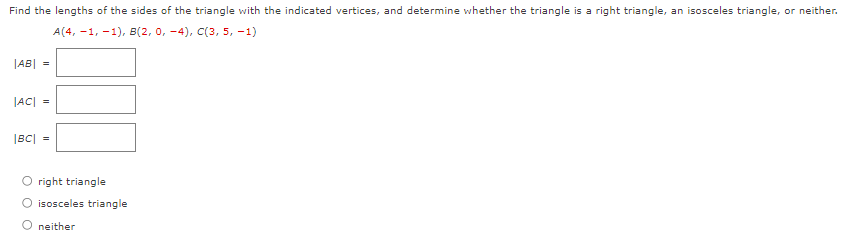
Find the lengths of the sides of the triangle with the indicated vertices, and determine whether the triangle is a right triangle, an isosceles triangle, or neither. A(4, -1, -1), B(2, 0, -4), C(3, 5, -1) |AB| = |AC| = |BC| = right triangle isosceles triangle neither
View Answer
divider
ANSWERED

Supreeta N verified

Numerade educator

Find u × v, v × u, and v × v. u = 3i + 7k v = 5i + 9j ? 2k. (a) u × v (b) v × u (c) v × v

View Answer
divider
ANSWERED

Melissa Munoz verified

Numerade educator

Find sets of parametric equations and symmetric equations of the line that passes through the given point and is parallel to the given vector or line. (For each line, write the direction numbers as integers.) Point Parallel to (-9, 0, 2) v = 8i + 4j - 6k (a) parametric equations (Enter your answers as a comma-separated list.) (b) symmetric equations x/8 = y = z/6 (x + 9)/8 = y/4 = (2 - z)/6 8x = y/4 = 6z (x - 9)/8 = y = z/6

View Answer
divider
ANSWERED

Supreeta N verified

Numerade educator

For the reaction, A ? B + C, the rate law is rate = k[A]. If it takes 80.0 seconds for 70.0% of a 10.0 gram sample of A to be transformed into products, what is the value of the rate constant? 0.00450 s?¹ 0.0290 s?¹ 0.00530 s?¹ 5.40 s?¹ 0.0150 s?¹

View Answer
divider
ANSWERED

Supreeta N verified

Numerade educator

Consider the following balanced equation: 4 NH3 + 7 O2 ? 6 H2O + 4 NO2 What is the order with respect to ammonia? -1 0 1/2 1 3/2 2 3 4 cannot be determined

View Answer
divider
ANSWERED

Supreeta N verified

Numerade educator

Consider the following balanced equation: 4 NH3 + 7 O2 ? 6 H2O + 4 NO2 What is the order with respect to ammonia? -1 0 1/2 1 3/2 2 3 4 cannot be determined

View Answer
divider
ANSWERED

Supreeta N verified

Numerade educator

For a first-order reaction with a single reactant, after 230.0 seconds, 10.0% of the reactant remains. The rate constant for the reaction is therefore 0.0100 s?¹ 0.0510 s?¹ 100 s?¹ 0.000640 s?¹ 0.0915 s?¹

View Answer
divider
ANSWERED

Supreeta N verified

Numerade educator

At a certain temperature the following data was collected for the reaction: 2NO2(g) + H2(g) ? 2HNO2(g) [NO2](M) | [H2](M) | Initial rate (M/s) 0.00100 | 0.00400 | 0.00200 0.00200 | 0.00400 | 0.00800 0.00300 | 0.00400 | 0.0180 0.00400 | 0.00100 | 0.00800 0.00400 | 0.00200 | 0.0160 0.00400 | 0.00300 | 0.0240 What is the rate law for this reaction? rate = k[NO2]2[H2]^2 rate = k[NO2]^0.5[H2] rate = k[NO2]^2[H2]^3 rate = k[NO2]^2[H2] rate = k[NO2]^2[H2]^2

View Answer
divider