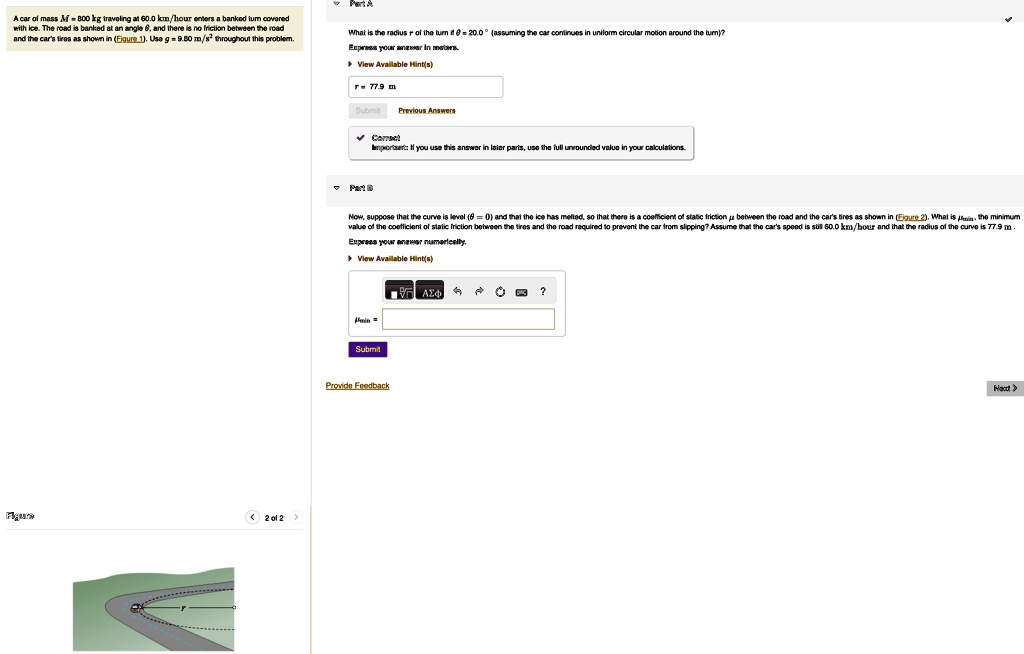
A car of mass $M = 800\text{ kg}$ traveling at $60.0\text{ km/hour}$ enters a banked turn covered with ice. The road is banked at an angle $\theta$, and there is no friction between the road and the car's tires as shown in (Figure 1). Use $g = 9.80\text{ m/s}^2$ throughout this problem.
Part A
What is the radius $r$ of the turn if $\theta = 20.0^\circ$ (assuming the car continues in uniform circular motion around the turn)?
Express your answer in meters.
View Available Hint(s)
r = 77.9 m
SubmitPrevious Answers
Correct
Important: If you use this answer in later parts, use the full unrounded value in your calculations.
Part B
Now, suppose that the curve is level ($\theta = 0$) and that the ice has melted, so that there is a coefficient of static friction $\mu$ between the road and the car's tires as shown in (Figure 2). What is $\mu_{min}$, the minimum value of the coefficient of static friction between the tires and the road required to prevent the car from slipping? Assume that the car's speed is still $60.0\text{ km/hour}$ and that the radius of the curve is $77.9\text{ m}$.
Express your answer numerically.
View Available Hint(s)
$\mu_{min} = $