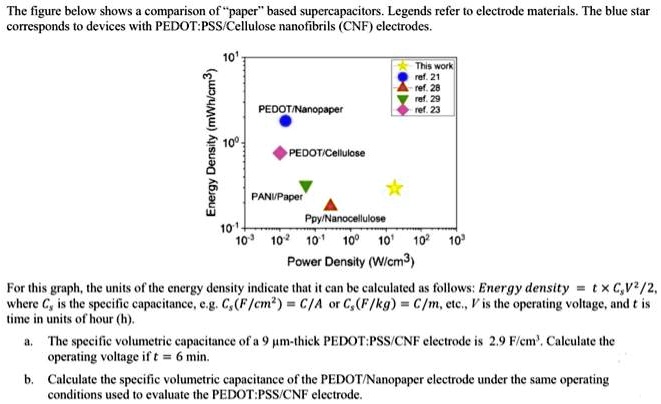
The figure below shows a comparison of \"paper\" based supercapacitors. Legends refer to electrode materials. The blue star corresponds to devices with PEDOT:PSS/Cellulose nanofibrils (CNF) electrodes.
10<sup>1</sup>
PEDOT/Nanopaper
10<sup>0</sup>
Energy Density (mWh/cm<sup>3</sup>)
PEDOT/Cellulose
PANI/Paper
This work
ref. 21
ref. 28
ref. 29
ref. 23
10<sup>-1</sup>
Ppy/Nanocellulose
10<sup>-3</sup> 10<sup>-2</sup> 10<sup>-1</sup> 10<sup>0</sup> 10<sup>1</sup> 10<sup>2</sup> 10<sup>3</sup>
Power Density (W/cm<sup>3</sup>)
For this graph, the units of the energy density indicate that it can be calculated as follows: Energy density = t \times C<sub>v</sub>V<sup>2</sup>/2, where C<sub>v</sub> is the specific capacitance, e.g. C<sub>v</sub>(F/cm<sup>2</sup>) = C/A or C<sub>v</sub>(F/kg) = C/m, etc., V is the operating voltage, and t is time in units of hour (h).
a. The specific volumetric capacitance of a 9 \textmu{}m-thick PEDOT:PSS/CNF electrode is 2.9 F/cm<sup>3</sup>. Calculate the operating voltage if t = 6 min.
b. Calculate the specific volumetric capacitance of the PEDOT/Nanopaper electrode under the same operating conditions used to evaluate the PEDOT:PSS/CNF electrode.