(b)
+ i(t) > +
Xs(t)
R=1?
C=1F
V?(t)
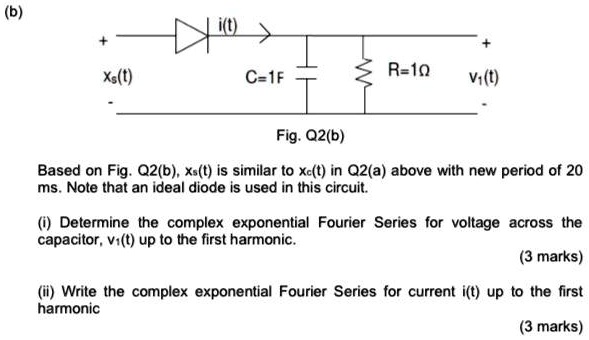
Fig. Q2(b)
Based on Fig. Q2(b), xs(t) is similar to xc(t) in Q2(a) above with new period of 20
ms. Note that an ideal diode is used in this circuit.
(i) Determine the complex exponential Fourier Series for voltage across the
capacitor, v?(t) up to the first harmonic.
(3 marks)
(ii) Write the complex exponential Fourier Series for current i(t) up to the first
harmonic
(3 marks)