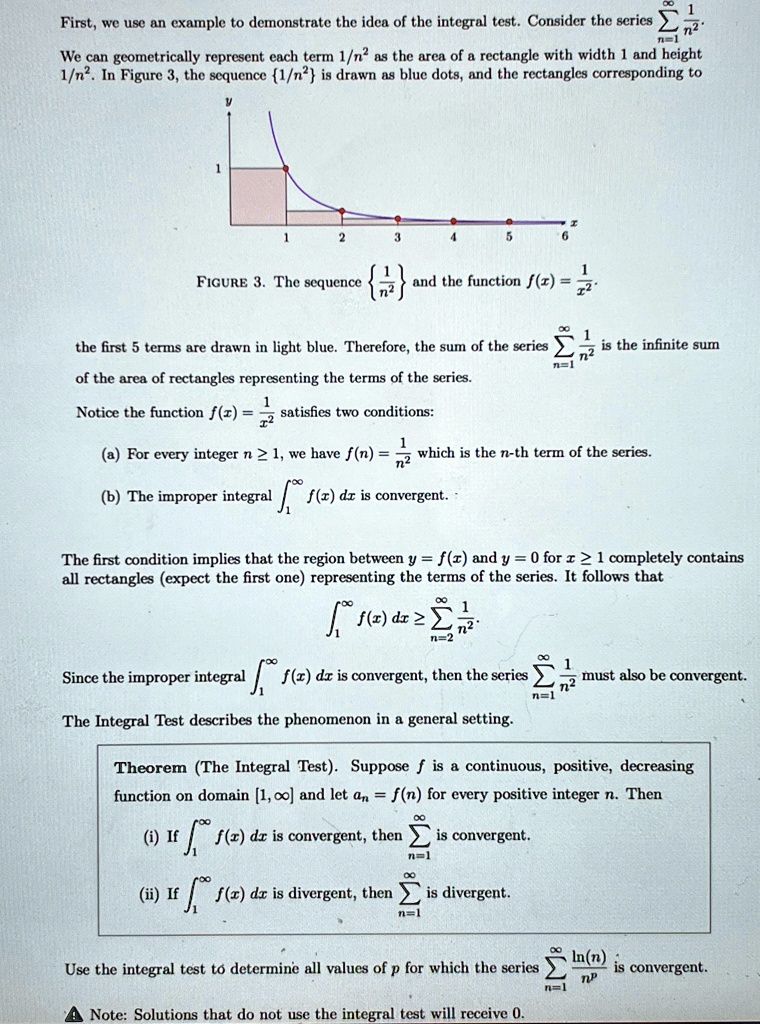
First, we use an example to demonstrate the idea of the integral test. Consider the series sum_(n=1)^(infty ) (1)/(n^(2)). We can geometrically represent each term (1)/(n^(2)) as the area of a rectangle with width 1 and height (1)/(n^(2)). In Figure 3 , the sequence {(1)/(n^(2))} is drawn as blue dots, and the rectangles corresponding to
Figure 3. The sequence {(1)/(n^(2))} and the function f(x)=(1)/(x^(2)).
the first 5 terms are drawn in light blue. Therefore, the sum of the series sum_(n=1)^(infty ) (1)/(n^(2)) is the infinite sum of the area of rectangles representing the terms of the series.
Notice the function f(x)=(1)/(x^(2)) satisfies two conditions:
(a) For every integer n>=1, we have f(n)=(1)/(n^(2)) which is the n-th term of the series.
(b) The improper integral int_1^(infty ) f(x)dx is convergent.
The first condition implies that the region between y=f(x) and y=0 for x>=1 completely contains all rectangles (expect the first one) representing the terms of the series. It follows that
int_1^(infty ) f(x)dx>=sum_(n=2)^(infty ) (1)/(n^(2))
Since the improper integral int_1^(infty ) f(x)dx is convergent, then the series sum_(n=1)^(infty ) (1)/(n^(2)) must also be convergent.
The Integral Test describes the phenomenon in a general setting.
Theorem (The Integral Test). Suppose f is a continuous, positive, decreasing function on domain 1,infty and let a_(n)=f(n) for every positive integer n. Then
(i) If int_1^(infty ) f(x)dx is convergent, then sum_(n=1)^(infty ) is convergent.
(ii) If int_1^(infty ) f(x)dx is divergent, then sum_(n=1)^(infty ) is divergent.
Use the integral test to determine all values of p for which the series sum_(n=1)^(infty ) (ln(n))/(n^(p)) is convergent.
A Note: Solutions that do not use the integral test will receive 0 .
First,we use an example to demonstrate the idea of the integral test. Consider the series n2 1E We can geometrically represent each term 1/n as the area of a rectangle with width 1 and height 1/n.In Figure 3,the sequence {1/n2} is drawn as bluc dots,and the rectangles corresponding to
2
FiGURE 3.The sequence
and the function f() =2
the first 5 terms are drawn in light blue. Therefore, the sum of the series > of the area of rectangles representing the terms of the series.
is the infinite sum
(b) The improper integral / f() dr is convergent.
The first condition implies that the region between y=f(and y=0 for 1 completely contains all rectangles (expect the first one representing the terms of the series. It follows that
Since the improper integral / f() dx is convergent, then the series must also be convergent. n2
The Integral Test describes the phenomenon in a general setting
Theorem (The Integral Test). Suppose f is a continuous, positive, decreasing function on domain [1,co] and let an = fn for every positive integer n.Then
( Iff( dr is convergent, then is convergent. n=1
(i Iff() dr is divergent, then is divergent. n=1
In(nis Use the integral test to determine all values of p for which the series is convergent n=1 nP
Note Solutions that do not use the integral test will receive 0.