5.4 The First Derivative Test
15. If \( g \) is a differentiable function such that \( g(x)<0 \) for all real numbers \( x \) and if \( f^{\prime}(x)=\left(x^{2}-x-12\right) \) which of the following is true?
(A) \( f \) has a relative maximum at \( x=-3 \) and a relative minimum at \( x=4 \).
(B) \( f \) has a relative minimum at \( x=-3 \) and a relative maximum at \( x=4 \)
(C) \( f \) has a relative maximum at \( x=3 \) and a relative minimum at \( x=-4 \).
(D) \( f \) has a relative minimum at \( x=3 \) and a relative maximum at \( x=-4 \).
(E) It cannot be determined if \( f \) has any relative extrema.
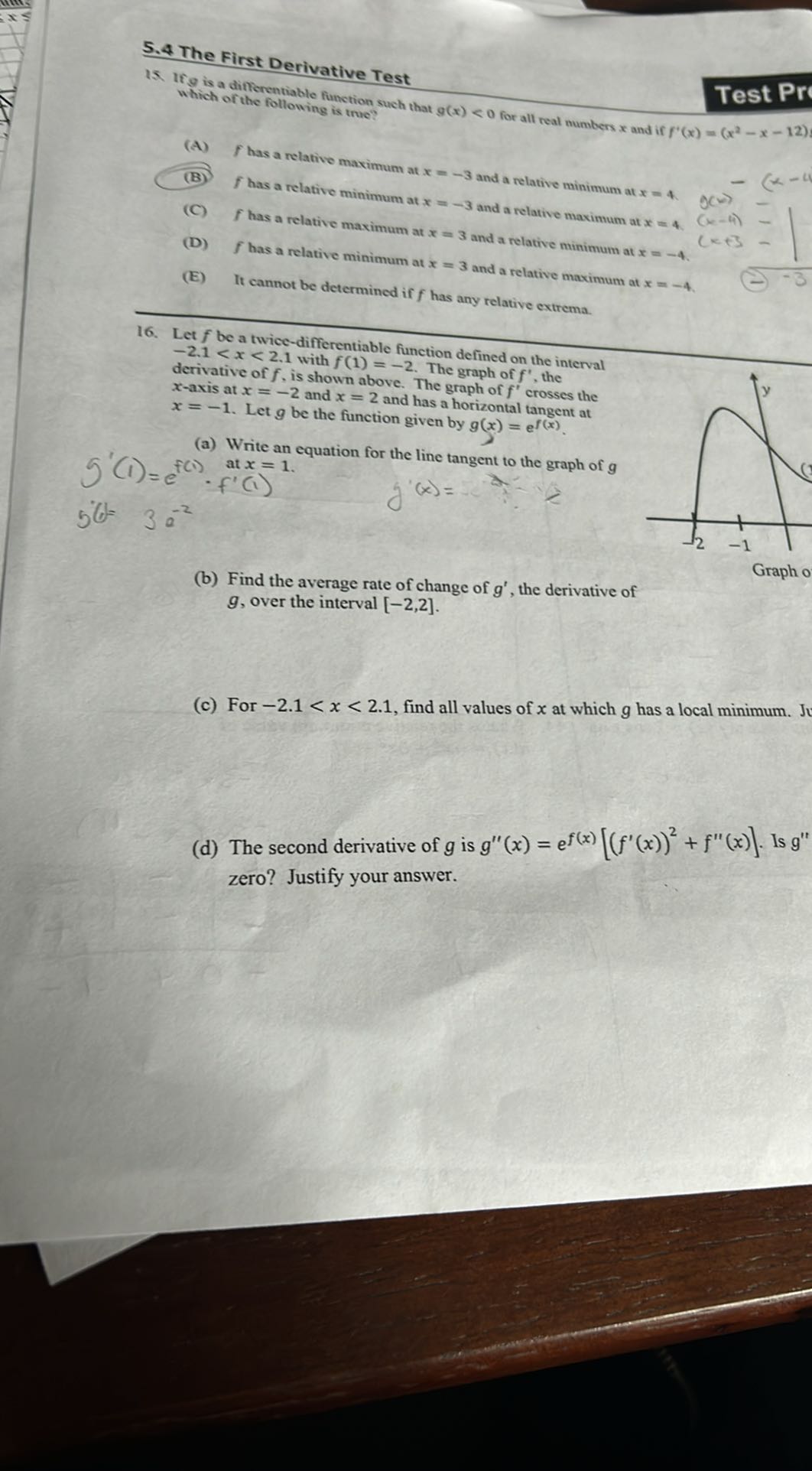
16. Let \( f \) be a twice-differentiable function defined on the interval \( -2.1<x<2.1 \) with \( f(1)=-2 \). The graph of \( f^{\prime} \), the derivative of \( f \), is shown above. The graph of \( f^{\prime} \) crosses the \( x \)-axis at \( x=-2 \) and \( x=2 \) and has a horizontal tangent at \( x=-1 \). Let \( g \) be the function given by \( g(x)=e^{f(x)} \).
(a) Write an equation for the line tangent to the graph of \( g \) \( g^{\prime}(1)=e^{f(1)} \cdot f^{\prime}(1) \) \( 56=3 a^{-2} \)
(b) Find the average rate of change of \( g^{\prime} \), the derivative of \( g \), over the interval \( [-2,2] \).
(c) For \( -2.1<x<2.1 \), find all values of \( x \) at which \( g \) has a local minimum.
(d) The second derivative of \( g \) is \( g^{\prime \prime}(x)=e^{f(x)}\left[\left(f^{\prime}(x)\right)^{2}+f^{\prime \prime}(x)\right] \). Is \( g^{\prime \prime} \) zero? Justify your answer.