Make sure to please answer EVERYTHING
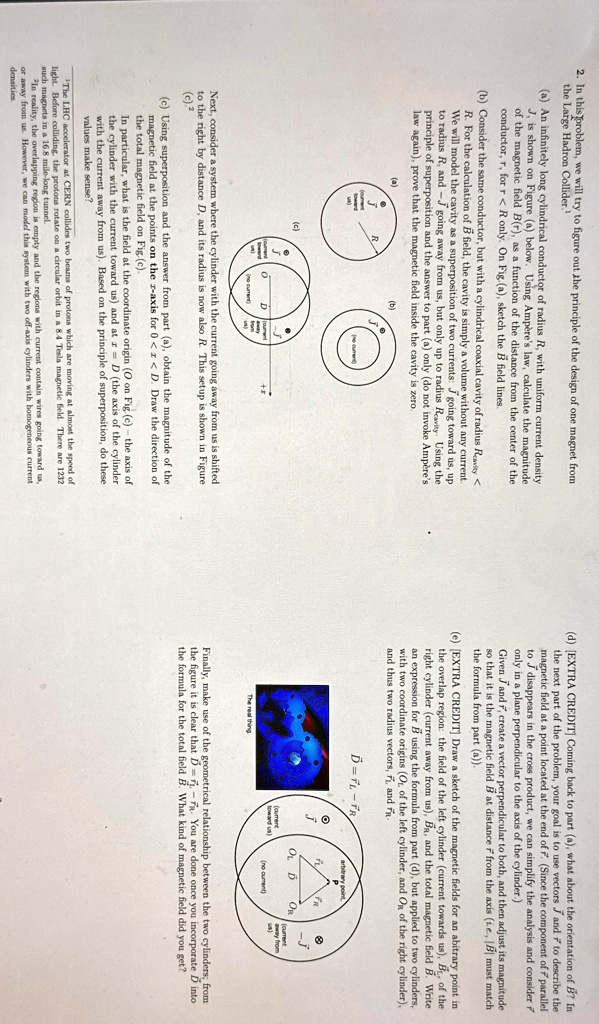
densities, or away from us. Light. Before values make sense, the total magnetic field on Fig. si1- (a) the Large Hadron Collider, with the current away from us. Based on the principle of superposition, do these the cylinder with the current toward us and at x = D (the axis of the cylinder magnetic field at the points on the -axis for Oz<D. Draw the direction of c Using superposition and the answer from part a, obtain the magnitude of the to the right by distance D, and its radius is now also R. This setup is shown in Figure. Next, consider a system where the cylinder with the current going away from us is shifted (b) law again, prove that the magnetic field inside the cavity is zero. R. For the calculation of B field, the cavity is simply a volume without any current. Consider the same conductor, but with a cylindrical coaxial cavity of radius Rey conductor, r, for rR only. On Fig. a, sketch the B field lines. of the magnetic field Br, as a function of the distance from the center of the J, is shown on Figure a below. Using Ampere's law, calculate the magnitude a An infinitely long cylindrical conductor of radius R, with uniform current density 2. In this problem, we will try to figure out the principle of the design of one magnet from +z
and thus two radius vectors, ri and. e the formula for the total field B. What kind of magnetic field did you get? D=TL-FR the formula from part (a). Finally, make use of the geometrical relationship between the two cylinders; from (no document with two coordinate origins O of the left cylinder, and O of the right cylinder right cylinder (current away from us, BR, and the total magnetic field B. Write the overlap region: the field of the left cylinder current towards us, B, of the [EXTRA CREDIT] Draw a sketch of the magnetic fields for an arbitrary point in so that it is the magnetic field at a distance from the axis must match Given and create a vector perpendicular to both and then adjust its magnitude only in a plane perpendicular to the axis of the cylinder. to J disappears in the cross product, we can simplify the analysis and consider r magnetic field at a point located at the end of F. (Since the component of parallel the next part of the problem, your goal is to use vectors J and to describe the d) [EXTRA CREDIT] Coming back to part (a), what about the orientation of B? In L