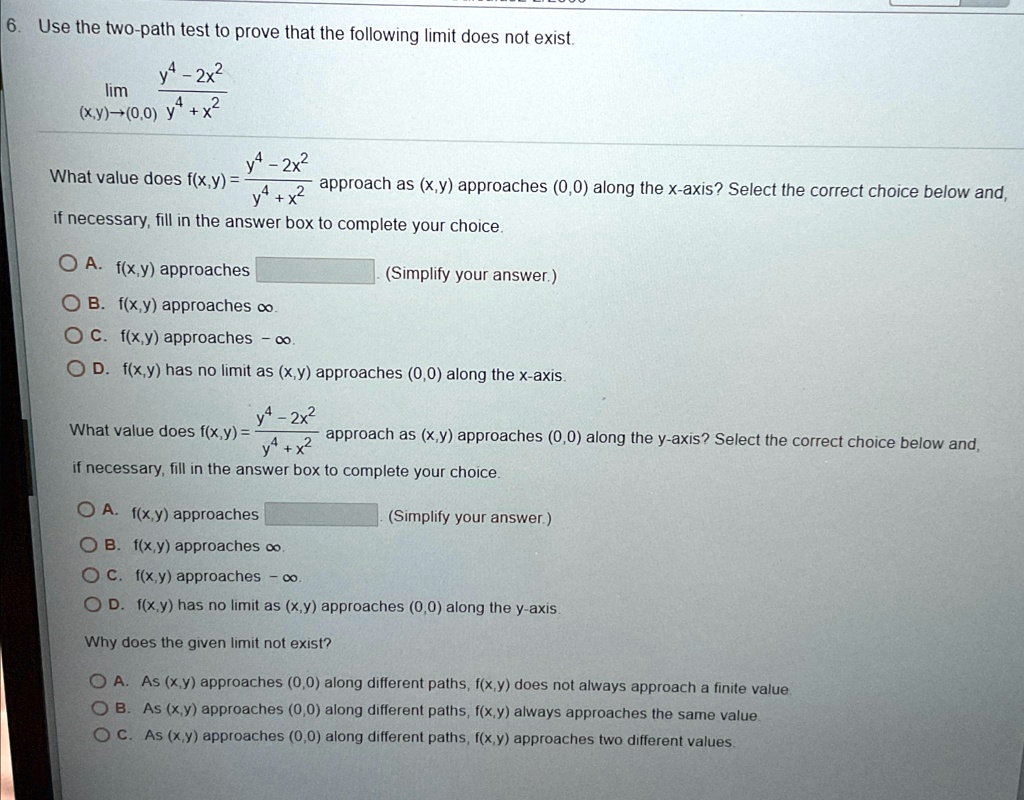
Use the two-path test to prove that the following limit does not exist.
lim_((x,y)->(0,0))(y^{4}-2x^{2})/(y^{4}+x^{2})
What value does f(x,y)=(y^{4}-2x^{2})/(y^{4}+x^{2}) approach as (x,y) approaches (0,0) along the x-axis? Select the correct choice below and, if necessary, fill in the answer box to complete your choice.
A. f(x,y) approaches (Simplify your answer.)
B. f(x,y) approaches infty .
C. f(x,y) approaches -infty .
D. f(x,y) has no limit as (x,y) approaches (0,0) along the x-axis.
What value does f(x,y)=(y^{4}-2x^{2})/(y^{4}+x^{2}) approach as (x,y) approaches (0,0) along the y-axis? Select the correct choice below and, if necessary, fill in the answer box to complete your choice.
A. f(x,y) approaches (Simplify your answer.)
B. f(x,y) approaches infty .
C. f(x,y) approaches -infty .
D. f(x,y) has no limit as (x,y) approaches (0,0) along the y-axis.
Why does the given limit not exist?
A. As (x,y) approaches (0,0) along different paths, f(x,y) does not always approach a finite value
B. As (x,y) approaches (0,0) along different paths, f(x,y) always approaches the same value.
C. As (x,y) approaches (0,0) along different paths, f(x,y) approaches two different values.
6.Use the two-path test to prove that the following limit does not exist. y^{4}-2x^{2} lim (x.y-0,0y^{4}+2
y^{4}-2x^{2} What value does f(x,y) y^{4}+x^{2} approach as (,y) approaches (0,0) along the x-axis? Select the correct choice below and, if necessary,fill in the answer box to complete your choice
OA.fxyapproaches (Simplify your answer.) OB.f(xyapproaches Oc.f(x,yapproaches - O D.f(x,y) has no limit as (x,y) approaches (0,0) along the x-axis
y^{4}-2x^{2} What value does f(x,y) y^{4}+2 approach as (x,y) approaches (0,0) along the y-axis? Select the correct choice below and if necessary,fill in the answer box to complete your choice
OA.f(xyapproaches (Simplify your answer. OB.fxyapproaches C.fxyapproaches- O D.f(xyhas no limit asxyapproaches0,0along the y-axis
Why does the given limit not exist?
O A.As xyapproaches0.0along different paths,f(xy does not always approach a finite value OB.As(xyapproaches0,0along different paths,f(xyalways approaches the same value O C.Asxyapproaches0,0along different paths,f(xyapproaches two different values