Ace - AI Tutor
Ask Our Educators
Textbooks
My Library
Flashcards
Scribe - AI Notes
Notes & Exams
Download App
anne fleming

anne f.

Divider

Questions asked

BEST MATCH

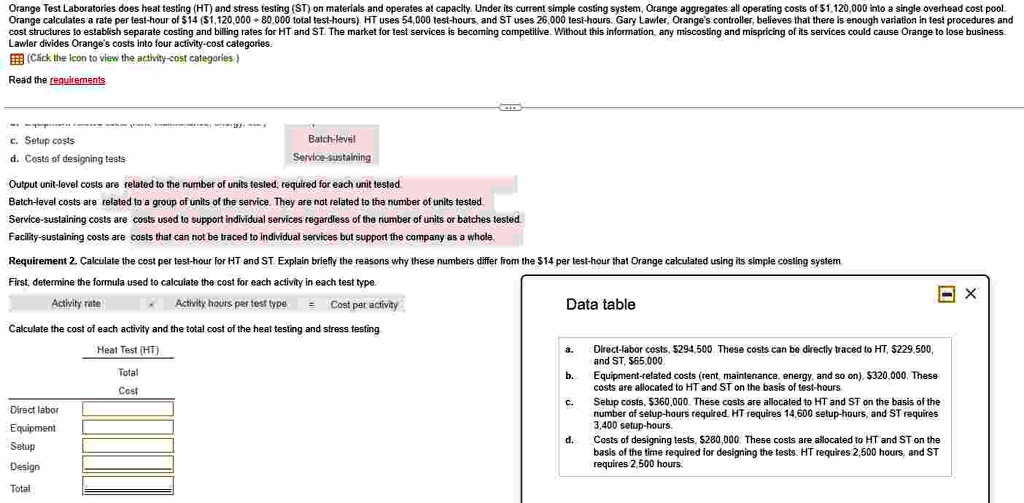
Orange Test Laboratories does heat testing (HT) and stress testing (ST) on materials and operates at capacity. Under its current simple costing system, Orange aggregates all operating costs of $1,120,000 into a single overhead cost pool. Orange calculates a rate per test-hour of $14 ($1,120,000-80,000 total test-hours). HT uses 54,000 test-hours, and ST uses 26,000 test-hours. Gary Lawler, Orange's controller, believes that there is enough variation in test procedures and cost structures to establish separate costing and billing rates for HT and ST. The market for test services is becoming competitive. Without this information, any miscosting and mispricing of its services could cause Orange to lose business. Lawler divides Orange's costs into four activity-cost categories. (Cáck the icon to view the activity-cost categories) Read the requirements. c. Setup costs d. Costs of designing tests Batch-level Service-sustaining Output unit-level costs are related to the number of units tested, required for each unit tested Batch-level costs are related to a group of units of the service. They are not related to the number of units tested Service-sustaining costs are costs used to support individual services regardless of the number of units or batches tested Facility-sustaining costs are costs that can not be traced to individual services but support the company as a whole. Requirement 2. Calculate the cost per test-hour for HT and ST. Explain briefly the reasons why these numbers differ from the $14 per test-hour that Orange calculated using its simple costing system First, determine the formula used to calculate the cost for each activity in each test type. Activity rate $\times$ Activity hours per test type = Cost per activity Calculate the cost of each activity and the total cost of the heat testing and stress testing Heat Test (HT) Total Cost Direct labor Equipment Setup Design Total Data table a. Direct-labor costs, $294,500 These costs can be directly traced to HT, $229,500, and ST, $65,000 b. Equipment-related costs (rent, maintenance, energy, and so on), $320.000. These costs are allocated to HT and ST on the basis of test-hours. c. Setup costs, $360,000. These costs are allocated to HT and ST on the basis of the number of selup-hours required. HT requires 14,600 setup-hours, and ST requires 3,400 setup-hours. d. Costs of designing tests, $280,000. These costs are allocated to HT and ST on the basis of the time required for designing the tests. HT requires 2,500 hours, and ST requires 2,500 hours.
View Answer
divider
BEST MATCH

Astronauts on our moon must function with an acceleration due to gravity of 0.165gg. Part A If an astronaut can throw a certain wrench 11.0 mm vertically upward on earth, how high could he throw it on our moon if he gives it the same starting speed in both places? Express your answer in meters.

View Answer
divider
BEST MATCH

What are three needs in Maslow’s hierarchy of needs? Group of answer choices Food, comfort, adventure Safety, water, financial Safety needs, physiological needs, self-actualization needs Love, financial, comfort

View Answer
divider
BEST MATCH

The "barking dog" reaction is an exciting combustion reaction that generates a bright blue flame because sulfur is produced during the reaction (sulfur burns blue!). At the end of the reaction, a "woosh" sound is made which sounds like a dogs bark (hence the name of the reaction). Assume the reaction is carried out in a closed container. You must show your work for full credit. CS2 + 4N20 -> CO2 + 502 + 5 + 4N2 Note: the equation is balanced (8 points) If you were to carry out the reaction with 8.36 g CS2 and 8.28g N20, what would be the limiting reagent? (4 points) How much CS (in mg) would you need to generate 4.86 mg of N2? (10 points) The reaction is carried out with 3.80g CS and 6.82g N20. At the end of the reaction, 1.14 g of S is isolated in the experiment, what is the percent yield?

View Answer
divider
BEST MATCH

What is the pH of a 0.25 M HCN ($K_a = 4 \times 10^{-10}$) solution? 5 7 3 9 1

View Answer
divider
BEST MATCH

Which of the following is typically NOT eligible for coverage in a group health policy? Full-time employee Temporary employee Business owner Partner in a partnership

View Answer
divider
BEST MATCH

Find out in which years in the 1990s there have been changes in the exchange rates in the EWS

View Answer
divider
BEST MATCH

Find the exact location of all the relative and absolute extrema of the function g(x)=6x^(2)-24sqrt(x) Find the exact location of all the relative and absolute extrema of the functior g(x)=6x2-24x

View Answer
divider
BEST MATCH

One potential major limitation in direct observation research is: Group of answer choices response bias reflectivity response rate reactivity

View Answer
divider
BEST MATCH

is thrown upward with an initial velocity of 128 ft/sec from a height of 560 ft. ight h, in feet, after t seconds is given by $h = -16t^2 + 128t + 560$. After how long will it take for the ball ach to its maximum height? (Round your answer to 1 decimal place.) The ball will

View Answer
divider