Ace - AI Tutor
Ask Our Educators
Textbooks
My Library
Flashcards
Scribe - AI Notes
Notes & Exams
Download App
anthony davis

anthony d.

Divider

Questions asked

BEST MATCH

38. Suppose you have a random variable X with: X: 3, 6, 9, 12; $P(X = 3) = 0.2$, $P(X = 6) = 0.2$, $P(X = 9) = 0.3$, $P(X = 12) = 0.3$. (a) Compute E[X]. (b) Compute E[$X^2$]. (c) Hence, find Var(X).

View Answer
divider
BEST MATCH

16. Risk of Corporate Bond ETFs. Explain why some corporate bond ETFs that you can purchase are more risky than others.

View Answer
divider
BEST MATCH

Which of the following is NOT a characteristic of an IT security framework? Question 16Select one: a. Provides an auditor a consistent approach for conducting audits b. Is rigid in structure and content c. Is a conceptual set of rules and ideas that provides structure to a complex situation d. Provides a consistent system of controls to which IT departments can adhere

View Answer
divider
BEST MATCH

Scenario Borrowing Method Frayer Bank typically has an abundance of funds in its accounts, but out of nowhere, several investors come to the bank looking to borrow a total of $45 million in funds that the bank simply does not have. The bank wants a temporary source of funds for two weeks and doesn’t want to borrow from the federal funds market or a source outside of the United States. New Horizon Bank has a shortage of funds and wants a temporary source of funds for two days to make up the difference. They want to pay an interest rate that’s similar to rates on Treasury securities and don't want to borrow from their Federal Reserve district bank or a source outside of the United States. First Guaranty Bank wants to borrow funds to purchase a $22 million building for its new branch location and wants to issue long-term securities to cover the financing of the new branch location. Flow Financial Bank wants to temporarily sell $100 million worth of its Treasury bills, with an agreement to buy them back in one year for $102 million

View Answer
divider
BEST MATCH

1. According to Winstanley, why are all men fundamentally equal and free?

View Answer
divider
BEST MATCH

If a borrower fails to repay a secured loan, the lender may foreclose on the collateral. True False

View Answer
divider
BEST MATCH

The height of an object thrown upward can be expressed as h = -16t^2 + vâ‚€t + c, where t is the time in motion, vâ‚€ is the initial upward velocity, and c is the initial height. This equation shows the solution for the initial velocity, vâ‚€.

View Answer
divider
BEST MATCH

1.1 A bead of mass m slides without friction along a straight wire AB, under the influence of the Earth's gravitational field. The perpendicular distance from the center of the wire C to the origin O is the constant distance d. The line OC rotates with constant angular velocity around a fixed horizontal axis through O and perpendicular to the wire. Initially the wire AB is horizontal and the bead is positioned at C with zero velocity. (a) Derive the Lagrangian for this system using appropriate generalized coordinates. (b) Establish the equation of motion for the bead and solve it.

View Answer
divider
BEST MATCH

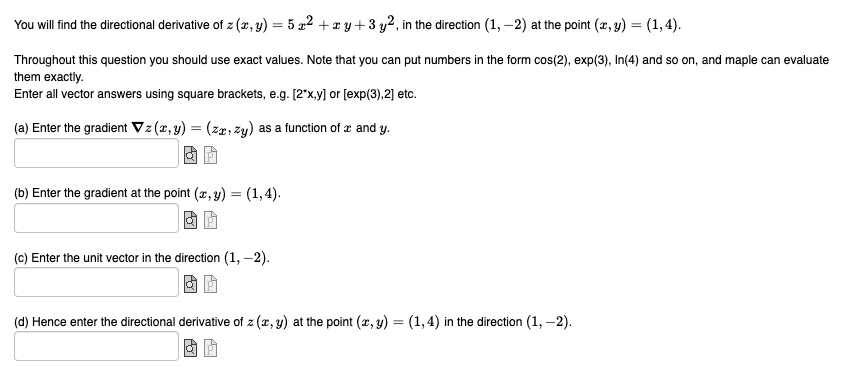
You will find the directional derivative of z(x, y) = 5x^2 + xy + 3y^2, in the direction (1, -2) at the point (x, y) = (1, 4). Throughout this question you should use exact values. Note that you can put numbers in the form cos(2), exp(3), ln(4) and so on, and maple can evaluate them exactly. Enter all vector answers using square brackets, e.g. [2*x,y] or [exp(3),2] etc. (a) Enter the gradient \nabla z(x, y) = (z_x, z_y) as a function of x and y. (b) Enter the gradient at the point (x, y) = (1, 4). (c) Enter the unit vector in the direction (1, -2). (d) Hence enter the directional derivative of z(x, y) at the point (x, y) = (1, 4) in the direction (1, -2).
View Answer
divider
BEST MATCH

A 18-kg particle moves along the x axis under the influence of a variable force. The potential energy is given by - U(x) = 9 x$^2$ + 6 x$^4$; where x is in coordinate of the particle. If the particle has a speed of 22 m/s when it is at x$_1$ = 2.0 m, what is its speed when it is at x$_2$ = 3.0 m? Please round your answer to one decimal place. Equation: Use the law of conservation of mechanical energy: U$_1$ + $ rac{1}{2}$mv$_1$$^2$ = U$_2$ + $ rac{1}{2}$v$_2$$^2$ U$_1$ = U(x$_1$) and U$_2$ = U(x$_2$)

View Answer
divider