03: Assignment - Financial Statements, Cash Flow, and Taxes
Mia Right! So, how useful would a firm's book value be for assessing the performance of Extensive's
management?
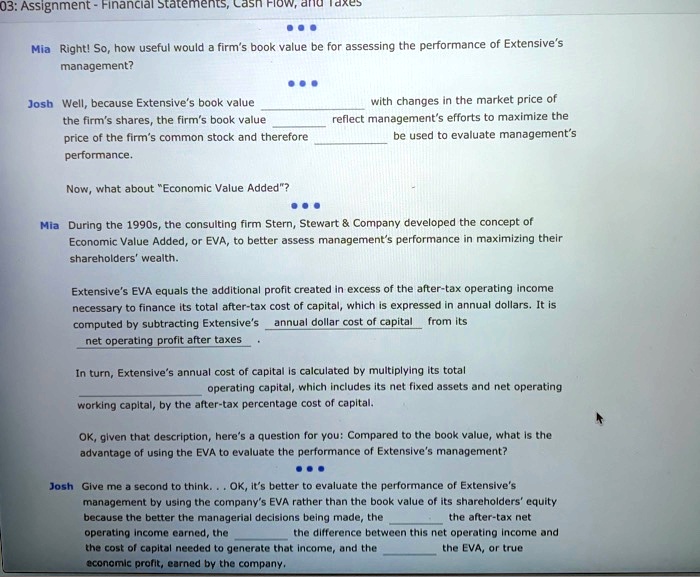
Josh Well, because Extensive's book value
with changes in the market price of
the firm's shares, the firm's book value
reflect management's efforts to maximize the
price of the firm's common stock and therefore
be used to evaluate management's
performance.
Now, what about "Economic Value Added"?
Mia During the 1990s, the consulting firm Stern, Stewart & Company developed the concept of
Economic Value Added, or EVA, to better assess management's performance in maximizing their
shareholders' wealth.
Extensive's EVA equals the additional profit created in excess of the after-tax operating income
necessary to finance its total after-tax cost of capital, which is expressed in annual dollars. It is
computed by subtracting Extensive's
net operating profit after taxes
annual dollar cost of capital from its
In turn, Extensive's annual cost of capital is calculated by multiplying its total
operating capital, which includes its net fixed assets and net operating
working capital, by the after-tax percentage cost of capital.
OK, given that description, here's a question for you: Compared to the book value, what is the
advantage of using the EVA to evaluate the performance of Extensive's management?
Josh Give me a second to think... OK, it's better to evaluate the performance of Extensive's
management by using the company's EVA rather than the book value of its shareholders' equity
because the better the managerial decisions being made, the
the after-tax net
operating income earned, the
the difference between this net operating income and
the cost of capital needed to generate that income, and the
the EVA, or true
economic profit, earned by the company.