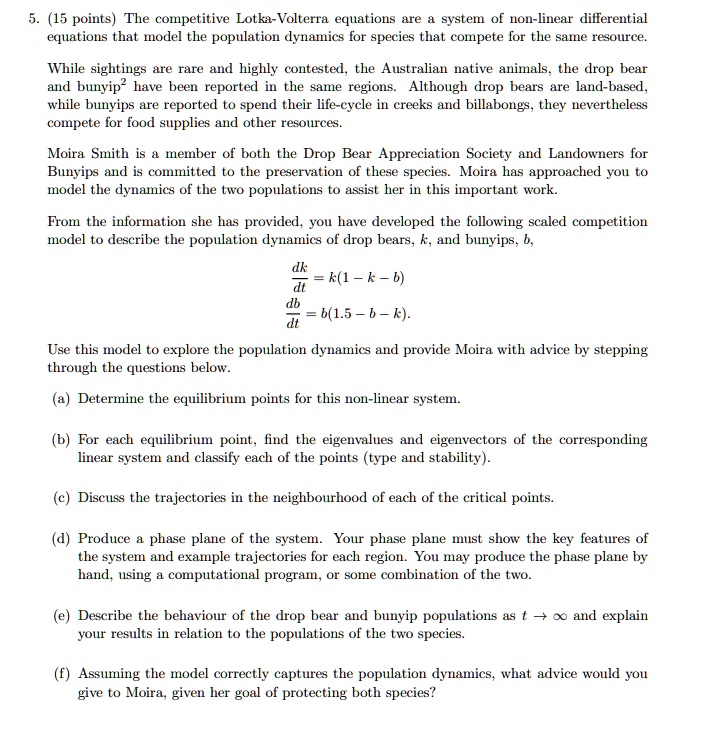
5. (15 points) The competitive Lotka-Volterra equations are a system of nonlinear differential equations that model the population dynamics for species that compete for the same resource.
While sightings are rare and highly contested, the Australian native animals, the drop bear and bunyip, have been reported in the same regions. Although drop bears are land-based while bunyips are reported to spend their life-cycle in creeks and billabongs, they nevertheless compete for food supplies and other resources.
Moira Smith is a member of both the Drop Bear Appreciation Society and Landowners for Bunyips and is committed to the preservation of these species. Moira has approached you to model the dynamics of the two populations to assist her in this important work.
From the information she has provided, you have developed the following scaled competition model to describe the population dynamics of drop bears, k, and bunyips, b:
dk = k(1 - k - b)
db = b(1.5 - b - k) dt
Use this model to explore the population dynamics and provide Moira with advice by stepping through the questions below.
a) Determine the equilibrium points for this nonlinear system.
(b) For each equilibrium point, find the eigenvalues and eigenvectors of the corresponding linear system and classify each of the points (type and stability).
c) Discuss the trajectories in the neighborhood of each of the critical points.
d) Produce a phase plane of the system. Your phase plane must show the key features of the system and example trajectories for each region. You may produce the phase plane by hand, using a computational program, or some combination of the two.
e) Describe the behavior of the drop bear and bunyip populations as t approaches infinity and explain your results in relation to the populations of the two species.
f) Assuming the model correctly captures the population dynamics, what advice would you give to Moira, given her goal of protecting both species?