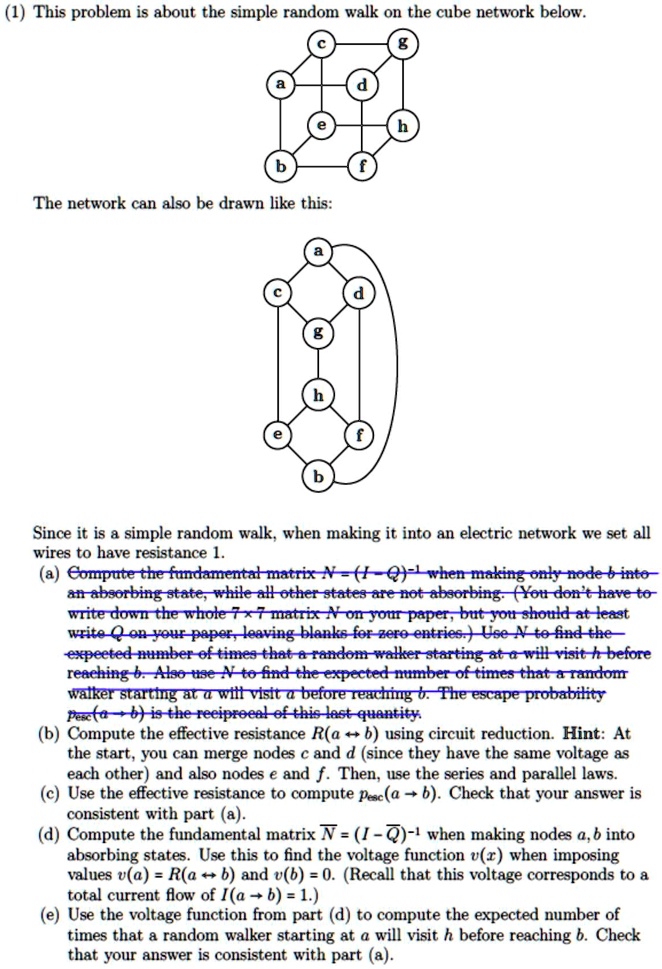
(1) This problem is about the simple random walk on the cube network below.
The network can also be drawn like this:
Since it is a simple random walk, when making it into an electric network we set all wires to resistance 1.
(b) Compute the effective resistance R(aharrb) using circuit reduction. Hint: At
the start, you can merge nodes c and d (since they have the same voltage as
each other) and also nodes e and f. Then, use the series and parallel laws.
(c) Use the effective resistance to compute p_(esc)(a->b). Check that your answer is
consistent with part (a).
(d) Compute the fundamental matrix /bar (N)=(I(-)/(b)ar (Q))^(-1) when making nodes a,b into
absorbing states. Use this to find the voltage function v(x) when imposing
values v(a)=R(aharrb) and v(b)=0. (Recall that this voltage corresponds to a
total current flow of I(a->b)=1.)
(e) Use the voltage function from part (d) to compute the expected number of
times that a random walker starting at a will visit h before reaching b. Check
that your answer is consistent with part (a).