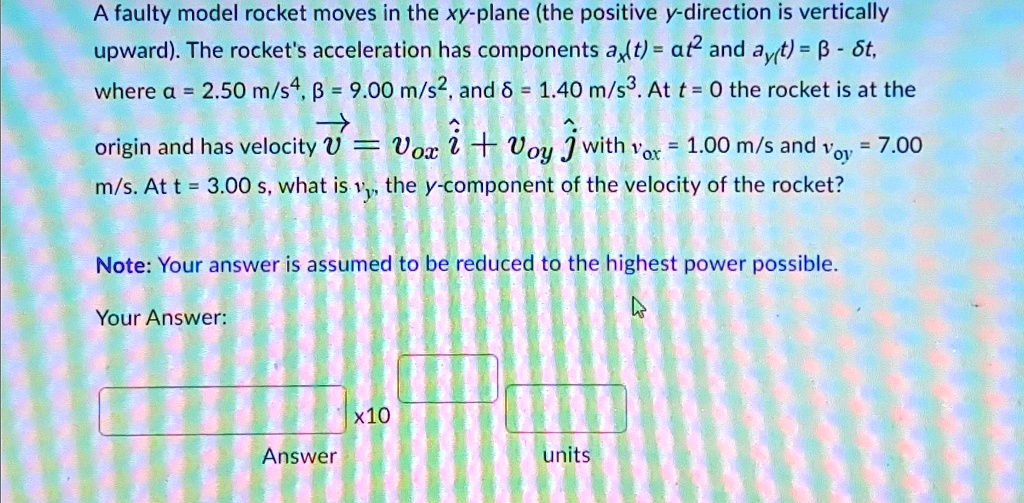
A faulty model rocket moves in the xy-plane (the positive y-direction is vertically upward). The rocket's acceleration has components a_x(t) = αt^2 and a_y(t) = β - δt, where α = 2.50 (m)/(s^4), β = 9.00 (m)/(s^2), and δ = 1.40 (m)/(s^3). At t = 0, the rocket is at the origin and has velocity vec(v) = v_{ox}hat(i) + v_{oy}hat(j) with v_{ox} = 1.00 (m)/(s) and v_{oy} = 7.00 (m)/(s). At t = 3.00 s, what is v_y, the y-component of the velocity of the rocket?
Note: Your answer is assumed to be reduced to the highest power possible.
Your Answer:
Answer
units
A faulty model rocket moves in the xy-plane (the positive y-direction is vertically upward). The rocket's acceleration has components a_x(t) = αt and a_y(t) = -t, where α = 2.50 m/s^4, β = 9.00 m/s^2, and δ = 1.40 m/s^3. At t = 0, the rocket is at the m/s. At t = 3.00 s, what is v_y, the y-component of the velocity of the rocket?
Note: Your answer is assumed to be reduced to the highest power possible.
Your Answer
x10
Answer
units