Theory:
Steam is transferred from a steam plant element to another by means of pipes,
often of considering length, as the steam obviously at a much higher
temperature than atmosphere, the heat energy lost all around. Pipes must be
insulated to minimize this loss: this is the purpose of the covering with a
suitable low conductivity material. This process is known as lagging.
1. Calculation of heat flow rate
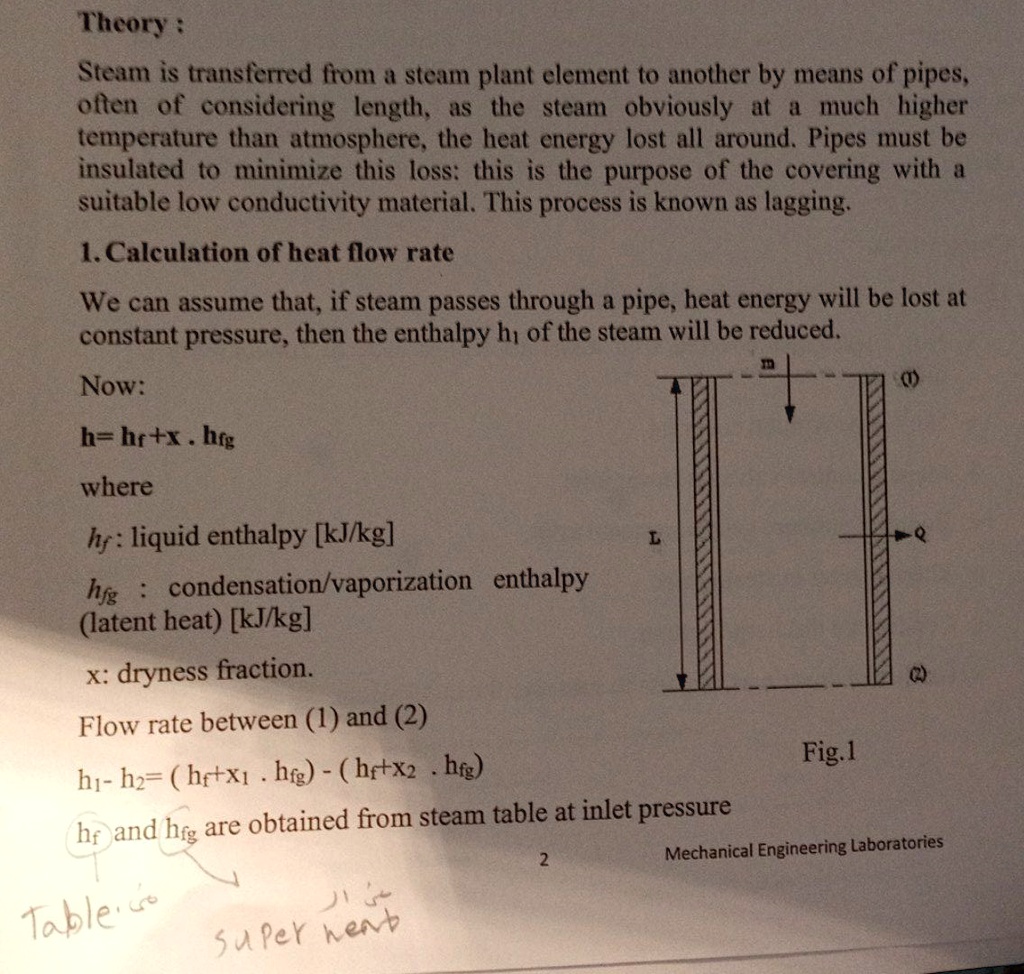
We can assume that, if steam passes through a pipe, heat energy will be lost at
constant pressure, then the enthalpy $h_1$ of the steam will be reduced.
Now:
h = $h_f$ + x.$h_{fg}$
where
$h_f$: liquid enthalpy [kJ/kg]
$h_{fg}$: condensation/vaporization enthalpy
(latent heat) [kJ/kg]
x: dryness fraction.
Flow rate between (1) and (2)
$h_1$ - $h_2$ = ($h_f$ + $x_1$.$h_{fg}$) - ($h_f$ + $x_2$.$h_{fg}$)
$h_f$ and $h_{fg}$ are obtained from steam table at inlet pressure
Fig.1
Mechanical Engineering Laboratories