Ace - AI Tutor
Ask Our Educators
Textbooks
My Library
Flashcards
Scribe - AI Notes
Notes & Exams
Download App
brian baker

brian b.

Divider

Questions asked

BEST MATCH

If a company's Quick Ratio is significantly lower than its Current Ratio, what does this indicate?

View Answer
divider
BEST MATCH

2. [-/1 Points] DETAILS MY NOTES SCALCET9 6.5.002. ASK YOUR TEACHER PRACTICE ANOTHER Find the average value $f_{ave}$ of the function $f$ on the given interval. $f(x) = \sqrt{x}$, $[0, 4]$ $f_{ave} =$

View Answer
divider
BEST MATCH

All the offspring of a cross between a red-flowered plant and a white-flowered plant have white flowers. This means that the allele for red flowers is ______ to the allele for white flowers. Dominant None of the above Codominant Recessive Incompletely dominant

View Answer
divider
BEST MATCH

Horizontal major axis of length 10, center at the origin and passes through (2,5) Foci (5,3) and (5,-5); Vertex (5,-7)

View Answer
divider
BEST MATCH

If the J = 2 to 3 rotational transition for a diatomic molecule occurs at lambda = 2.00 cm, what is the wavelength of the J = 6 to 7 transition of this molecule (in cm)?

View Answer
divider
BEST MATCH

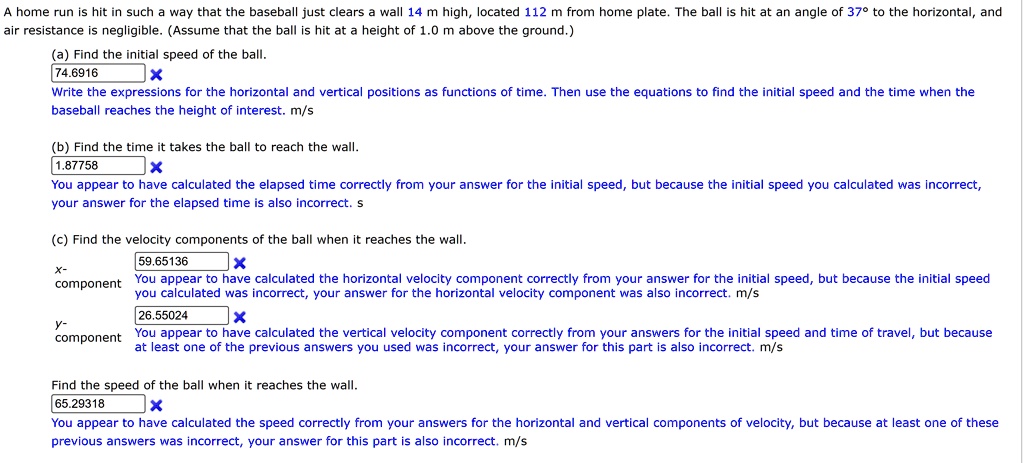
A home run is hit in such a way that the baseball just clears a wall 14 m high, located 112 m from home plate. The ball is hit at an angle of 37° to the horizontal, and air resistance is negligible. (Assume that the ball is hit at a height of 1.0 m above the ground.) (a) Find the initial speed of the ball. 74.6916 X Write the expressions for the horizontal and vertical positions as functions of time. Then use the equations to find the initial speed and the time when the baseball reaches the height of interest. m/s (b) Find the time it takes the ball to reach the wall. 1.87758 X You appear to have calculated the elapsed time correctly from your answer for the initial speed, but because the initial speed you calculated was incorrect, your answer for the elapsed time is also incorrect. s (c) Find the velocity components of the ball when it reaches the wall. x- 59.65136 X component You appear to have calculated the horizontal velocity component correctly from your answer for the initial speed, but because the initial speed you calculated was incorrect, your answer for the horizontal velocity component was also incorrect. m/s y- 26.55024 X component You appear to have calculated the vertical velocity component correctly from your answers for the initial speed and time of travel, but because at least one of the previous answers you used was incorrect, your answer for this part is also incorrect. m/s Find the speed of the ball when it reaches the wall. 65.29318 X You appear to have calculated the speed correctly from your answers for the horizontal and vertical components of velocity, but because at least one of these previous answers was incorrect, your answer for this part is also incorrect. m/s
View Answer
divider
BEST MATCH

Find the doubling time (or half-life) for each of the following functions (where x is in years). Give the exact answers. a. $f(x) = 400 \cdot 16^x$ is year(s). b. $g(x) = 400 \cdot \left(\frac{1}{16}\right)^x$ is year(s).

View Answer
divider
BEST MATCH

Rewrite csc 54° in terms of its cofunction. csc 54° = (Type an exact answer. Simplify your answer. Type any angle measures in de

View Answer
divider
BEST MATCH

3. Stationary observers and the energy of a photon In the standard coordinates \((t, r, \theta, \phi)\) introduced by Droste, the Schwarzschild metric is invariant under time-translations, and this allows us to define a preferred class of stationary observers - those whose world lines are given by constant values of \((r, \theta, \phi)\). (a) Explain why the world lines of these observers are not geodesics. (5 points) (b) Compute the 4-acceleration defined as $a = \nabla_u u$ (u is the 4-velocity). Why does this expression make sense in General Relativity? (10 points) (c) Compute the magnitude of the 4-acceleration vector and show that for large values of $r$ (compared to $r_s$) it reduces to the modulus of the Newtonian 3-acceleration. (10 points) (d) One such stationary observer detects a photon moving outwards in the radial direction with energy $E_{obs}$. What is the four-momentum of the photon? (20 points) Hint: Use the fact that inner product of the four-momentum of the photon and the four-velocity of an observer is an invariant quantity.

View Answer
divider
BEST MATCH

This is a Snellen Eye Chart. It is used to test visual acuity by having the client stand 20 feet away from the full sized chart and read as far down as they can. The client can be asked to read lines backwards as well to prevent them from memorizing the letter on a line. (note it is not full sized and should not be used to assess anything at this size) E 1 20/200 FP 2 20/100 TOZ 3 20/70 LPED 4 20/50 PECFD 5 20/40 EDFCZP 6 20/30 FELOPZD 7 20/25 DEFPOTEC 8 20/20 LEFODPCT 9 FDPLTCEO 10 PEZOLCFTD 11 On testing a client's visual acuity, you determine that the lowest row they can read is row 5. What does this mean? Their vision is 20/20. They can see at 20 feet what a typical person can see at 20 feet. Their vision is 20/40. They can see at 20 feet what a typical person can see at 40 feet. Their vision is 20/40. They can see at 40 feet what a typical person can see at 20 feet. Their vision is 20/30. They can see at 30 feet what a typical person can see at 20 feet.

View Answer
divider