Ace - AI Tutor
Ask Our Educators
Textbooks
My Library
Flashcards
Scribe - AI Notes
Notes & Exams
Download App
bryan fernandez

bryan f.

Divider

Questions asked

BEST MATCH

Requirement 1. What is the company's contribution margin per unit? Contribution margin percentage? Total contribution margin? Begin by identifying the formula. – = Contribution margin per unit Part 2 The contribution margin per unit is . Part 3 What is the company's contribution margin percentage?

View Answer
divider
BEST MATCH

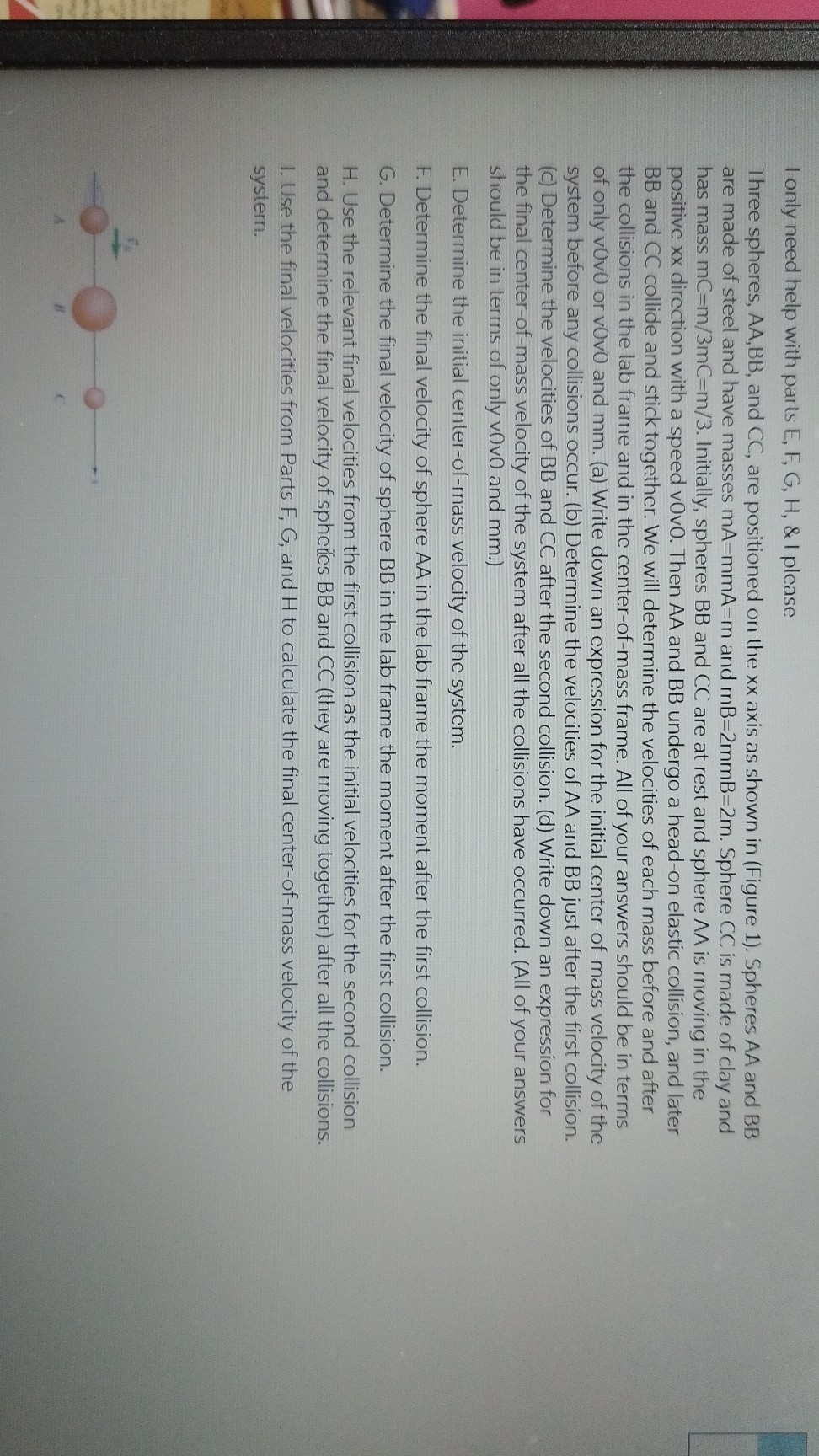
I only need help with parts E, F, G, H, \& I please Three spheres, \( A A, B B \), and \( C C \), are positioned on the \( x x \) axis as shown in (Figure 1). Spheres \( A A \) and \( B B \) are made of steel and have masses \( m A=m m A=m \) and \( m B=2 m m B=2 m \). Sphere \( C C \) is made of clay and has mass \( m C=m / 3 m C=m / 3 \). Initially, spheres BB and CC are at rest and sphere \( A A \) is moving in the positive xx direction with a speed vOvO . Then AA and BB undergo a head-on elastic collision, and later BB and CC collide and stick together. We will determine the velocities of each mass before and after the collisions in the lab frame and in the center-of-mass frame. All of your answers should be in terms of only vOvO or vO vO and mm . (a) Write down an expression for the initial center-of-mass velocity of the system before any collisions occur. (b) Determine the velocities of \( A A \) and \( B B \) just after the first collision. (c) Determine the velocities of BB and CC after the second collision. (d) Write down an expression for the final center-of-mass velocity of the system after all the collisions have occurred. (All of your answers should be in terms of only v 0 v 0 and mm .) E. Determine the initial center-of-mass velocity of the system. F. Determine the final velocity of sphere \( A A \) in the lab frame the moment after the first collision. G. Determine the final velocity of sphere BB in the lab frame the moment after the first collision. H. Use the relevant final velocities from the first collision as the initial velocities for the second collision and determine the final velocity of spheies BB and CC (they are moving together) after all the collisions. I. Use the final velocities from Parts F, G, and H to calculate the final center-of-mass velocity of the system.
View Answer
divider
BEST MATCH

Q1 (25 points) Draw a block diagram for the Sit-to-Stand movement based on the phases shown in the image: 1. Sitting (Phase 1) 2. Seat off (Phase 2) 3. Standing (Phase 3) Sitting Seat off Standing Phase 1 Phase 2 Phase 3 Define and label the following components in your block diagram: plant, sensor, input, output, actuator and controller separately. Provide a brief description of how each phase of the movement progresses and how the control system operates to transition from sitting to standing.

View Answer
divider
BEST MATCH

• Compute the partial-fraction expansion of $F(s)$ \\ 1. $F(s) = \frac{2s + 12}{s(s^2 + 2s + 5)}$ \\ 2. $F(s) = \frac{2}{s^2(s^2 + 6s + 10)}$

View Answer
divider
BEST MATCH

But intuitively, Murray was not so sure. She had a bad feeling about the new technology. She believed the record companies, which had lost the battle to tape manufacturers, might get together with compact disc makers and audio equipment manufacturers to stop the digital technology from entering the South African market.Describe the concept of resistance to change and how this can be addressed in this case study(please not marks will onlybe awarded if examples from case study are given). (15 Marks)

View Answer
divider
BEST MATCH

Which intervention would not be necessary for a patient who has impaired skin integrity? Demonstrate correct repositioning techniques. Apply dressings to support moist wound healing. Perform an ongoing wound and risk assessment. Apply a moisture barrier to the area at least 3 times daily.

View Answer
divider
BEST MATCH

Refer to the graph below to answer questions 5. and 6. Price Quantity The change illustrated in the graph above could have been caused by: Itranscript a. an increase in the price of a complement b. an increase in the number of buyers c. an increase in the cost of production d. All of the above D2 D S

View Answer
divider
BEST MATCH

4) Given the position vector of a moving object r(t) = <-cos(3t), sin(3t), -1+3t>, determine the velocity v(t), the speed s(t), and the acceleration a(t) at time t = π/6 seconds.

View Answer
divider
BEST MATCH

Given a set A = {7, 5, 6, n, G, I} , answer the following questions

View Answer
divider
BEST MATCH

Find the extremum of $f(x,y)$ subject to the given constraint, and state whether it is a maximum or a minimum.\ f(x,y) = 2x^2 + 3y^2 - 2xy; x + y = 7\ There is a value of located at $(x, y) = $. (Simplify your answers.)

View Answer
divider