Questions asked
A key weakness in the calculation of capital ratio that Basel 4 attempts to correct is the: Question 28 options: 1) Wide variability in the calculation of risk-weighted assets 2) Internal ratings-based approach 3) Standardized approach calculations 4) Wide variation in the calculation of leverage ratios
An infinitely long wire carries a current of I = 195 A. Randomized Variables I = 195 A Part (a) Consider a circle with a radius r and centered on the wire. Determine the magnitude of the magnetic field B at points along the circle in terms of I and r. Part (b) If r = 0.49 m, calculate the numerical value of B in tesla.
Questions 21 - 22 refer to a picture attached to the wall. A picture of weight 20 N is attached by a string looped symmetrically over a nail. The forces acting on the picture and the nail are represented in the figure below. 21. The tension $\vec{T}$ of the string is equal to: A. $\frac{\sqrt{3}}{20} N$ B. $\frac{\sqrt{3}}{10} N$ C. $\frac{20}{\sqrt{3}} N$ D. $20 N$ E. $20\sqrt{3} N$ 22. A similar picture is attached by another string of different length looped the same way over the nail. The angle formed by the string over the nail is smaller than the one in the first picture. Let $\vec{R'}$ be the upward normal force and $\vec{T'}$ the tension on the string. Which of the following expressions is true? A. $R = R'$ and $T = T'$ B. $R = R'$ and $T > T'$ C. $R = R'$ and $T < T'$ D. $R < R'$ and $T > T'$ E. $R > R'$ and $T < T'$
Opponents of mandatory minimum sentences claim that: ? they fill American prisons with minor players, such as drug abusers ? they do have some effect on deterring drug abuse ? they are not tough enough to keep people away from drugs ? too much is spent on in-prison treatment, which does not work
Discuss TWO different lags that can affect the effectiveness of fiscal policy
2 ? j4 ? a b -j2 ? 4 ? 60?0° V+ 6? 5?90° A -j3 ? 1) Find $Z_{th}$ of Thevenin equivalent at terminals a-b. (3 point) 2) Find $V_{th}$ of Thevenin equivalent at terminals a-b. (5 point) 3) Find $I_N$, $Z_N$ of Norton equivalent at terminals a-b and draw the circuit. (2 point)
Problem 1. (10 points) Suppose that from a very large sample you have estimated a parameter beta as 2.80 with estimated variance 0.25. Calculate 90% confidence interval for beta. Problem 2 (15 points) You are working with data in Stata and have a dataset with 935 observations that you would like to use to estimate the returns to education. However, you would like for your sample to be somewhat representative of the general US population in terms of the average IQ which is known to be around 100 in the population. To check this, you perform a test using the variable IQ. Denote by µ its population mean. More specifically, you run a two-sided t-test in Stata and obtain the following output: ttest IQ==100 One-sample t test Variable Obs Mean Std. err. Std. dev. [95% conf. interval] IQ 935 101.2824 .4922738 15.05264 100.3163 102.2484 mean mean (IQ) t H0: mean 100 Degrees of freedom 2.6050 934 Ha: mean < 100 Pr(Tt) 0.9953 Ha: mean! 100 Pr(T> t) = 0.0093 Ha: mean > 100 Pr(T > t) 0.0047 1) What is the null hypothesis being tested in terms of the notation used in class? 2) What is the alternative hypothesis in terms of the notation used in class? 3) Do you reject the null at the 1% significance level (a = 0.01, Ca/2-2.575)? Why or why not? 4) How was the t-statistic t = 2.6050 calculated?
Who in essentially planned economy decides what goods and services will be produced with the scars resources available in that economy
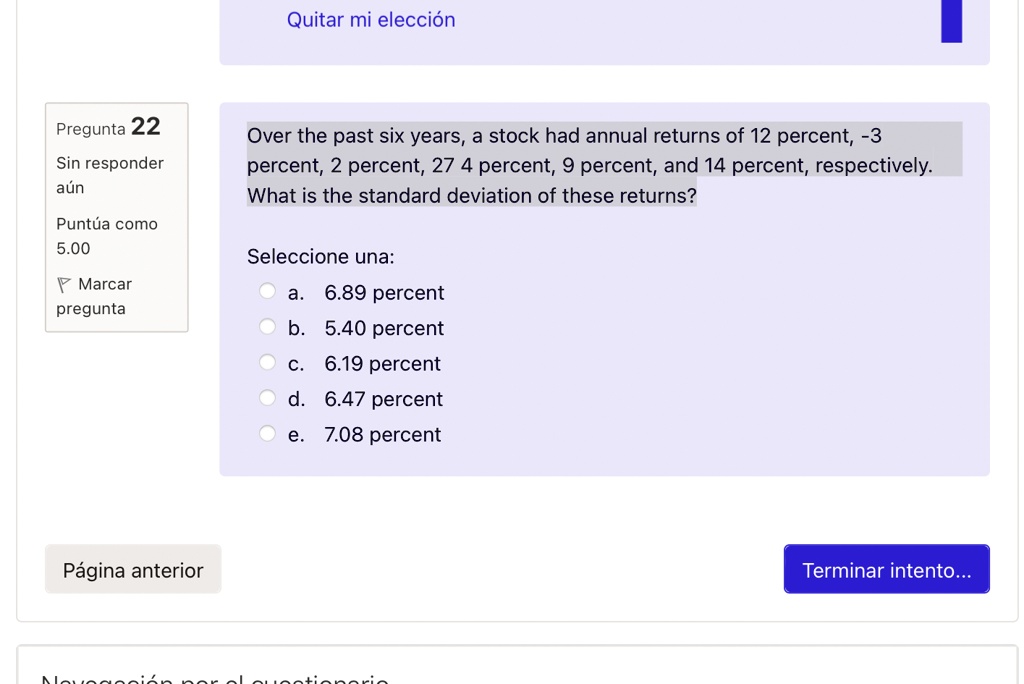
Over the past six years, a stock had annual returns of 12 percent, -3 percent, 2 percent, 27 4 percent, 9 percent, and 14 percent, respectively. What is the standard deviation of these returns?
Interesting algorithms Task • Choose an algorithm or a group of algorithms • Implement it and demonstrate that it is working • Write a sort of documentation that contain: • Description of a chosen algorithm • What is a complexity of this algorithm? • What could be the appliactions of this algorithm? • Is it possible to optimize it? • Are there any other algorithms that solve the same problem? Examples of algorithms/types of algorithms • Number theoretic algorithms (i.e. integer factorization, multiplications algorithms) • Graph algorithms (i.e. graph coloring, routing for graphs) • Geometry (i.e. triangulation, collision detection) • Swarm intelligence (i.e. crowd simulations, ant colony optimization) • The above suggestions are only examples, feel free to choose anything else.