Ace - AI Tutor
Ask Our Educators
Textbooks
My Library
Flashcards
Scribe - AI Notes
Notes & Exams
Download App
Cassie Thompson

Cassie T.

Divider

Viewed Questions

A model for the basal metabolism rate, in $\mathrm{kcal} / \mathrm{h},$ of a young man is $R(t)=85-0.18 \cos (\pi t / 12),$ where $t$ is the time in hours measured from $5 : 00$ AM. What is the total basal metabolism of this man, $\int_{0}^{24} R(t) d t,$ over a 24 -hour time period?

A model for the basal metabolism rate, in $\mathrm{kcal} / \mathrm{h},$ of a young man is $R(t)=85-0.18 \cos (\pi t / 12),$ where $t$ is the time in hours measured from $5 : 00$ AM. What is the total basal metabolism of this man, $\int_{0}^{24} R(t) d t,$ over a 24 -hour time period?

Essential Calculus Early Transcendentals

INTEGRALS

The Substitution Rule

A model for the basal metabolism rate, in kcal/h, of a young man is $ R(t) = 85 - 0.18 \cos(\pi t/12) $, where $ t $ is the time in hours measured from 5:00 AM. What is the total basal metabolism of this man, $ \displaystyle \int^{24}_0 R(t) \, dt $, over a 24-hour time period?

A model for the basal metabolism rate, in kcal/h, of a young man is $ R(t) = 85 - 0.18 \cos(\pi t/12) $, where $ t $ is the time in hours measured from 5:00 AM. What is the total basal metabolism of this man, $ \displaystyle \int^{24}_0 R(t) \, dt $, over a 24-hour time period?

Calculus: Early Transcendentals

Integrals

The Substitution Rule

Evaluate the limit by first recognizing the sum as a Riemann sum for a function defined on $[0,1]$ .

$$\lim _{n \rightarrow \infty} \sum_{i=1}^{n} \frac{i^{3}}{n^{4}}$$

Evaluate the limit by first recognizing the sum as a Riemann sum for a function defined on $[0,1]$ . $$\lim _{n \rightarrow \infty} \sum_{i=1}^{n} \frac{i^{3}}{n^{4}}$$

Calculus Early Transcendentals

Integrals

The Fundamental Theorem of Calculus

Evaluate the limit by first recognizing the sum as a Riemann sum for a function defined on [0,1].
$$\lim _{n \rightarrow \infty} \sum_{i=1}^{n} \frac{i^{3}}{n^{4}}$$

Evaluate the limit by first recognizing the sum as a Riemann sum for a function defined on [0,1]. $$\lim _{n \rightarrow \infty} \sum_{i=1}^{n} \frac{i^{3}}{n^{4}}$$

Calculus

Integrals

Evaluating Detinite Integrals

Questions asked

ANSWERED

Jacob Fry verified

Numerade educator

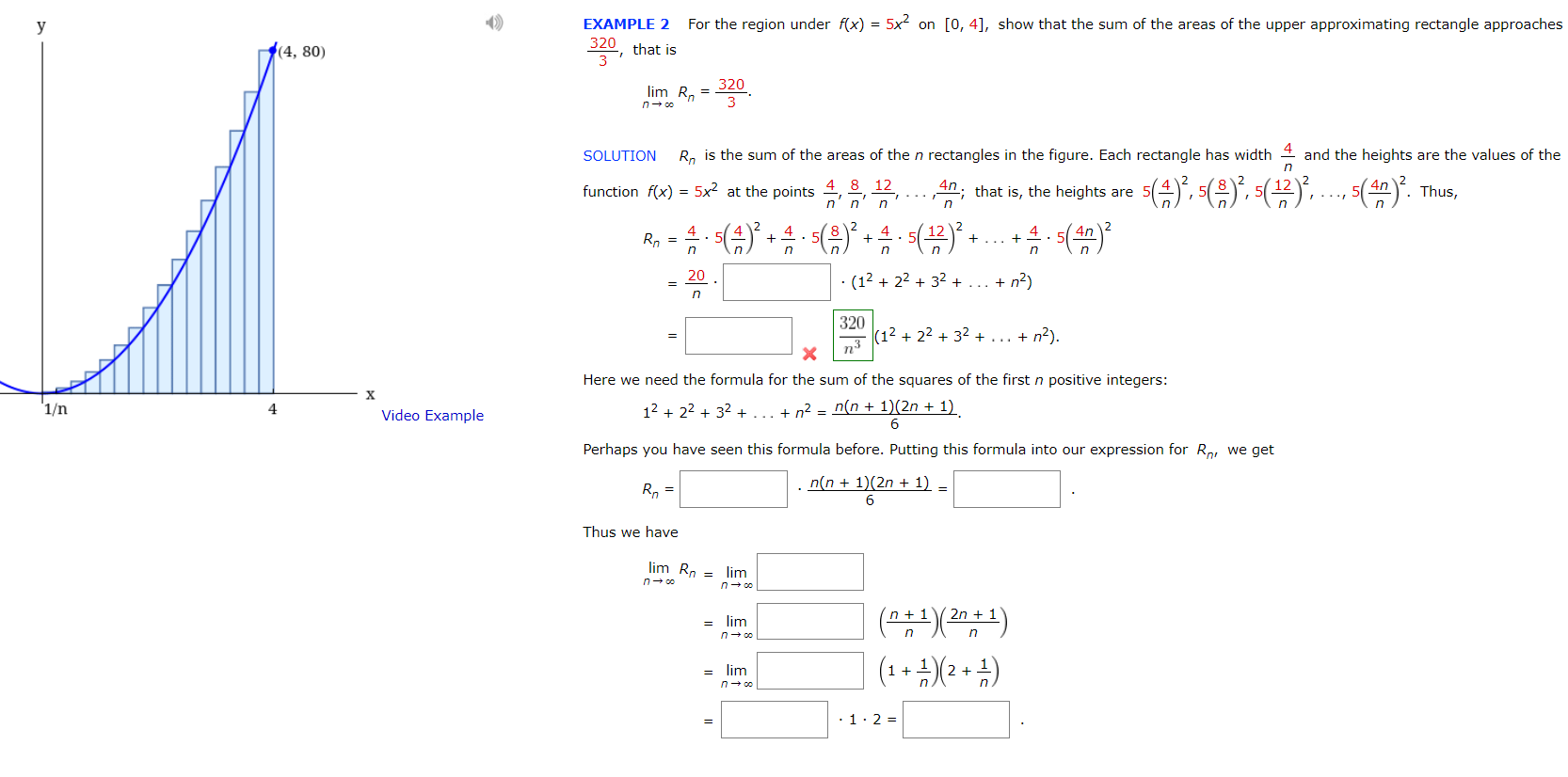
EXAMPLE 2 For the region under ( f(x)=5 x^{2} ) on ( [0,4] ), show that the sum of the areas of the upper approximating rectangle approaches ( frac{320}{3} ), that is [ lim _{n ightarrow infty} R_{n}=frac{320}{3} ] SOLUTION ( R_{n} ) is the sum of the areas of the ( n ) rectangles in the figure. Each rectangle has width ( frac{4}{n} ) and the heights are the values of the function ( f(x)=5 x^{2} ) at the points ( frac{4}{n}, frac{8}{n}, frac{12}{n}, ldots, frac{4 n}{n} ); that is, the heights are ( 5left(frac{4}{n} ight)^{2}, 5left(frac{8}{n} ight)^{2}, 5left(frac{12}{n} ight)^{2}, ldots, 5left(frac{4 n}{n} ight)^{2} ). Thus, [ egin{aligned} R_{n} & =frac{4}{n} cdot 5left(frac{4}{n} ight)^{2}+frac{4}{n} cdot 5left(frac{8}{n} ight)^{2}+frac{4}{n} cdot 5left(frac{12}{n} ight)^{2}+ldots+frac{4}{n} cdot 5left(frac{4 n}{n} ight)^{2} \ & =frac{20}{n} cdot square cdotleft(1^{2}+2^{2}+3^{2}+ldots+n^{2} ight) \ & =square cdot frac{320}{n^{3}}left(1^{2}+2^{2}+3^{2}+ldots+n^{2} ight) . end{aligned} ] Here we need the formula for the sum of the squares of the first ( n ) positive integers: [ 1^{2}+2^{2}+3^{2}+ldots+n^{2}=frac{n(n+1)(2 n+1)}{6} . ] Perhaps you have seen this formula before. Putting this formula into our expression for ( R_{n} ), we get [ R_{n}=square cdot frac{n(n+1)(2 n+1)}{6}=square . ] Thus we have [ egin{aligned} lim _{n ightarrow infty} R_{n} & =lim _{n ightarrow infty} square \ & =lim _{n ightarrow infty} squareleft(frac{n+1}{n} ight)left(frac{2 n+1}{n} ight) \ & =lim _{n ightarrow infty} squareleft(1+frac{1}{n} ight)left(2+frac{1}{n} ight) \ & =square cdot 1 cdot 2=square . end{aligned} ]
View Answer
divider
ANSWERED

Jason Horton verified

Numerade educator

Evaluate the indefinite integral. (Use ( C ) for the constant of integration.) [ int frac{x^{7}}{1+x^{16}} d x ]

View Answer
divider
ANSWERED

Jason Horton verified

Numerade educator

Evaluate the integral by making the given substitution. (Use ( C ) for the constant of integration.) [ int sin ^{4}( heta) cos ( heta) d heta, quad u=sin ( heta) ] [ frac{sin ( heta)^{5}+C}{5} ]

View Answer
divider
ANSWERED

Sanchit Jain verified

Numerade educator

Use the form of the definition of the integral given in the theorem to evaluate the integral. [ int_{1}^{7}left(x^{2}-4 x+7 ight) d x ]

View Answer
divider
ANSWERED

Audrey Fong verified

Numerade educator

(a) Use the definition to find an expression for the area under the curve ( y=x^{3} ) from 0 to 1 as a limit. [ lim _{n ightarrow infty} sum_{i=1}^{n}left(left(frac{i}{n} ight)^{3}left(frac{1}{n} ight) ight) ] (b) The following formula for the sum of the cubes of the first ( n ) integers is proved in Appendix E. Use it to evaluate the limit in part (a). [ 1^{3}+2^{3}+3^{3}+cdots+n^{3}=left[frac{n(n+1)}{2} ight]^{2} ]

View Answer
divider
ANSWERED

Sanchit Jain verified

Numerade educator

Find the limit. Use l'Hospital's Rule where appropriate. If there is a more elementary method, consider using it. [ lim _{x ightarrow 0} frac{sqrt{1+4 x}-sqrt{1-5 x}}{x} ]

View Answer
divider
ANSWERED

Supreeta N verified

Numerade educator

( f^{prime}(t)=frac{a}{1+b e^{-.6 t}} )

View Answer
divider
ANSWERED

Sanat Mukherjee verified

Numerade educator

(a) The volume V of a growing spherical cell is V = 4/3?r^3, where the radius is measured in micrometers (1 ?m = 10^-6m). Find the average rate of change of V with respect to r when r changes from 2 to each of the following. (Round your answers to one decimal place.) (i) 2 to 5 ?m ?m^3/?m (ii) 2 to 3 ?m ?m^3/?m (iii) 2 to 2.1 ?m ?m^3/?m (b) Find the instantaneous rate of change of V with respect to r when r = 2 ?m. (Round your answer to one decimal place.) V'(2) = ?m^3 / ?m

View Answer
divider
ANSWERED

Khoi V verified

Numerade educator

A Cepheid variable star is a star whose brightness alternately increases and decreases. For a certain star, the interval between times of maximum brightness is 3.5 days. The average brightness of this star is 4.0 and its brightness changes by ±0.25. In view of these data, the brightness of the star at time t, where t is measured in days, has been modeled by the function B(t) = 4.0 + 0.25 sin(2?t / 3.5). (a) Find the rate of change of the brightness after t days. dB/dt = (0.25 cos(2?t / 3.5)) * 2?/3.5 = (5? / 35) cos(2?t / 3.5) (b) Find, correct to two decimal places, the rate of increase after three days. dB/dt = 0.28

View Answer
divider
ANSWERED

Zhumagali Shomanov verified

Numerade educator

Differentiate. [ f(z)=frac{z}{z+frac{b}{z}} ]

View Answer
divider