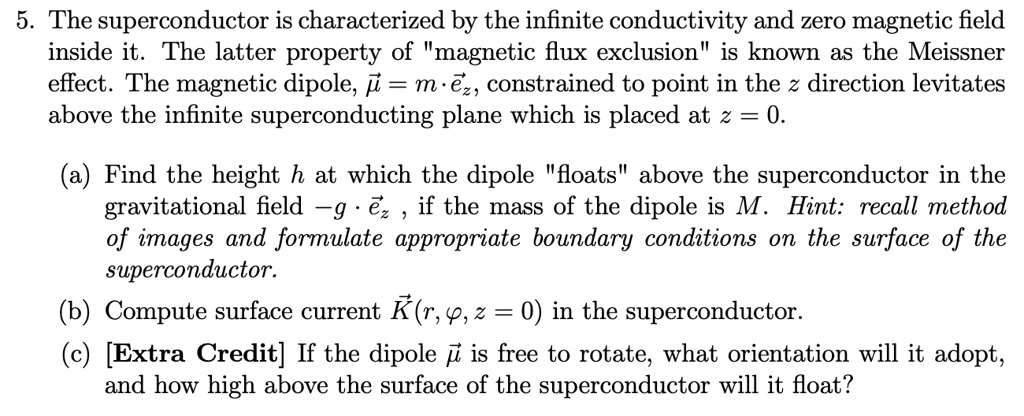
5. The superconductor is characterized by the infinite conductivity and zero magnetic field
inside it. The latter property of "magnetic flux exclusion" is known as the Meissner
effect. The magnetic dipole, $\vec{\mu} = m \cdot \vec{e}_z$, constrained to point in the z direction levitates
above the infinite superconducting plane which is placed at z = 0.
(a) Find the height h at which the dipole "floats" above the superconductor in the
gravitational field $-g \cdot \vec{e}_z$, if the mass of the dipole is M. Hint: recall method
of images and formulate appropriate boundary conditions on the surface of the
superconductor.
(b) Compute surface current $\vec{K}(r, \varphi, z = 0)$ in the superconductor.
(c) [Extra Credit] If the dipole $\vec{\mu}$ is free to rotate, what orientation will it adopt,
and how high above the surface of the superconductor will it float?