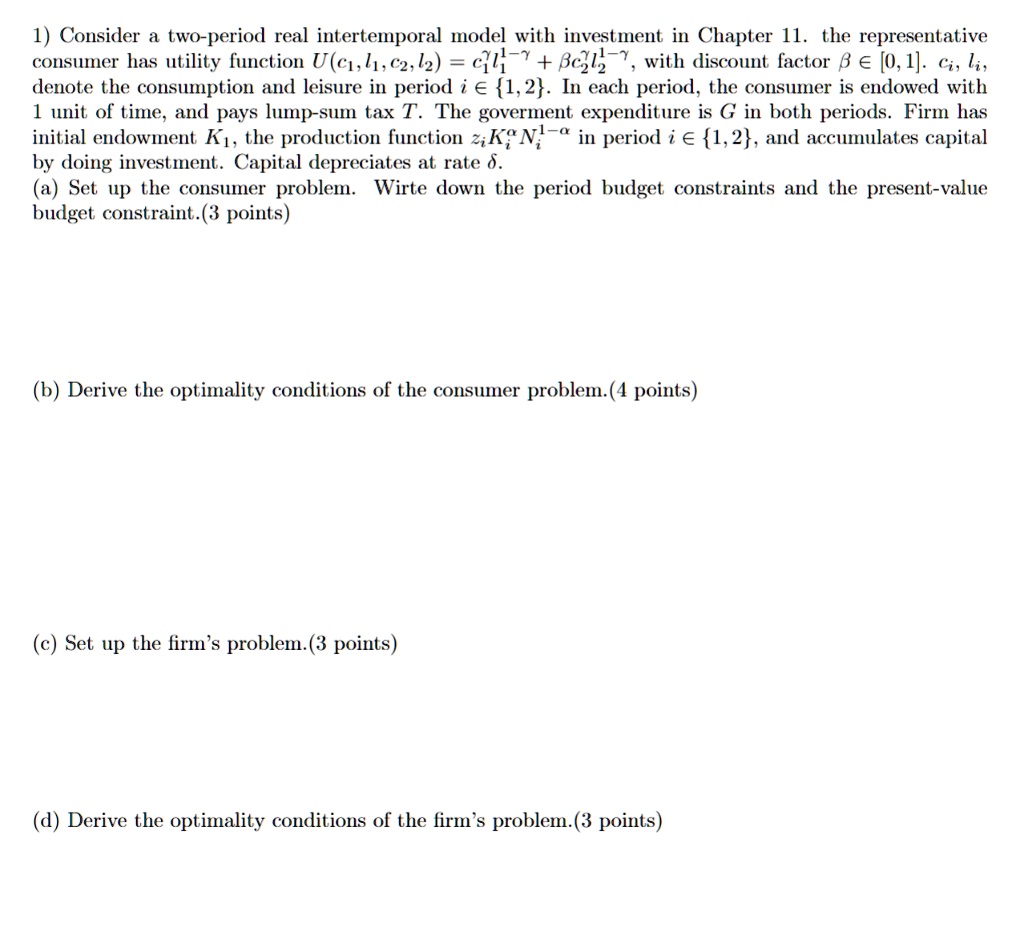
1) Consider a two-period real intertemporal model with investment in Chapter 11. the representative
consumer has utility function $U(c_1, l_1, c_2, l_2) = c_1^{1-\gamma} + \beta c_2^{1-\gamma}$, with discount factor $\beta \in [0, 1]$. $c_i, l_i$,
denote the consumption and leisure in period $i \in \{1, 2\}$. In each period, the consumer is endowed with
1 unit of time, and pays lump-sum tax $T$. The government expenditure is $G$ in both periods. Firm has
initial endowment $K_1$, the production function $z_i K_i^{\alpha} N_i^{1-\alpha}$ in period $i \in \{1, 2\}$, and accumulates capital
by doing investment. Capital depreciates at rate $\delta$.
(a) Set up the consumer problem. Write down the period budget constraints and the present-value
budget constraint. (3 points)
(b) Derive the optimality conditions of the consumer problem. (4 points)
(c) Set up the firm's problem. (3 points)
(d) Derive the optimality conditions of the firm's problem. (3 points)