Ace - AI Tutor
Ask Our Educators
Textbooks
My Library
Flashcards
Scribe - AI Notes
Notes & Exams
Download App
christina morgan

christina m.

Divider

Questions asked

BEST MATCH

What happens to the solubility of an ionic compound as the ionic strength solubility increases solubility decreases Why is there a correlation between the solubility of an ionic compound and The increase in the ionic strength decreases the concentration of aqueous The increase in the ionic strength increases the concentration of aqueous The increase in the ionic strength increases the ionic atmosphere around between ions, and increasing the tendency for ions to bind together. The increase in the ionic strength increases the ionic atmosphere around a ions, and decreasing the tendency for ions to bind together.

View Answer
divider
BEST MATCH

The fraud triangle identifies three elements that are generally present in the client s organization when fraud occurs. Which of the following is one of those elements? Question 41 options: Professional skepticism Inceptions Opportunity Ramifications

View Answer
divider
BEST MATCH

The 90 kg farmer tries to restrain the cow from escaping by wrapping the rope two turns around the tree trunk as shown in Figure 3. If the cow exerts a force of 1250 N on the rope and the coefficients of static friction between the rope and the trunk is $\mu_s = 0.15$ and between the man's shoes and the ground is $\mu_s' = 0.3$, determine if the farmer can keep the cow from escaping.

View Answer
divider
BEST MATCH

3.1. Find the equilibrium points for the following dynamical systems and analyze their stability (a) $\dot{x} = x^2 - 2$ (b) $\dot{x} = x^3 - 2x^2 - x + 2$ 3.2. Find the Eigen values of the A matrix and classify the stability of the origin $\begin{pmatrix} \dot{x}_1(t) \\ \dot{x}_2(t) \end{pmatrix} = \begin{pmatrix} 2 & 1 \\ 0 & 4 \end{pmatrix} \begin{pmatrix} x_1(t) \\ x_2(t) \end{pmatrix}$ a) $\begin{pmatrix} \dot{x}_1(t) \\ \dot{x}_2(t) \end{pmatrix} = \begin{pmatrix} -1 & 3 \\ 0 & 4 \end{pmatrix} \begin{pmatrix} x_1(t) \\ x_2(t) \end{pmatrix}$ b) $\begin{pmatrix} \dot{x}_1(t) \\ \dot{x}_2(t) \end{pmatrix} = \begin{pmatrix} 2 & -1 \\ 2 & 0 \end{pmatrix} \begin{pmatrix} x_1(t) \\ x_2(t) \end{pmatrix}$ c) $\begin{pmatrix} \dot{x}_1(t) \\ \dot{x}_2(t) \end{pmatrix} = \begin{pmatrix} 0 & -1 \\ 2 & -2 \end{pmatrix} \begin{pmatrix} x_1(t) \\ x_2(t) \end{pmatrix}$ d) (2) (2) (16)

View Answer
divider
BEST MATCH

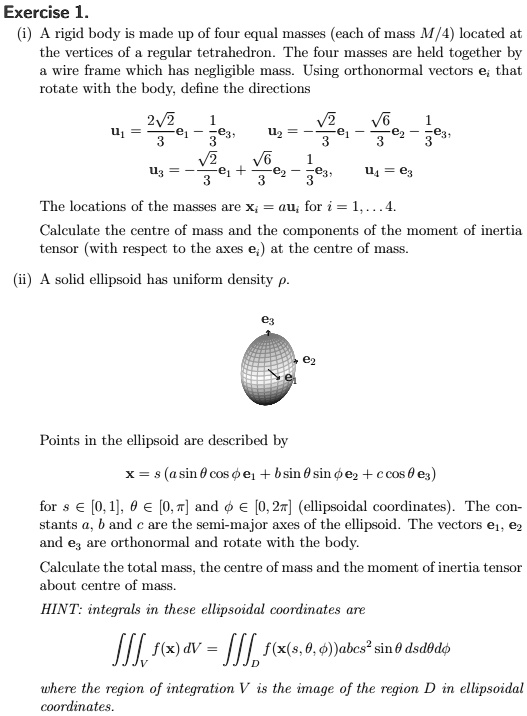
Exercise 1. (i) A rigid body is made up of four equal masses (each of mass M/4) located at the vertices of a regular tetrahedron. The four masses are held together by a wire frame which has negligible mass. Using orthonormal vectors $e_i$ that rotate with the body, define the directions $u_1 = \frac{2\sqrt{2}}{3}e_1 - \frac{1}{3}e_3$, $u_2 = \frac{\sqrt{2}}{3}e_1 - \frac{\sqrt{6}}{3}e_2 - \frac{1}{3}e_3$, $u_3 = -\frac{\sqrt{2}}{3}e_1 + \frac{\sqrt{6}}{3}e_2 - \frac{1}{3}e_3$, $u_4 = e_3$ The locations of the masses are $x_i = au_i$ for $i = 1, \dots, 4$. Calculate the centre of mass and the components of the moment of inertia tensor (with respect to the axes $e_i$) at the centre of mass. (ii) A solid ellipsoid has uniform density $\rho$. $e_3$ $e_2$ $e_1$ Points in the ellipsoid are described by $x = s(a \sin \theta \cos \phi e_1 + b \sin \theta \sin \phi e_2 + c \cos \theta e_3)$ for $s \in [0, 1]$, $\theta \in [0, \pi]$ and $\phi \in [0, 2\pi]$ (ellipsoidal coordinates). The con- stants $a$, $b$ and $c$ are the semi-major axes of the ellipsoid. The vectors $e_1$, $e_2$ and $e_3$ are orthonormal and rotate with the body. Calculate the total mass, the centre of mass and the moment of inertia tensor about centre of mass. HINT: integrals in these ellipsoidal coordinates are $\iiint_V f(x)dV = \iiint_D f(x(s, \theta, \phi))abcs^2 \sin \theta dsd\theta d\phi$ where the region of integration $V$ is the image of the region $D$ in ellipsoidal coordinates.
View Answer
divider
BEST MATCH

Which taxpayer(s) should file Schedule C, Profit or Loss from Business (Sole Proprietorship), to report business activity? Alexander. He is an employee of a ride-hailing company. He received a Form W-2 showing compensation received through the ride-hailing platform. Elijah. He and his sister, Sadie, jointly own an unincorporated business. They are both material participants. The business is a limited liability company under the laws of the state in which business is conducted. Luke and his wife, Harper. They are married and will file a joint return. They are the only owners of a business in which they each materially participate. The business does not have limited liability status under state law, and they elect not to be treated as a partnership. Matthew and his brother, Casey. They are the only owners of an unincorporated business in which they each materially participate. The business does not have limited liability status under state law. Which taxpayer(s) should file Schedule C, Profit or Loss from Business (Sole Proprietorship), to report business activity? ride-hailing platform. limited liability company under the laws of the state in which business is conducted. partnership. materially participate. The business does not have limited liability status under state law, and they elect not to be treated as a The business does not have limited liability status under state law.

View Answer
divider
BEST MATCH

Write a VHDL code for a Flip-Flop

View Answer
divider
BEST MATCH

Q2. (Ch2-Q9) Consider table 2, assume that both the attributes X and Y are numeric, and the table represents the entire population. If we know that the correlation between X and Y is zero, what can you infer about the values of Y? X Y 1 A 0 B 1 C 0 A 0 C Table 2

View Answer
divider
BEST MATCH

• Complete the table below: Skin Structure Arrector pili muscle Meissner's corpuscle Adipocyte Epidermis Pacinian corpuscle Basic Tissue Type Function of Structure 98

View Answer
divider
BEST MATCH

Table 11.2 Approximate Characteristics of Various Natural Porous Media Media Porosity (%) Hydraulic Conductivity (m/s) Unconsolidated Gravel 25 to 40 1x10<sup>-3</sup> to 1 Coarse sand 30 to 45 1x10<sup>-4</sup> to 1x10<sup>-2</sup> Sand, mixture 20 to 35 5x10<sup>-5</sup> to 1x10<sup>-4</sup> Fine sand 25 to 50 1x10<sup>-5</sup> to 5x10<sup>-4</sup> Silt 35 to 50 1x10<sup>-7</sup> to 5x10<sup>-6</sup> Clay 40 to 70 1x10<sup>-8</sup> and lower Unweathered marine clay 5x10<sup>-13</sup> to 1x10<sup>-9</sup> Consolidated Karst limestone 5 to 50 8x10<sup>-7</sup> to 1x10<sup>-2</sup> Fractured igneous & metamorphic rocks 0 to 10 5x10<sup>-9</sup> to 2x10<sup>-4</sup> Limestone & dolomite 0 to 20 3x10<sup>-10</sup> to 2x10<sup>-6</sup> Sandstone 5 to 30 8x10<sup>-11</sup> to 2x10<sup>-6</sup> Shale 0 to 10 1x10<sup>-13</sup> to 1x10<sup>-9</sup> Unfractured igneous & metamorphic rocks 0 to 5 <10<sup>-13</sup> to 2x10<sup>-10</sup> Sources: Harr (1962), Freeze and Cherry (1979), McWhorter and Sunada (1977).

View Answer
divider