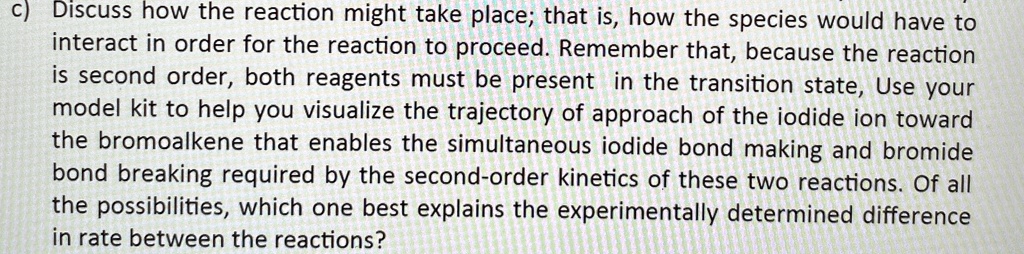
c) Discuss how the reaction might take place; that is, how the species would have to
interact in order for the reaction to proceed. Remember that, because the reaction
is second order, both reagents must be present in the transition state, Use your
model kit to help you visualize the trajectory of approach of the iodide ion toward
the bromoalkene that enables the simultaneous iodide bond making and bromide
bond breaking required by the second-order kinetics of these two reactions. Of all
the possibilities, which one best explains the experimentally determined difference
in rate between the reactions?