EXERCISES
1. In the procedure some water was added to the initial reaction mixture. How might the
yield of 1-bromobutane be affected by the failure on the part of the student to add the
water, and what product(s) would be favored? How might the yield of product be affected
by adding, for example, twice as much water as is called for while keeping the quantities
of the other reagents the same?
2. In the purification process, the organic layer is washed with 2 M NaOH and then with
water. What is the purpose of these washes?
3. After the washes described in Exercise 2, the 1-bromobutane is treated with anhydrous
magnesium sulfate. Why is this done, and what does it remove?
4. The final step of the purification process involves adding some dichloromethane, fol-
lowed by a simple distillation.
a. Why is simple rather than fractional distillation used?
b. Why is this final distillation performed? Suggest what is removed by this distillation.
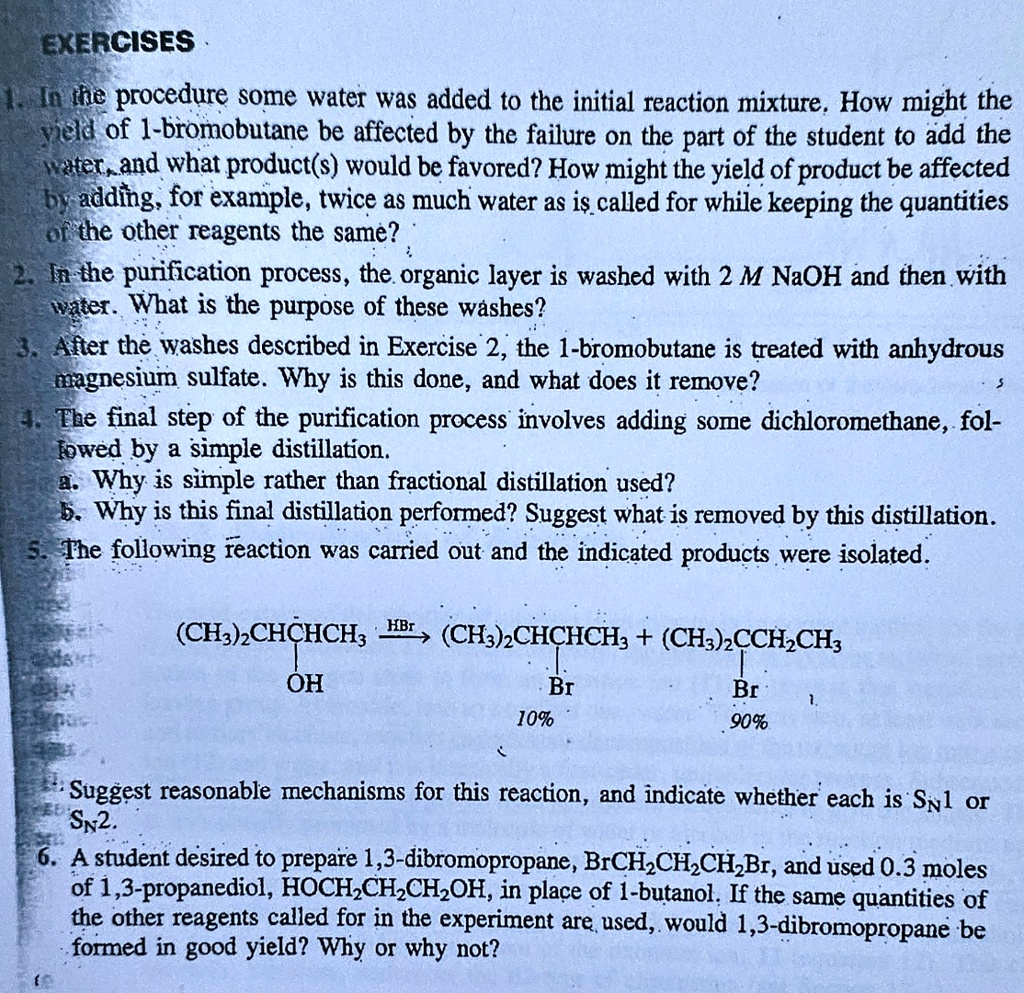
5. The following reaction was carried out and the indicated products were isolated.
(CH$_3$)$_2$CHCHCH$_3$ HBr (CH$_3$)$_2$CHCHCH$_3$ + (CH$_3$)$_2$CCH$_2$CH$_3$
S
OH
?
Br
10%
Br
1.
90%
Suggest reasonable mechanisms for this reaction, and indicate whether each is SN1 or
SN2.
6. A student desired to prepare 1,3-dibromopropane, BrCH$_2$CH$_2$CH$_2$Br, and used 0.3 moles
of 1,3-propanediol, HOCH$_2$CH$_2$CH$_2$OH, in place of 1-butanol. If the same quantities of
the other reagents called for in the experiment are used, would 1,3-dibromopropane be
formed in good yield? Why or why not?