Ace - AI Tutor
Ask Our Educators
Textbooks
My Library
Flashcards
Scribe - AI Notes
Notes & Exams
Download App
colton cameron

colton c.

Divider

Questions asked

BEST MATCH

Certain types of cell growth and repair can occur only with the involvement of a unique class of cells that can divide and remain unspecialized for the entire lifetime of an organism. These cells are known as ________. Group of answer choices muscle cells gametes stem cells cancer cells

View Answer
divider
BEST MATCH

Why was this problem selected for the Group Work exercise? Choose all that apply. Question 2 options: It uses the principles of free-fall motion that we learned in the first lab. It uses vector components that we learned about in the second lab, It uses the principle of independence of horizontal and vertical motion, that we learned about in this lab. It requires us to work out the problem in a step-wise fashion, using learned concepts.

View Answer
divider
BEST MATCH

6.10 Calculate enthalpies of formation for the respective complexes from the stability constants tabulated below. (a) \begin{tabular}{lccc} Monothiocyanatouranium(IV) : & & & \\ \( \mathrm{T} / \mathrm{K} \) & 283.2 & 298.2 & 313.2 \\ \( K_{1} / \mathrm{dm}^{3} \mathrm{~mol}^{-1} \) & 60 & 33 & 20 \end{tabular} (b) Mono(ethane-1,2-diamine)nickel(II) : \{The answer is \( -27 \mathrm{~kJ} \mathrm{~mol}^{-1} \) \} \[ \begin{array}{lrrrr} \mathrm{T} / \mathrm{K} & 283.2 & 293.2 & 303.2 & 313.2 \\ \log _{10}\left\{K_{1} / \mathrm{dm}^{3} \mathrm{~mol}^{-1}\right\} & 7.74 & 7.52 & 7.27 & 7.04 \end{array} \] \{The answer is \( -38 \mathrm{~kJ} \mathrm{~mol}^{-1} \) \} (c) \[ \begin{array}{lcc} \text { Monocysteinatomercury(II) : } & & \\ \mathrm{T} / \mathrm{K} & 285.2 & 298.2 \\ \log _{10}\left\{K_{1} / \mathrm{dm}^{3} \mathrm{~mol}^{-1}\right\} & 45.4 & 43.6 \end{array} \] (d) Monoacetatomercury(II) : \begin{tabular}{lccc} \( \mathrm{T} / \mathrm{K} \) & 293.2 & 300.2 & 307.2 \\ \( K_{1} / \mathrm{dm}^{3} \mathrm{~mol}^{-1} \) & 3600 & 3330 & 3130 \end{tabular} (e) \begin{tabular}{lccc} Monothiocyanatoneodymium(III) : & & \\ \( \mathrm{T} / \mathrm{K} \) & 298.2 & 313.2 & 328.2 \\ \( \log _{10}\left\{K_{\mathrm{l}} / \mathrm{dm}^{3} \mathrm{~mol}^{-1}\right\} \) & 0.81 & 0.61 & 0.47 \\ Monothiocyanatonickel(II) : & & & \\ \( \mathrm{T} / \mathrm{K} \) & 288.2 & 298.2 & 308.2 \\ \( \log _{10}\left\{K_{\mathrm{l}} / \mathrm{dm}^{3} \mathrm{~mol}^{-1}\right\} \) & 1.34 & 1.24 & 1.17 \end{tabular} Compare the relative values for the three thiocyanate complexes, for the two nickel complexes, and for the two mercury complexes; comment on your comparisons.

View Answer
divider
BEST MATCH

Discuss all the components of blood and their functions in the body’s defense (platelets, basophils, neutrophils, eosinophils, monocytes, lymphocytes).

View Answer
divider
BEST MATCH

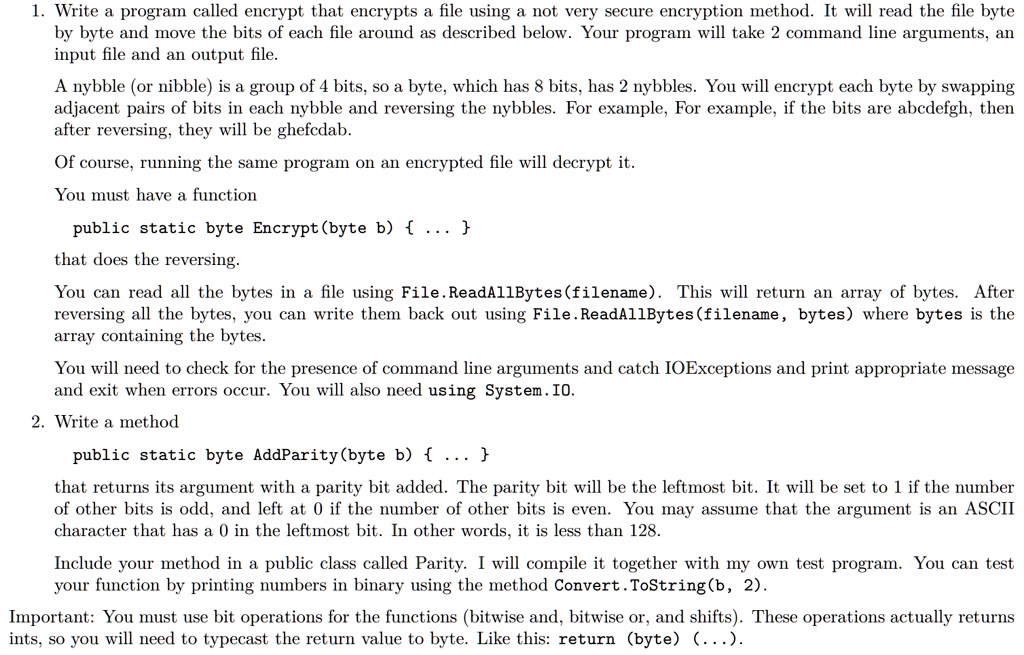
In C# 1. Write a program called "encrypt" that encrypts a file using a not very secure encryption method. It will read the file byte by byte and move the bits of each byte around as described below. Your program will take 2 command line arguments: an input file and an output file. A nybble (or nibble) is a group of 4 bits, so a byte, which has 8 bits, has 2 nybbles. You will encrypt each byte by swapping adjacent pairs of bits in each nybble and reversing the nybbles. For example, if the bits are "abcdefgh", then after reversing, they will be "ghefcdab". Of course, running the same program on an encrypted file will decrypt it. You must have a function: public static byte Encrypt(byte b) { ... } that does the reversing. You can read all the bytes in a file using File.ReadAllBytes(filename). This will return an array of bytes. After reversing all the bytes, you can write them back out using File.WriteAllBytes(filename, bytes) where "bytes" is the array containing the bytes. You will need to check for the presence of command line arguments and catch IOExceptions and print appropriate messages and exit when errors occur. You will also need to use System.IO. 2. Write a method: public static byte AddParity(byte b) { ... } that returns its argument with a parity bit added. The parity bit will be the leftmost bit. It will be set to 1 if the number of other bits is odd, and left at 0 if the number of other bits is even. You may assume that the argument is an ASCII character that has a 0 in the leftmost bit. In other words, it is less than 128. Include your method in a public class called "Parity". I will compile it together with my own test program. You can test your function by printing numbers in binary using the method Convert.ToString(b, 2). Important: You must use bit operations for the functions (bitwise and, bitwise or, and shifts). These operations actually return ints, so you will need to typecast the return value to byte. Like this: return (byte) (...).
View Answer
divider
BEST MATCH

cout << endl; 2. Write a sequence of statements that interact with the program user in this fashion: Enter temperature (kelvin) => 302 Enter volume (liters) => 8.4 Your program fragment should store the first input value in variable temp and the second in variable vol. 2.4 Data Types C++ programs manipulate data of many different types. The two most basic kinds of data are numbers and characters. In this section we examine how C++ represents characters and real numbers, and we study the arithmetic op- erators that C++ predefines. Numbers Like most programming languages, C++ defines two categories of numbers:

View Answer
divider
BEST MATCH

Identify the population and the sample. P=50,000 S = 23% b. Is the value 23% a statistic or a parameter? Parameter c. What is the level of measurement of the value 23 Ratio Are the number of subjects in this survey discre discrete

View Answer
divider
BEST MATCH

Using the matrices \begin{equation*} D = \begin{bmatrix} 2 & -3 & 4 \\ -3 & -1 & 4 \\ -1 & -2 & 3 \end{bmatrix}, E = \begin{bmatrix} -4 & 4 & 2 \\ 4 & -3 & 0 \\ -3 & -1 & 0 \end{bmatrix} \end{equation*}compute the following. \begin{equation*} trace(4E^T - D) \end{equation*} \begin{equation*} trace(4E^T - D) = \end{equation*}

View Answer
divider
BEST MATCH

ADVANCED PROBLEMS AP1 A spring-mass-damper system is shown in Figure AP1(a). The Bode diagram obtained by experimental means using a sinusoidal forcing function is shown in Figure AP1(b). Determine the numerical values of $m$, $b$, and $k$. Spring, $k$ $r(t)$ 20 log$|G|$ (dB) -10 -20 -30 -40 Mass, $m$ -50 y(t) Damper, $b$ 0.01 0.1 1 10 100 FIGURE AP1 A spring-mass- damper system. (a) $\omega$ (rad/s) (b) 0° -90° $\phi$ -180°

View Answer
divider
BEST MATCH

A steel spur pinion and gear of grade 1 have a diametral pitch of 11 teeth/in, shaped profile teeth, 16 and 32 teeth, respectively, a 20° pressure angle, the pinion speed is 585 rev/min. The tooth properties are $S_{actbend} = 20230$ psi and the Brinell hardness is 210. For a design factor of 3, a face width of 0.85 in, what is the power due to bending and wear for pinion?

View Answer
divider