Ace - AI Tutor
Ask Our Educators
Textbooks
My Library
Flashcards
Scribe - AI Notes
Notes & Exams
Download App
craig bryan

craig b.

Divider

Questions asked

BEST MATCH

10) What impact can be expected if the Fed responds to a negative real shock with an increase in money supply? A. inflation will increase, and unemployment might decrease. B. inflation will increase, and unemployment will increase. C. inflation will decrease, and unemployment might decrease. D. inflation will decrease, and unemployment will increase

View Answer
divider
BEST MATCH

Consider the following. (If an answer does not exist, enter DNE.) f(x) = x2 − 63x − 8 (a) Find the interval(s) on which f is increasing. (Enter your answer using interval notation.) (b) Find the interval(s) on which f is decreasing. (Enter your answer using interval notation.) (c) Find the local minimum and maximum value of f. local minimum value local maximum value

View Answer
divider
BEST MATCH

Write a program to create a file called emp_records and store information about a person, in terms of his name, age and salary

View Answer
divider
BEST MATCH

Which of the following is NOT a sleep disorder? Group of answer choices Insomnia Sleep apnea Narcolepsy Hallucinations

View Answer
divider
BEST MATCH

Which is a key limitation of a randomized control trial? Question 13 options: Instrumentation changes can lead to identification of spurious effect May have contamination and extended learning effects Need to collect extensive quantitative and qualitative data May have low external validity

View Answer
divider
BEST MATCH

Question 29 2 pts According to Freud it is the purpose of society to keep us from meeting our needs for these two things Sex and aggression Love and belongingness Safety and physical needs

View Answer
divider
BEST MATCH

Question 5 When a bank loans out $1,000, the money supply does not change. decreases. increases. may do any of the above. 1 pts

View Answer
divider
BEST MATCH

19-3 Kirchhoff's Rules 25. (I) Calculate the current in the circuit of Fig. 19-53, and show that the sum of all the voltage changes around the circuit is zero. r = 2.0 ? 9.0 V 9.5 ? FIGURE 19-53 Problem 25. 14.0 ?

View Answer
divider
BEST MATCH

Review: The Doppler Effect equation in general: where "s" represents the sound SOURCE, "f" is the intrinsic frequency of the sound source, and "v" is the SPEED of the source relative to air. Learning Goal: Doppler Effect - In general Self Assessment "o" represents the "OBSERVER", "f" is the frequency heard by the observer, and "v" is the SPEED of the observer relative to air. Two train whistles, A and B, each have a built-in frequency of 700 Hz. A is stationary and B is moving to the right at a speed of 35.1 m/s. A listener is between the two whistles. The speed of sound in air is 343 m/s. "v" is the speed of sound in air, v = 343 m/s. The problem solving boils down to choosing a sign in the numerator and/or choosing a sign in the denominator, as shown in: The Doppler effect in general: Observer moving at speed v (relative to medium) Source moving at speed v (relative to medium) Frequency perceived by observer: 1 Case 1: the listener moves to the RIGHT at a speed of 32.8 m/s Case 2: the listener moves to the LEFT at a speed of 32.8 m/s Case 1 ≠ 0 d source (higher /) away from source (lower /) Denominator - if source moves toward observer (higher /), if source moves away from observer (lower /) Part A - Case 1: Calculate the frequency of the whistle A heard by you Case 2 ≠ 0 Part B - Case 1: Calculate the frequency of the whistle B heard by you. Part C - Case 2: Calculate the frequency of the whistle A heard by you. Part D - Case 2: Calculate the frequency of the whistle B heard by you.

View Answer
divider
BEST MATCH

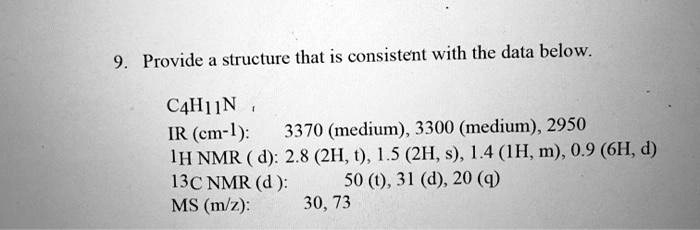
9. Provide a structure that is consistent with the data below. $C_4H_{11}N$ IR (cm$^{-1}$): 3370 (medium), 3300 (medium), 2950 $^1H$ NMR (?): 2.8 (2H, t), 1.5 (2H, s), 1.4 (1H, m), 0.9 (6H, d) $^{13}C$ NMR (?): 50 (t), 31 (d), 20 (q) MS ($m/z$): 30, 73
View Answer
divider